Abstract
Biochar has emerged as an innovative and sustainable soil amendment with significant potential to improve soil health, enhance agricultural productivity, and mitigate climate change. It is a stable carbon-rich material produced through the pyrolysis of biomass under limited oxygen conditions using agricultural residues, forestry waste, animal manure, and other organic materials. Owing to its porous structure, high surface area, and strong adsorption capacity, biochar improves soil physical, chemical, and biological properties. It enhances soil aggregation, increases water-holding capacity, improves nutrient retention, reduces nutrient leaching, and stimulates beneficial microbial activity. Biochar also contributes to carbon sequestration by storing stable carbon in soils for extended periods, thereby reducing greenhouse gas emissions and supporting climate-smart agriculture. Numerous studies have demonstrated that biochar application improves crop growth, nutrient uptake, fertilizer-use efficiency, and resilience against drought, salinity, and other environmental stresses. Modern technologies such as Geographic Information Systems (GIS), Remote Sensing (RS), precision agriculture, Internet of Things (IoT)-based soil monitoring, and artificial intelligence are increasingly being integrated with biochar management to optimize application rates and monitor long-term soil responses. Despite its considerable benefits, challenges including feedstock variability, production costs, quality standardization, and farmer awareness continue to influence its large-scale adoption. This paper examines the production and properties of biochar, evaluates its role in improving soil health and agricultural sustainability, discusses its contribution to climate change mitigation, and explores emerging technologies and future prospects for its wider application in sustainable farming systems..
- Biochar
- Soil Health
- Agricultural Sustainability
- Carbon Sequestration
- Soil Fertility
- Crop Productivity
- Climate-Smart Agriculture
- Soil Amendment
- Nutrient Management
- Sustainable Farming
Introduction#
Sustainable agriculture requires management practices that improve soil fertility while conserving natural resources and minimizing environmental degradation. Increasing soil degradation, declining organic matter, nutrient depletion, water scarcity, and climate change have intensified the search for environmentally friendly soil amendments capable of enhancing agricultural productivity and ecosystem resilience. Among the various sustainable technologies available, biochar has gained considerable attention because of its ability to improve soil quality, increase crop productivity, and contribute to long-term carbon sequestration. Biochar is a carbon-rich, porous material produced by the thermal decomposition of organic biomass under oxygen-limited conditions through a process known as pyrolysis. Feedstocks commonly used for biochar production include crop residues, rice husk, wheat straw, maize stalks, sugarcane bagasse, coconut shells, forestry residues, sawdust, poultry litter, cattle manure, and other biodegradable organic wastes. Depending on the feedstock type and pyrolysis temperature, biochar exhibits different physical and chemical characteristics that influence its effectiveness as a soil amendment. The unique structure of biochar provides several agronomic and environmental benefits. Its highly porous nature increases soil porosity, improves aeration, enhances water-holding capacity, and promotes root growth. Biochar possesses a large surface area and high cation exchange capacity, enabling it to retain nutrients such as nitrogen, phosphorus, potassium, calcium, and magnesium within the root zone. Consequently, nutrient leaching decreases while fertilizer-use efficiency improves. These characteristics make biochar particularly beneficial for degraded, sandy, acidic, and nutrient-deficient soils. Biochar also plays a significant role in improving soil biological properties. The porous surfaces provide favorable habitats for beneficial microorganisms including nitrogen-fixing bacteria, phosphate-solubilizing bacteria, mycorrhizal fungi, and decomposer organisms. Enhanced microbial activity accelerates nutrient cycling, organic matter decomposition, and enzyme activity, thereby improving soil fertility and overall ecosystem functioning. In addition, biochar can immobilize toxic substances and reduce the availability of heavy metals in contaminated soils, supporting healthier crop production. Beyond improving soil fertility, biochar contributes significantly to climate change mitigation. Unlike fresh organic matter that decomposes rapidly, biochar contains stable aromatic carbon structures that remain in soil for decades or even centuries. This long-term carbon storage reduces atmospheric carbon dioxide concentrations while simultaneously improving soil productivity. Furthermore, biochar has been reported to reduce emissions of greenhouse gases such as nitrous oxide and methane from agricultural soils, making it an important component of climate-smart agriculture. Advances in precision agriculture and digital technologies have expanded the potential applications of biochar. Geographic Information Systems (GIS), Remote Sensing (RS), Internet of Things (IoT)-based soil sensors, artificial intelligence, and data-driven decision-support systems now enable site-specific biochar application and continuous monitoring of soil properties. These innovations improve resource-use efficiency while maximizing the agronomic and environmental benefits of biochar.
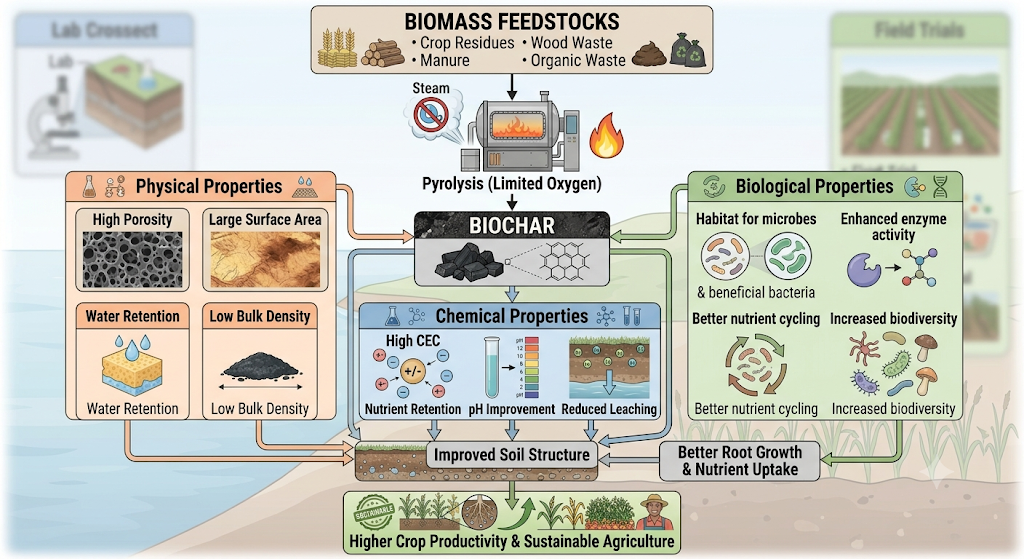
Figure. Biochar, Its Properties, Production Methods, and Mechanisms of Soil Improvement
Despite its numerous advantages, widespread adoption of biochar remains limited due to production costs, inconsistent feedstock quality, lack of standardized production methods, transportation challenges, and limited awareness among farmers. Continued research, policy support, and technological innovation are therefore essential to overcome these barriers.
This paper examines the production processes, characteristics, and mechanisms of biochar, evaluates its role in improving soil health and agricultural sustainability, discusses its contribution to climate change mitigation, and explores emerging technologies and future strategies for promoting its sustainable use in agriculture.
Biochar, Its Properties, Production Methods, and Mechanisms of Soil Improvement#
Biochar is a stable, carbon-rich material produced through the thermochemical conversion of organic biomass under oxygen-limited or oxygen-free conditions, a process known as pyrolysis. Unlike ordinary charcoal, biochar is specifically produced for environmental and agricultural applications with the objective of improving soil quality, enhancing crop productivity, and sequestering atmospheric carbon. The properties of biochar vary depending on the type of feedstock, pyrolysis temperature, heating rate, and residence time. Understanding these factors is essential for selecting suitable biochar for different soil types and agricultural systems.
A wide variety of feedstocks can be used for biochar production, including crop residues such as rice husk, wheat straw, maize stalks, sugarcane bagasse, cotton stalks, and groundnut shells. Forestry residues, wood chips, sawdust, bamboo waste, coconut shells, poultry litter, cattle manure, and municipal organic waste are also commonly utilized. Converting these agricultural and organic wastes into biochar not only reduces waste disposal problems but also creates a valuable soil amendment that supports circular economy principles and sustainable resource management.
Biochar is primarily produced using three thermochemical processes: slow pyrolysis, fast pyrolysis, and gasification. Slow pyrolysis, conducted at temperatures between 350°C and 600°C with a longer heating period, produces the highest biochar yield and is widely used for agricultural purposes. Fast pyrolysis operates at higher heating rates and produces more bio-oil with comparatively lower biochar yield. Gasification involves partial oxidation at very high temperatures and mainly generates syngas while producing limited quantities of biochar. Among these methods, slow pyrolysis is considered the most suitable for sustainable agricultural applications because it generates biochar with greater stability and higher carbon content.
Biochar possesses several physical properties that improve soil structure. Its highly porous nature increases soil porosity, lowers bulk density, and enhances aeration, allowing better root penetration and gaseous exchange. The porous structure also improves water-holding capacity by retaining moisture within soil pores, which is particularly beneficial in sandy soils and drought-prone regions. Improved soil aggregation enhances infiltration while reducing runoff, compaction, and erosion.
The chemical properties of biochar also contribute significantly to soil improvement. Biochar has a high surface area and elevated cation exchange capacity (CEC), enabling it to adsorb and retain essential nutrients such as nitrogen, phosphorus, potassium, calcium, and magnesium. This reduces nutrient leaching and increases fertilizer-use efficiency. Many biochars possess alkaline properties, making them effective in neutralizing acidic soils and improving nutrient availability. In addition, biochar can adsorb heavy metals and organic pollutants, reducing their mobility and toxicity in contaminated soils.
Biochar substantially enhances the biological properties of soil by providing favorable habitats for beneficial microorganisms. Its porous surfaces protect microbial communities from environmental stress while supplying attachment sites for bacteria and fungi. Increased populations of nitrogen-fixing bacteria, phosphate-solubilizing microorganisms, arbuscular mycorrhizal fungi, and decomposer organisms improve nutrient cycling, organic matter decomposition, and soil enzyme activity. Enhanced microbial diversity contributes to greater soil fertility and ecosystem stability.
The mechanisms through which biochar improves soil involve several interconnected processes. Improved water retention ensures a continuous supply of moisture to plants during dry periods. Enhanced nutrient adsorption minimizes fertilizer losses while maintaining nutrient availability within the crop root zone. Improved soil structure facilitates root growth, increases oxygen diffusion, and promotes efficient water movement. Biochar also stimulates microbial activity, which accelerates nutrient mineralization and organic matter transformation.
Furthermore, biochar contributes to carbon sequestration by storing stable forms of carbon in soils for decades or even centuries. Unlike fresh organic matter that decomposes rapidly, biochar resists microbial decomposition, thereby reducing atmospheric carbon dioxide concentrations. It also lowers emissions of greenhouse gases such as methane (CH₄) and nitrous oxide (N₂O), making it an important component of climate-smart agriculture.
Overall, the unique physical, chemical, and biological properties of biochar make it an effective soil amendment capable of restoring degraded soils, improving nutrient and water-use efficiency, enhancing crop growth, and promoting long-term agricultural sustainability.
Role of Biochar in Improving Soil Health and Crop Productivity#
Biochar has become an important component of sustainable agriculture because of its ability to improve soil health while increasing crop productivity. Soil health refers to the capacity of soil to function as a living ecosystem that supports plant growth, regulates water, cycles nutrients, and sustains biological activity. Continuous cultivation, excessive use of chemical fertilizers, erosion, and climate change have degraded soil quality in many agricultural regions. Biochar offers a sustainable solution by restoring soil fertility through improvements in its physical, chemical, and biological characteristics.
One of the most significant contributions of biochar is the improvement of soil physical properties. Its highly porous structure reduces soil bulk density and increases pore space, allowing better movement of air and water within the soil profile. Improved porosity promotes root penetration and enhances gaseous exchange necessary for healthy root respiration. Biochar also increases the soil's water-holding capacity, enabling it to retain moisture for longer periods. This characteristic is particularly valuable in sandy soils and drought-prone regions where rapid water loss limits crop growth. Improved soil aggregation reduces erosion, minimizes surface crusting, and enhances infiltration, thereby supporting sustainable soil management.
Biochar also improves soil chemical fertility by increasing the retention and availability of essential plant nutrients. Its large surface area and high cation exchange capacity (CEC) allow it to adsorb nutrients such as nitrogen, phosphorus, potassium, calcium, and magnesium, reducing nutrient leaching and improving fertilizer-use efficiency. In acidic soils, biochar acts as a liming material by increasing soil pH and reducing aluminum toxicity, creating more favorable conditions for root development and nutrient uptake. Furthermore, biochar can immobilize heavy metals and organic contaminants, reducing their availability to crops and improving food safety.
The biological health of soil is significantly enhanced following biochar application. The porous surfaces of biochar provide habitats for beneficial microorganisms, including nitrogen-fixing bacteria, phosphate-solubilizing bacteria, arbuscular mycorrhizal fungi, and decomposer organisms. Increased microbial diversity improves nutrient cycling, accelerates organic matter decomposition, and enhances soil enzyme activity. These biological processes contribute to greater soil fertility and improve the resilience of agricultural ecosystems against environmental stresses.
Biochar also plays an important role in improving crop growth and productivity. Enhanced soil moisture availability, better nutrient retention, and healthier root systems collectively promote seed germination, vegetative growth, flowering, fruit development, and grain filling. Numerous field studies have reported significant increases in the yields of cereals such as rice, wheat, and maize, as well as legumes, vegetables, fruits, and horticultural crops following biochar application. The extent of yield improvement depends on factors such as feedstock type, application rate, soil characteristics, climate, and crop species.
Another important benefit of biochar is its ability to increase nutrient-use efficiency. Conventional fertilizers often suffer losses through leaching, volatilization, and runoff, reducing their effectiveness and increasing environmental pollution. Biochar retains applied nutrients within the root zone, allowing plants to absorb them more efficiently over time. When combined with compost, farmyard manure, biofertilizers, or integrated nutrient management practices, biochar further enhances nutrient availability and supports balanced plant nutrition.
Biochar also improves crop tolerance to abiotic stresses such as drought, salinity, and heavy metal contamination. Improved water retention helps plants withstand moisture deficits during dry periods, while enhanced soil structure supports better root growth under stressful conditions. In saline soils, biochar reduces sodium toxicity, improves soil aggregation, and promotes favorable ionic balance. Its adsorption properties also reduce the mobility of toxic metals such as cadmium, lead, and arsenic, thereby minimizing their uptake by crops.
From an environmental perspective, biochar supports sustainable agriculture by reducing nutrient losses, minimizing greenhouse gas emissions, and promoting long-term carbon sequestration. Increased soil organic carbon improves ecosystem stability while reducing dependence on chemical fertilizers. These combined benefits enhance agricultural resilience under changing climatic conditions and contribute to sustainable food production systems.
Overall, biochar serves as an effective multifunctional soil amendment that improves soil quality, increases nutrient and water-use efficiency, enhances microbial activity, boosts crop productivity, and strengthens environmental sustainability. Its integration into modern agricultural practices offers significant opportunities for restoring degraded soils and achieving long-term agricultural sustainability.
Biochar for Climate Change Mitigation and Sustainable Agricultural Systems#
Climate change poses significant challenges to global agriculture by increasing temperatures, altering rainfall patterns, intensifying droughts, degrading soils, and reducing crop productivity. Sustainable agricultural practices that improve soil health while reducing greenhouse gas emissions are therefore becoming increasingly important. Biochar has emerged as a promising climate-smart technology because it simultaneously enhances agricultural productivity, sequesters carbon, and improves the resilience of farming systems against environmental stresses.
One of the most significant environmental benefits of biochar is its role in carbon sequestration. During the pyrolysis process, a substantial proportion of carbon contained in biomass is converted into highly stable aromatic carbon structures. Unlike fresh organic matter that decomposes rapidly, biochar remains in the soil for decades or even centuries, preventing the release of carbon dioxide (CO₂) into the atmosphere. This long-term storage of carbon contributes directly to climate change mitigation by reducing atmospheric greenhouse gas concentrations while increasing soil organic carbon stocks.
Biochar also reduces emissions of greenhouse gases (GHGs) from agricultural soils. Research has demonstrated that biochar application can decrease emissions of nitrous oxide (N₂O), methane (CH₄), and carbon dioxide by improving soil aeration, regulating microbial processes, and increasing nutrient-use efficiency. Reduced nitrogen losses through leaching and volatilization further limit N₂O emissions, while improved soil structure creates conditions that suppress methane production in certain agricultural systems. These environmental benefits support national and international efforts to reduce agricultural greenhouse gas emissions.
Another important contribution of biochar is its ability to improve climate resilience in agricultural systems. Increasing temperatures and prolonged droughts often reduce soil moisture availability and crop performance. Because of its highly porous structure, biochar enhances soil water-holding capacity and moisture retention, enabling crops to withstand short-term water stress more effectively. Improved soil aggregation and infiltration reduce runoff and erosion during heavy rainfall events, helping maintain soil productivity under extreme weather conditions.
Biochar also strengthens integrated nutrient management by improving fertilizer-use efficiency and reducing nutrient losses. Its high cation exchange capacity enables the adsorption of essential nutrients such as nitrogen, phosphorus, potassium, calcium, and magnesium, ensuring their gradual release according to crop requirements. Consequently, farmers can achieve higher yields with reduced fertilizer inputs, lowering production costs while minimizing environmental pollution caused by nutrient runoff and groundwater contamination.
The application of biochar supports the principles of the circular economy by converting agricultural residues, forestry waste, animal manure, and other organic biomass into valuable soil amendments. Instead of burning crop residues or disposing of organic waste in landfills, pyrolysis transforms these materials into biochar, bio-oil, and syngas, promoting efficient resource utilization while reducing waste generation and air pollution. This sustainable recycling approach contributes to renewable energy production and environmental conservation.
Biochar is increasingly being integrated with conservation agriculture practices such as minimum tillage, crop residue retention, cover cropping, and crop rotation. Together, these practices improve soil organic matter, increase biodiversity, reduce erosion, conserve water, and maintain long-term soil fertility. Biochar also complements precision agriculture technologies by supporting site-specific nutrient management and improving the effectiveness of modern irrigation systems.
Recent advances in digital agriculture have expanded the scope of biochar application. Geographic Information Systems (GIS), Remote Sensing (RS), Global Positioning Systems (GPS), Internet of Things (IoT)-based soil sensors, drone technology, and Artificial Intelligence (AI) enable precise assessment of soil properties and optimize biochar application according to local soil conditions. Data-driven decision-support systems help determine appropriate application rates, monitor long-term soil responses, and maximize agronomic and environmental benefits.
Despite its considerable potential, challenges such as feedstock variability, production costs, quality standardization, and limited farmer awareness continue to affect the widespread adoption of biochar. Future research should focus on developing standardized production protocols, evaluating long-term field performance across different agroecosystems, and integrating biochar with other sustainable soil management practices.
Overall, biochar represents a multifunctional technology that contributes simultaneously to climate change mitigation, soil restoration, carbon sequestration, resource conservation, and sustainable agricultural development. Its continued adoption will play an important role in building resilient farming systems capable of meeting future food security and environmental sustainability goals.
Challenges, Emerging Technologies, and Future Prospects of Biochar Application#
Although biochar has demonstrated considerable potential for improving soil health and promoting sustainable agriculture, several technical, economic, and institutional challenges continue to limit its large-scale adoption. Addressing these constraints through scientific innovation, supportive policies, and advanced technologies is essential for maximizing the long-term benefits of biochar in modern agricultural systems.
One of the major challenges is the variation in biochar quality resulting from differences in feedstock materials and production conditions. Agricultural residues, forestry waste, animal manure, and municipal organic waste produce biochar with different chemical compositions, pH values, nutrient contents, porosity, and carbon stability. Similarly, variations in pyrolysis temperature and residence time significantly influence biochar characteristics. Consequently, inconsistent biochar quality may produce variable responses under different soil and crop conditions, making standardized production methods necessary.
Another significant limitation is the high production and transportation cost associated with biochar. Establishing pyrolysis units requires substantial initial investment, and transporting bulky biomass feedstocks or finished biochar over long distances increases operational expenses. Small and marginal farmers often lack the financial resources needed to adopt biochar technology without government incentives or institutional support. Developing decentralized biochar production units near agricultural communities can reduce transportation costs and improve accessibility.
Farmer awareness and technical knowledge also influence adoption. Many producers remain unfamiliar with appropriate biochar application rates, suitable feedstocks, methods of incorporation, and expected agronomic benefits. Inadequate extension services and limited field demonstrations often discourage widespread implementation. Capacity-building programs, farmer training, and demonstration projects are therefore essential for promoting the practical adoption of biochar-based soil management.
Environmental considerations also require careful attention. Poorly controlled pyrolysis processes may generate unwanted emissions or produce biochar containing contaminants such as heavy metals or polycyclic aromatic hydrocarbons (PAHs), particularly when unsuitable feedstocks are used. Establishing quality standards, certification systems, and environmental guidelines for biochar production will ensure product safety and environmental sustainability.
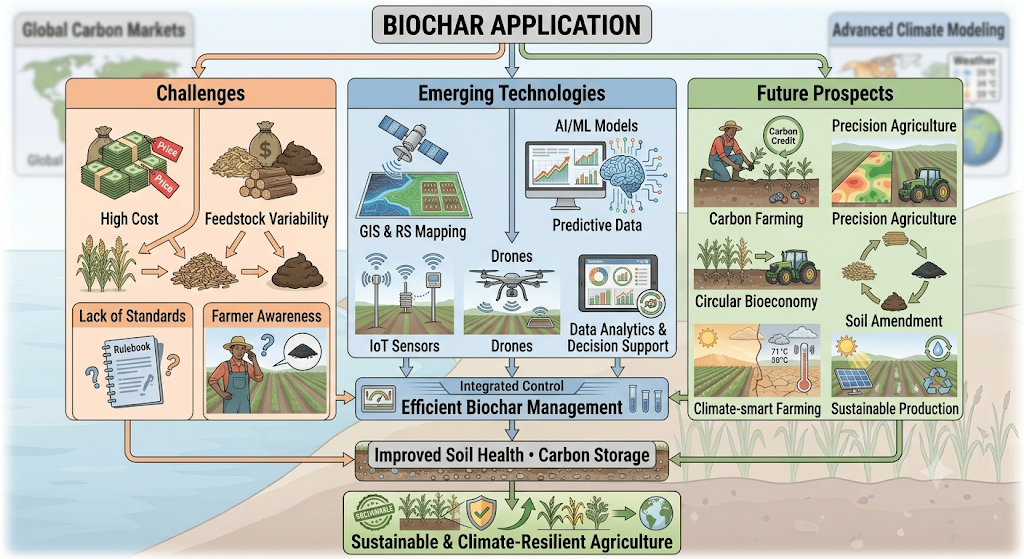
Figure. Challenges, Emerging Technologies, and Future Prospects of Biochar Application
Recent technological advances are creating new opportunities for improving biochar production and application. Geographic Information Systems (GIS) and Remote Sensing (RS) facilitate the identification of degraded soils where biochar application is most beneficial. Spatial analysis of soil fertility, organic carbon, moisture, and land-use patterns enables site-specific recommendations that improve resource-use efficiency and maximize agronomic benefits. The Internet of Things (IoT) has enhanced precision soil management through sensors that continuously monitor soil moisture, temperature, electrical conductivity, nutrient status, and pH. These real-time data allow farmers to evaluate the performance of biochar-treated soils and optimize irrigation and fertilizer management. Integration of IoT with cloud-based platforms provides timely decision support for improving crop performance. Artificial Intelligence (AI) and Machine Learning (ML) are increasingly being used to analyze large agricultural datasets and predict the long-term impacts of biochar under different climatic and soil conditions. AI models can estimate optimal application rates, forecast crop responses, evaluate carbon sequestration potential, and support precision agriculture practices. Drone technology and hyperspectral imaging further improve monitoring of crop growth, soil moisture, and vegetation health following biochar application.
Future prospects for biochar are closely linked with climate-smart agriculture, carbon farming, and the circular bioeconomy. The conversion of agricultural residues into biochar simultaneously reduces waste, lowers greenhouse gas emissions, and enhances soil fertility. Integration of biochar with compost, biofertilizers, conservation agriculture, precision irrigation, and integrated nutrient management offers significant opportunities for improving sustainable crop production. Carbon credit programs may also encourage farmers to adopt biochar by providing financial incentives for long-term carbon sequestration.
Policy support will play a crucial role in accelerating biochar adoption. Governments should encourage research, establish quality standards, promote public-private partnerships, provide financial assistance for pyrolysis technologies, and strengthen extension services. Collaboration among researchers, industries, policymakers, and farming communities will facilitate the commercialization and widespread use of biochar technologies.
Overall, despite existing economic and technical challenges, emerging digital technologies and supportive policy frameworks are expected to significantly enhance the effectiveness and adoption of biochar. Its integration into sustainable farming systems will contribute to improved soil health, increased agricultural productivity, climate change mitigation, and long-term environmental sustainability.
Conclusion#
Biochar has emerged as one of the most promising sustainable soil amendments for improving soil health, enhancing agricultural productivity, and addressing global environmental challenges. Produced through the pyrolysis of organic biomass under limited oxygen conditions, biochar possesses unique physical, chemical, and biological properties that make it an effective tool for restoring degraded soils and promoting long-term agricultural sustainability. As concerns regarding soil degradation, declining fertility, climate change, and food security continue to increase, biochar offers a practical solution that integrates agricultural productivity with environmental conservation.
The discussion presented in this paper demonstrates that biochar significantly improves soil physical properties by increasing porosity, reducing bulk density, enhancing water-holding capacity, and improving soil aggregation. These improvements facilitate better root development, increase infiltration, reduce erosion, and create favorable conditions for sustainable crop production. Simultaneously, biochar enhances soil chemical properties by increasing cation exchange capacity, improving nutrient retention, reducing nutrient leaching, and correcting soil acidity. The improved availability of essential nutrients results in greater fertilizer-use efficiency and healthier crop growth.
Biochar also contributes substantially to improving soil biological health. Its porous structure provides an ideal habitat for beneficial microorganisms such as nitrogen-fixing bacteria, phosphate-solubilizing bacteria, mycorrhizal fungi, and decomposer organisms. Enhanced microbial diversity stimulates nutrient cycling, organic matter decomposition, and soil enzyme activity, thereby strengthening soil fertility and ecosystem resilience. These biological improvements support sustained agricultural productivity while reducing dependence on chemical inputs.
Another major contribution of biochar is its role in climate change mitigation. Stable carbon compounds present in biochar remain in soils for decades or even centuries, making biochar an effective carbon sequestration strategy. In addition to storing atmospheric carbon, biochar reduces emissions of greenhouse gases such as methane and nitrous oxide from agricultural soils. These environmental benefits align closely with the objectives of climate-smart agriculture and sustainable land management. Furthermore, converting agricultural residues and organic wastes into biochar promotes resource recycling and supports the development of a circular bioeconomy.
Modern technological advancements have further expanded the potential of biochar. Geographic Information Systems (GIS), Remote Sensing (RS), Internet of Things (IoT)-based sensors, Artificial Intelligence (AI), machine learning, drone technology, and precision agriculture now enable site-specific biochar application, continuous monitoring of soil properties, and optimized nutrient and water management. These innovations improve decision-making, reduce production costs, and maximize the agronomic and environmental benefits of biochar.
Despite these advantages, several barriers continue to limit large-scale adoption. Variability in feedstock quality, lack of standardized production methods, high production and transportation costs, limited farmer awareness, and inadequate policy support remain significant challenges. Addressing these issues through scientific research, technology development, quality certification, financial incentives, and farmer education will be essential for realizing the full potential of biochar in sustainable agriculture.
In conclusion, biochar represents a multifunctional and environmentally friendly technology capable of improving soil fertility, increasing crop productivity, conserving water and nutrients, reducing greenhouse gas emissions, and strengthening climate resilience. Its integration with conservation agriculture, integrated nutrient management, renewable energy systems, and precision farming provides a comprehensive approach to sustainable agricultural development. Continued research, supportive government policies, public-private partnerships, and widespread farmer adoption will ensure that biochar becomes an integral component of resilient, productive, and environmentally sustainable agricultural systems capable of meeting future food security demands.
Works Cited#
- Lehmann, J., & Joseph, S. (Eds.). (2015). Biochar for Environmental Management: Science, Technology and Implementation (2nd ed.). Routledge.
- Lehmann, J. (2007). A Handful of Carbon. Nature, 447(7141), 143–144.
- Woolf, D., Amonette, J. E., Street-Perrott, F. A., Lehmann, J., & Joseph, S. (2010). Sustainable Biochar to Mitigate Global Climate Change. Nature Communications, 1(56), 1–9.
- Jeffery, S., Verheijen, F. G. A., van der Velde, M., & Bastos, A. C. (2011). A Quantitative Review of the Effects of Biochar Application to Soils on Crop Productivity Using Meta-Analysis. Agriculture, Ecosystems & Environment, 144(1), 175–187.
- Glaser, B., Lehmann, J., & Zech, W. (2002). Ameliorating Physical and Chemical Properties of Highly Weathered Soils in the Tropics with Charcoal. Biology and Fertility of Soils, 35(4), 219–230.
- Laird, D. A. (2008). The Charcoal Vision: A Win–Win–Win Scenario for Simultaneously Producing Bioenergy, Permanently Sequestering Carbon, and Improving Soil and Water Quality. Agronomy Journal, 100(1), 178–181.
- Agegnehu, G., Bass, A. M., Nelson, P. N., & Bird, M. I. (2016). Benefits of Biochar, Compost and Biochar–Compost for Soil Quality, Maize Yield and Greenhouse Gas Emissions in Tropical Agricultural Soil. Science of the Total Environment, 543, 295–306.
- FAO. (2021). The State of the World's Land and Water Resources for Food and Agriculture – Systems at Breaking Point. Food and Agriculture Organization.
- Brady, N. C., & Weil, R. R. (2017). The Nature and Properties of Soils (15th ed.). Pearson.
- Marschner, P. (2012). Marschner's Mineral Nutrition of Higher Plants (3rd ed.). Academic Press.
- Lal, R. (2015). Restoring Soil Quality to Mitigate Soil Degradation. Sustainability, 7(5), 5875–5895.
- Sohi, S. P., Krull, E., Lopez-Capel, E., & Bol, R. (2010). A Review of Biochar and Its Use in Soil Management. Advances in Agronomy, 105, 47–82.
- Joseph, S., et al. (2021). How Biochar Works and When It Doesn't: A Review of Mechanisms Controlling Soil and Plant Responses. GCB Bioenergy, 13(11), 1731–1764.
- Qian, L., Chen, B., & Hu, D. (2013). Effective Alleviation of Aluminum Phytotoxicity by Manure-Derived Biochar. Environmental Science & Technology, 47(6), 2737–2745.
- Schmidt, H. P., et al. (2014). Biochar and Biochar-Compost as Soil Amendments to Improve Soil Quality. Journal of Environmental Quality, 43(6), 1812–1824.
- IPCC. (2023). Climate Change 2023: Synthesis Report. Intergovernmental Panel on Climate Change.
- UNEP. (2022). Global Environment Outlook. United Nations Environment Programme.
- World Bank. (2023). Water in Agriculture. World Bank.
- International Biochar Initiative. (2023). Standardized Product Definition and Product Testing Guidelines for Biochar. International Biochar Initiative.
- ESRI. (2023). ArcGIS Pro Documentation. Environmental Systems Research Institute.