Abstract
Integrated Soil Fertility Management (ISFM) is a comprehensive approach to improving soil fertility by combining organic resources, inorganic fertilizers, improved crop varieties, and appropriate agronomic practices to maximize crop productivity while maintaining long-term soil health. Continuous dependence on chemical fertilizers alone has contributed to soil degradation, nutrient imbalance, declining organic matter, and environmental pollution, making sustainable nutrient management increasingly important. ISFM addresses these challenges by integrating locally available organic amendments such as farmyard manure, compost, crop residues, green manures, and biofertilizers with balanced mineral fertilizer application and sound soil management practices. This integrated approach enhances nutrient availability, improves soil physical, chemical, and biological properties, increases nutrient-use efficiency, and promotes sustainable crop production. Numerous studies have demonstrated that ISFM increases crop yields, improves water-use efficiency, enhances soil organic carbon, stimulates beneficial microbial activity, and reduces nutrient losses through leaching and volatilization. Furthermore, ISFM contributes to climate resilience by improving soil structure, increasing carbon sequestration, and reducing dependence on excessive chemical fertilizer use. Despite its numerous advantages, adoption remains constrained by limited farmer awareness, inadequate access to quality inputs, labor requirements, and financial limitations. This paper examines the principles and components of Integrated Soil Fertility Management, evaluates its influence on soil health, nutrient-use efficiency, and crop productivity, and discusses the challenges and future prospects of its implementation. The study concludes that ISFM is a practical and sustainable strategy for achieving higher agricultural productivity while conserving natural resources and ensuring long-term food security.
- Integrated Soil Fertility Management
- Sustainable Agriculture
- Soil Health
- Nutrient Use Efficiency
- Organic Manures
- Chemical Fertilizers
- Biofertilizers
- Crop Productivity
- Soil Organic Carbon
- Integrated Nutrient Management
Introduction#
Sustainable agricultural production depends largely on the maintenance of healthy and fertile soils capable of supplying essential nutrients for optimum plant growth. Rapid population growth, increasing food demand, shrinking cultivable land, and climate variability have intensified pressure on agricultural systems worldwide. To achieve higher crop yields, many farming systems have relied heavily on synthetic fertilizers. Although chemical fertilizers have substantially increased agricultural productivity, their prolonged and excessive use has contributed to nutrient imbalances, declining soil organic matter, soil acidification, reduced microbial diversity, environmental pollution, and deterioration of soil quality. These concerns have highlighted the need for integrated approaches that improve soil fertility while conserving natural resources. Integrated Soil Fertility Management (ISFM) has emerged as a scientifically proven and sustainable strategy that combines the efficient use of mineral fertilizers with organic nutrient sources, improved crop varieties, and sound agronomic practices. Rather than relying on a single source of nutrients, ISFM seeks to optimize nutrient availability through the complementary use of farmyard manure, compost, vermicompost, green manures, crop residues, biofertilizers, and balanced chemical fertilizers. This integrated approach enhances nutrient-use efficiency, improves soil structure, promotes beneficial microbial activity, and sustains long-term agricultural productivity. The concept of ISFM recognizes that soil fertility is influenced not only by nutrient availability but also by soil physical, chemical, and biological properties. Organic amendments improve soil aggregation, water-holding capacity, porosity, and organic carbon content, while inorganic fertilizers provide readily available nutrients required during critical stages of crop growth. Biofertilizers further enhance nutrient availability through biological nitrogen fixation, phosphorus solubilization, and other beneficial microbial processes. Together, these components create a productive and resilient soil environment.
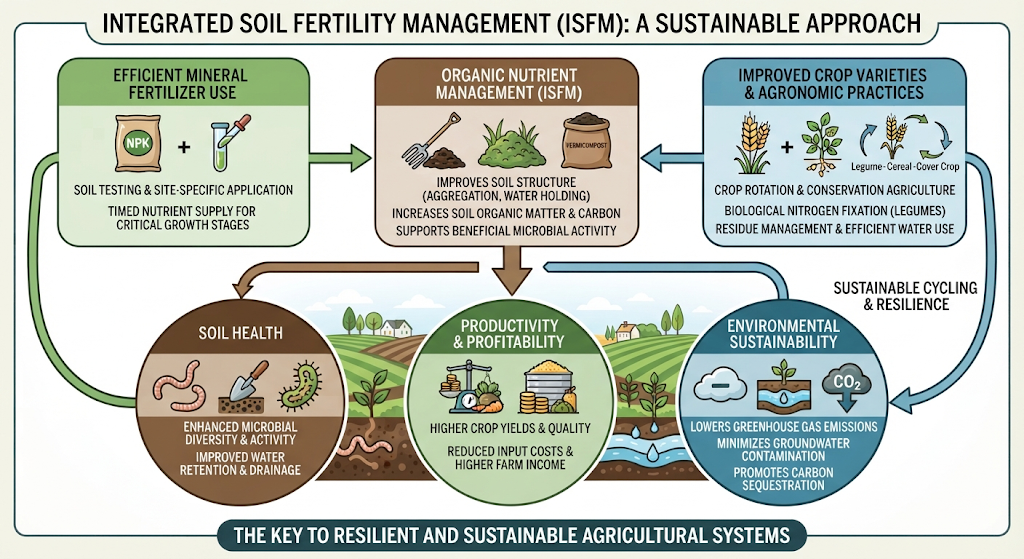
ISFM also emphasizes crop-specific nutrient management based on soil testing, balanced fertilizer application, crop rotation, conservation agriculture, residue management, and efficient water use. Such practices reduce nutrient losses through leaching, runoff, erosion, and volatilization while increasing fertilizer-use efficiency and minimizing environmental impacts. The integration of legumes into cropping systems further contributes to biological nitrogen fixation and improved soil fertility. Numerous studies have demonstrated that Integrated Soil Fertility Management improves crop growth, yield, nutrient uptake, and farm profitability across cereals, pulses, oilseeds, vegetables, and commercial crops. Increased soil organic matter supports diverse microbial communities that accelerate nutrient cycling and improve nutrient availability throughout the growing season. Improved soil structure enhances root development and moisture retention, enabling crops to tolerate drought and other environmental stresses more effectively. Beyond productivity, ISFM contributes significantly to environmental sustainability. Reduced dependence on excessive chemical fertilizers lowers greenhouse gas emissions, minimizes groundwater contamination, and conserves soil biodiversity. Increased soil organic carbon also promotes carbon sequestration, making ISFM an important component of climate-smart agriculture.
Despite these benefits, widespread adoption of ISFM remains limited due to constraints such as insufficient farmer awareness, limited availability of organic inputs, labor-intensive management, inadequate extension services, and financial barriers. Strengthening research, extension programs, input delivery systems, and policy support will be essential for expanding its adoption.
This paper examines the principles and components of Integrated Soil Fertility Management and evaluates its impact on soil health, nutrient-use efficiency, and sustainable crop production. It also discusses the major challenges, opportunities, and future prospects of ISFM in promoting resilient and environmentally sustainable agricultural systems.
Concept, Principles, and Components of Integrated Soil Fertility Management#
Integrated Soil Fertility Management (ISFM) is a holistic approach to maintaining and improving soil fertility by combining organic nutrient sources, mineral fertilizers, improved crop varieties, and appropriate agronomic practices. Unlike conventional nutrient management systems that rely primarily on chemical fertilizers, ISFM seeks to maximize crop productivity while preserving soil health and minimizing environmental degradation. It recognizes that sustainable agricultural production depends not only on supplying nutrients but also on improving the physical, chemical, and biological properties of the soil. By integrating multiple nutrient sources and management practices, ISFM enhances nutrient availability, increases fertilizer-use efficiency, and supports long-term agricultural sustainability. The fundamental principle of ISFM is the balanced and efficient use of available resources. Instead of replacing chemical fertilizers entirely, ISFM advocates their judicious use in combination with organic materials such as farmyard manure, compost, vermicompost, green manures, crop residues, and biofertilizers. Organic inputs improve soil organic matter, microbial activity, and nutrient retention, while inorganic fertilizers provide readily available nutrients during periods of high crop demand. This complementary relationship ensures continuous nutrient availability throughout the crop growth cycle.
Another important principle is site-specific nutrient management. Soil fertility varies considerably depending on soil type, climate, cropping history, and management practices. ISFM emphasizes soil testing and nutrient budgeting to determine the precise nutrient requirements of individual fields. Based on soil analysis, appropriate fertilizer recommendations are developed to avoid nutrient deficiencies, excess application, and unnecessary production costs. Balanced fertilization also prevents nutrient mining and maintains soil fertility over successive cropping seasons. A key component of ISFM is the incorporation of organic nutrient sources. Farmyard manure, compost, vermicompost, green manures, poultry manure, and crop residues contribute organic matter that improves soil structure, aggregation, porosity, and water-holding capacity. Organic amendments also increase cation exchange capacity, reduce bulk density, and stimulate microbial activity, thereby creating favorable conditions for root growth and nutrient absorption. The gradual decomposition of organic materials provides a slow and continuous release of nutrients while enhancing long-term soil fertility. Mineral fertilizers remain an essential component of ISFM because they supply concentrated nutrients in readily available forms. Nitrogen, phosphorus, potassium, sulfur, and micronutrient fertilizers support rapid crop growth, particularly during critical developmental stages. However, under ISFM, fertilizer application is carefully balanced according to crop needs, soil fertility status, and expected yield targets. This approach minimizes nutrient losses through leaching, runoff, and volatilization while improving fertilizer-use efficiency.
Another important component is the use of biofertilizers and beneficial microorganisms. Nitrogen-fixing bacteria, phosphate-solubilizing microorganisms, potassium-mobilizing bacteria, and arbuscular mycorrhizal fungi increase nutrient availability through biological processes. These microorganisms enhance root development, stimulate plant growth, improve nutrient uptake, and contribute to healthier soil ecosystems. Their integration with organic and mineral fertilizers further strengthens nutrient cycling and crop performance. ISFM also incorporates improved crop varieties and sound agronomic practices. High-yielding and nutrient-efficient crop varieties utilize available nutrients more effectively than traditional cultivars. Crop rotation, intercropping, conservation tillage, residue retention, mulching, efficient irrigation, and timely weed management further improve nutrient-use efficiency while protecting soil from erosion and degradation. Inclusion of leguminous crops in crop rotations contributes biological nitrogen fixation and enriches soil fertility naturally. The adoption of ISFM offers several agronomic, economic, and environmental benefits. Improved nutrient synchronization between soil supply and crop demand enhances nutrient uptake and reduces fertilizer wastage. Increased soil organic matter improves water infiltration, moisture retention, and resistance to erosion, making cropping systems more resilient to climate variability. Higher nutrient-use efficiency reduces production costs while minimizing environmental pollution caused by excessive fertilizer use.
Overall, Integrated Soil Fertility Management represents a scientifically sound and practical approach to sustainable nutrient management. By integrating organic resources, mineral fertilizers, biofertilizers, improved crop varieties, and efficient agronomic practices, ISFM enhances soil fertility, improves crop productivity, conserves natural resources, and supports environmentally sustainable agricultural development.
Impact of Integrated Soil Fertility Management on Soil Health and Nutrient Use Efficiency#
Integrated Soil Fertility Management (ISFM) plays a crucial role in improving soil health and enhancing nutrient-use efficiency by integrating organic amendments, mineral fertilizers, biofertilizers, and improved agronomic practices. Healthy soil forms the foundation of sustainable agriculture because it supports plant growth, regulates water movement, facilitates nutrient cycling, and maintains diverse biological communities. Continuous dependence on chemical fertilizers alone often leads to nutrient imbalances, soil degradation, and declining soil organic matter. ISFM addresses these challenges by restoring soil fertility through balanced nutrient management and sustainable farming practices. One of the most important contributions of ISFM is the improvement of soil physical properties. Organic materials such as farmyard manure, compost, vermicompost, crop residues, and green manures increase soil organic matter, which enhances soil aggregation and structural stability. Well-aggregated soils exhibit better porosity, aeration, and water infiltration, creating favorable conditions for root growth and microbial activity. Organic matter also reduces soil bulk density, making the soil loose and friable, thereby facilitating root penetration and nutrient absorption. Improved soil structure minimizes erosion, surface runoff, and compaction, contributing to long-term soil conservation.
ISFM also significantly improves the chemical properties of soil. Organic amendments gradually release essential nutrients such as nitrogen, phosphorus, potassium, sulfur, calcium, and magnesium during decomposition, while mineral fertilizers provide readily available nutrients to meet immediate crop demands. The combined use of organic and inorganic nutrient sources ensures a continuous supply of nutrients throughout the crop growth cycle. Furthermore, increased soil organic matter enhances the cation exchange capacity (CEC), allowing soils to retain more nutrient ions and reduce nutrient losses through leaching. Organic matter also buffers soil pH, improving the availability of both macro- and micronutrients. An equally important benefit of ISFM is the enhancement of soil biological properties. Organic inputs stimulate the growth and activity of beneficial microorganisms, including bacteria, fungi, actinomycetes, and earthworms. These organisms decompose organic residues, mineralize nutrients, fix atmospheric nitrogen, solubilize phosphorus, and mobilize potassium, thereby increasing nutrient availability for plants. A biologically active soil ecosystem also suppresses certain soil-borne pathogens and improves overall soil resilience. Enhanced microbial diversity supports efficient nutrient cycling and contributes to sustained soil fertility over time.
One of the primary objectives of ISFM is to improve nutrient-use efficiency (NUE). Nutrient-use efficiency refers to the ability of crops to absorb and utilize applied nutrients effectively for growth and yield. Under conventional fertilizer management, substantial proportions of applied nutrients are often lost through leaching, runoff, volatilization, and fixation in the soil. ISFM minimizes these losses by synchronizing nutrient release from organic sources with crop nutrient demand while supplying additional nutrients through balanced mineral fertilizer application. Improved synchronization increases nutrient recovery by crops and reduces fertilizer wastage. Biofertilizers integrated within ISFM further enhance nutrient-use efficiency through biological processes such as atmospheric nitrogen fixation, phosphate solubilization, and potassium mobilization. Arbuscular mycorrhizal fungi expand the effective root surface area, improving the uptake of phosphorus, zinc, copper, and water from the soil. These biological interactions enable crops to utilize soil nutrients more efficiently while reducing dependence on synthetic fertilizers. ISFM also contributes to environmental sustainability by reducing nutrient losses that cause groundwater contamination, eutrophication of water bodies, and greenhouse gas emissions. Increased soil organic carbon enhances carbon sequestration and strengthens the soil's capacity to withstand drought, flooding, and other climate-related stresses. Consequently, soils managed under ISFM remain productive for longer periods while maintaining ecological balance. Several long-term field experiments have demonstrated that integrated nutrient management consistently improves soil fertility indicators, including soil organic carbon, microbial biomass, nutrient availability, aggregate stability, and moisture retention. These improvements translate into greater nutrient-use efficiency, higher crop productivity, and reduced production costs compared with systems relying exclusively on chemical fertilizers.
Overall, Integrated Soil Fertility Management provides a balanced and sustainable approach to improving soil health and maximizing nutrient-use efficiency. By integrating organic amendments, mineral fertilizers, biofertilizers, and improved agronomic practices, ISFM enhances soil productivity, conserves natural resources, and supports resilient agricultural systems capable of meeting future food security challenges.
Influence of Integrated Soil Fertility Management on Crop Growth and Sustainable Productivity#
Integrated Soil Fertility Management (ISFM) has become an essential strategy for improving crop growth, increasing agricultural productivity, and ensuring the long-term sustainability of farming systems. By combining organic nutrient sources, mineral fertilizers, biofertilizers, and improved crop management practices, ISFM provides balanced nutrition throughout the crop growth cycle. This integrated approach enhances plant physiological processes, improves nutrient uptake, strengthens root development, and ultimately leads to higher and more stable crop yields across diverse agro-ecological conditions. One of the primary benefits of ISFM is its ability to promote vigorous plant growth. Balanced nutrient availability supports essential physiological processes such as cell division, chlorophyll formation, photosynthesis, enzyme activation, and protein synthesis. Organic amendments improve soil conditions for root development, while mineral fertilizers provide readily available nutrients during periods of rapid crop growth. Consequently, crops grown under ISFM often exhibit greater plant height, increased leaf area, stronger stems, enhanced tillering, and higher biomass production than those managed using either organic or inorganic nutrient sources alone.ISFM significantly enhances root growth and nutrient uptake. Improved soil structure, greater porosity, and increased microbial activity create favorable conditions for root proliferation. A larger and healthier root system enables plants to absorb water and nutrients more efficiently from a greater volume of soil. Biofertilizers incorporated into ISFM further improve nutrient availability through biological nitrogen fixation, phosphorus solubilization, potassium mobilization, and enhanced micronutrient uptake. Efficient nutrient absorption contributes directly to better crop growth and improved productivity.
Major field crops such as rice, wheat, maize, sorghum, pearl millet, soybean, chickpea, pigeon pea, mustard, sunflower, sugarcane, and cotton have consistently shown higher yields under ISFM practices. In cereal crops, balanced nutrient management increases productive tillers, ear length, grain number, grain weight, and overall grain yield. Leguminous crops benefit from improved nodulation and biological nitrogen fixation, resulting in increased pod formation, seed weight, and protein content. Oilseed crops demonstrate higher seed yield, improved oil content, and enhanced quality due to balanced nutrient availability throughout reproductive growth.
ISFM also contributes significantly to yield stability under changing climatic conditions. Improved soil organic matter increases the soil's water-holding capacity, allowing crops to withstand periods of drought more effectively. Enhanced soil aggregation improves drainage during excessive rainfall, reducing waterlogging stress. These improvements make cropping systems more resilient to climate variability and extreme weather events, thereby reducing the risk of crop failure. Another important advantage of ISFM is the improvement of crop quality. Balanced nutrition enhances grain protein content, fruit size, sugar accumulation, oil content, vitamin concentration, and other quality parameters depending on the crop. Better-quality produce increases market value and farmer income while meeting consumer demands for nutritious food products. From an economic perspective, ISFM improves resource-use efficiency and farm profitability. Although integrated nutrient management may require careful planning and additional labor for handling organic inputs, it reduces excessive dependence on costly chemical fertilizers. Improved nutrient-use efficiency lowers fertilizer losses and increases returns on investment. Higher crop yields, improved produce quality, and reduced expenditure on fertilizers collectively contribute to greater economic sustainability for farmers. ISFM also supports environmental sustainability by minimizing nutrient losses, reducing greenhouse gas emissions associated with fertilizer production and application, and enhancing carbon sequestration through increased soil organic matter. Improved soil fertility reduces land degradation and maintains productive agricultural landscapes for future generations. Furthermore, the recycling of crop residues and organic wastes within ISFM contributes to circular agricultural systems that efficiently utilize locally available resources.Numerous long-term studies have confirmed that integrated nutrient management consistently outperforms the exclusive use of either chemical fertilizers or organic amendments. The synergistic interaction among organic materials, mineral fertilizers, biofertilizers, improved crop varieties, and efficient agronomic practices ensures sustained productivity while maintaining soil health and environmental quality.
Overall, Integrated Soil Fertility Management provides a practical and scientifically validated approach to achieving sustainable crop production. Its ability to improve plant growth, enhance nutrient uptake, stabilize yields, increase farm profitability, and conserve natural resources makes it an indispensable component of modern sustainable agriculture.
Challenges, Opportunities, and Future Prospects of Integrated Soil Fertility Management#
Integrated Soil Fertility Management (ISFM) has proven to be an effective strategy for improving soil fertility, enhancing nutrient-use efficiency, and increasing sustainable crop productivity. However, despite its scientific validity and long-term benefits, the widespread adoption of ISFM remains limited in many developing and developed agricultural regions. Various technical, economic, institutional, and socio-cultural factors influence the implementation of ISFM practices. Addressing these constraints while utilizing emerging opportunities is essential for promoting sustainable agricultural development and ensuring long-term food security.
One of the major challenges in implementing ISFM is the limited availability of organic nutrient sources. Organic materials such as farmyard manure, compost, crop residues, green manure, and vermicompost are essential components of ISFM, but their availability is often insufficient to meet the nutrient requirements of large agricultural areas. In many farming systems, crop residues are used as livestock feed, household fuel, or construction material, reducing the quantity available for soil application. Similarly, inadequate livestock populations limit the production of farmyard manure in many regions.
Another significant constraint is the high labor requirement associated with the collection, transportation, preparation, and application of organic amendments. Compared to chemical fertilizers, organic materials are bulky and require greater labor for handling and field incorporation. Smallholder farmers with limited labor resources often find it difficult to adopt integrated nutrient management practices despite their long-term benefits. Financial limitations also affect the adoption of ISFM. Although the approach reduces fertilizer costs over time by improving nutrient-use efficiency, farmers may initially face expenses related to purchasing quality fertilizers, biofertilizers, improved crop varieties, composting materials, or irrigation facilities. Limited access to agricultural credit and financial support further discourages investment in integrated soil fertility practices. Lack of farmer awareness and technical knowledge remains another important challenge. Successful implementation of ISFM requires understanding soil testing, nutrient budgeting, balanced fertilizer application, crop rotation, residue management, and the appropriate use of organic amendments and biofertilizers. Inadequate extension services, limited farmer training, and insufficient demonstration programs reduce awareness regarding the economic and environmental advantages of ISFM. Variability in soil characteristics and climatic conditions also influences the effectiveness of Integrated Soil Fertility Management. Soil texture, pH, organic matter content, rainfall patterns, and temperature vary significantly across regions, making it difficult to develop universal nutrient management recommendations. Site-specific nutrient management based on soil testing is therefore essential but is not always accessible to resource-poor farmers.
Despite these challenges, ISFM offers substantial opportunities for sustainable agricultural development. Growing concerns regarding soil degradation, declining fertility, climate change, and environmental pollution have increased global interest in integrated nutrient management approaches. Governments, research institutions, and international organizations are increasingly promoting ISFM through extension programs, input subsidies, climate-smart agriculture initiatives, and sustainable land management projects. Rapid advancements in precision agriculture, digital farming, remote sensing, geographic information systems (GIS), artificial intelligence, and decision-support tools are creating new opportunities for site-specific nutrient management. These technologies enable farmers to apply fertilizers according to crop requirements and soil nutrient status, thereby increasing nutrient-use efficiency while minimizing environmental impacts.
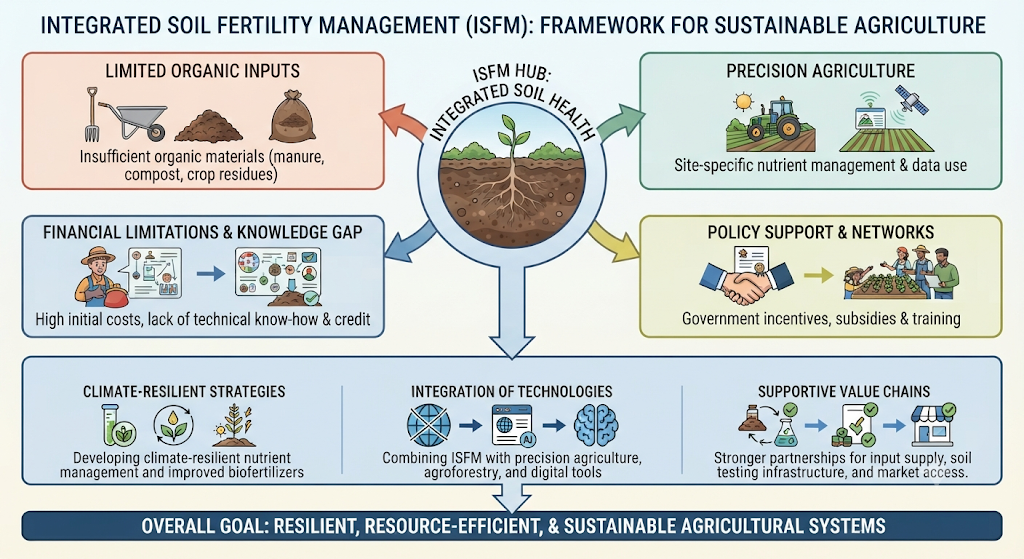
Future research should focus on developing crop-specific nutrient recommendations, improving nutrient synchronization between organic and inorganic sources, identifying efficient biofertilizer strains, and evaluating climate-resilient nutrient management strategies. Strengthening partnerships among researchers, extension agencies, policymakers, private organizations, and farming communities will facilitate the widespread dissemination of ISFM technologies. Supportive government policies, improved input supply systems, farmer education, financial incentives, and investment in soil testing infrastructure will play a critical role in increasing adoption. Integrating ISFM with conservation agriculture, precision farming, agroforestry, and climate-smart agricultural practices can further enhance agricultural sustainability.
Overall, while several constraints continue to limit the adoption of Integrated Soil Fertility Management, its long-term agronomic, economic, and environmental benefits make it one of the most promising approaches for sustainable crop production. Continued innovation, policy support, and capacity building will ensure that ISFM remains a cornerstone of resilient and resource-efficient agricultural systems.
Conclusion#
Integrated Soil Fertility Management (ISFM) has emerged as a comprehensive and sustainable approach for maintaining soil fertility, improving nutrient-use efficiency, and enhancing agricultural productivity. As modern agriculture faces increasing challenges related to soil degradation, nutrient depletion, climate change, environmental pollution, and growing food demand, balanced nutrient management has become essential for ensuring long-term food security. ISFM effectively addresses these challenges by integrating organic nutrient sources, mineral fertilizers, biofertilizers, improved crop varieties, and sound agronomic practices into a unified soil fertility management strategy.
The discussion presented in this paper demonstrates that ISFM significantly improves the physical, chemical, and biological properties of soil. Organic amendments such as farmyard manure, compost, vermicompost, crop residues, and green manures increase soil organic matter, improve soil aggregation, enhance water-holding capacity, reduce bulk density, and promote better root development. Simultaneously, mineral fertilizers provide readily available nutrients required during critical stages of crop growth, while biofertilizers improve nutrient availability through biological nitrogen fixation, phosphorus solubilization, and other beneficial microbial activities. The combined effect of these practices creates a productive and resilient soil environment capable of supporting sustainable crop production. ISFM also plays a vital role in improving nutrient-use efficiency by synchronizing nutrient release with crop demand and minimizing nutrient losses through leaching, runoff, erosion, and volatilization. Increased soil organic matter enhances cation exchange capacity and nutrient retention, allowing crops to utilize applied nutrients more effectively. Consequently, fertilizer-use efficiency improves while reducing production costs and minimizing environmental pollution associated with excessive fertilizer application.
The positive influence of ISFM on crop growth and productivity has been consistently demonstrated across cereals, pulses, oilseeds, vegetables, and commercial crops. Balanced nutrient availability promotes vigorous vegetative growth, efficient photosynthesis, stronger root systems, improved flowering, better grain filling, and higher yields. Enhanced soil moisture retention and improved microbial activity further increase crop resilience against drought, nutrient stress, and adverse climatic conditions. These benefits contribute to stable agricultural production and improved farm profitability.
In addition to agronomic advantages, ISFM contributes significantly to environmental sustainability. Increased soil organic carbon promotes carbon sequestration, while reduced chemical fertilizer use decreases greenhouse gas emissions and groundwater contamination. Recycling organic residues within farming systems also supports circular agriculture and efficient resource utilization. These ecological benefits align closely with the principles of climate-smart agriculture and sustainable land management. Despite its proven effectiveness, several challenges continue to hinder the widespread adoption of ISFM. Limited availability of organic inputs, labor-intensive management, financial constraints, inadequate extension services, poor access to soil testing facilities, and insufficient farmer awareness remain important barriers. Addressing these issues requires coordinated efforts involving research institutions, governments, extension agencies, and farming communities. Investments in soil testing infrastructure, quality input supply, farmer training, digital agriculture, and policy support will be essential for expanding ISFM adoption. Future developments in precision agriculture, artificial intelligence, remote sensing, biofertilizer technologies, and site-specific nutrient management are expected to further strengthen the effectiveness of ISFM. Integrating these innovations with traditional nutrient management practices will enhance agricultural resilience, improve resource-use efficiency, and support sustainable food production under changing climatic conditions.
In conclusion, Integrated Soil Fertility Management represents a scientifically sound, environmentally responsible, and economically viable strategy for sustainable crop production. Its widespread implementation can significantly improve soil health, enhance crop productivity, conserve natural resources, and strengthen global food security. Continued research, technological innovation, policy support, and farmer participation will ensure that ISFM remains a cornerstone of sustainable agricultural development for future generations.
Works Cited#
- Vanlauwe, B., Bationo, A., Chianu, J., et al. (2010). Integrated Soil Fertility Management: Operational definition and consequences for implementation and dissemination. Outlook on Agriculture, 39(1), 17–24.
- Vanlauwe, B., Wendt, J., & Giller, K. E. (2014). A fourth principle is required to define Conservation Agriculture in sub-Saharan Africa. Proceedings of the National Academy of Sciences, 111(27), E2740.
- Palm, C. A., Myers, R. J. K., & Nandwa, S. M. (1997). Combined use of organic and inorganic nutrient sources. In Replenishing Soil Fertility in Africa. SSSA Special Publication.
- Sanchez, P. A. (2002). Soil fertility and hunger in Africa. Science, 295(5562), 2019–2020.
- Bationo, A., Waswa, B., Kihara, J., & Kimetu, J. (2007). Advances in Integrated Soil Fertility Management in Sub-Saharan Africa. Springer.
- Food and Agriculture Organization. (2022). The State of the World's Land and Water Resources for Food and Agriculture. FAO.
- Brady, N. C., & Weil, R. R. (2017). The Nature and Properties of Soils (15th ed.). Pearson.
- Lal, R. (2020). Soil organic matter and sustainable agriculture. Journal of Soil and Water Conservation, 75(5), 123A–128A.
- Tisdale, S. L., Nelson, W. L., Beaton, J. D., & Havlin, J. L. (2013). Soil Fertility and Fertilizers (8th ed.). Pearson.
- Havlin, J. L., Tisdale, S. L., Nelson, W. L., & Beaton, J. D. (2014). Soil Fertility and Fertilizers: An Introduction to Nutrient Management. Pearson.
- Singh, J. S., Pandey, V. C., & Singh, D. P. (2011). Efficient soil microorganisms: A new dimension for sustainable agriculture. Agriculture, Ecosystems & Environment, 140(3–4), 339–353.
- Vessey, J. K. (2003). Plant growth-promoting rhizobacteria as biofertilizers. Plant and Soil, 255(2), 571–586.
- Giller, K. E. (2001). Nitrogen Fixation in Tropical Cropping Systems (2nd ed.). CABI.
- Gruhn, P., Goletti, F., & Yudelman, M. (2000). Integrated Nutrient Management, Soil Fertility, and Sustainable Agriculture. IFPRI.
- Roy, R. N., Finck, A., Blair, G. J., & Tandon, H. L. S. (2006). Plant Nutrition for Food Security. FAO.
- Dobermann, A., & Cassman, K. G. (2002). Plant nutrient management for enhanced productivity. Plant and Soil, 247(1), 153–175.
- Pretty, J. (2008). Agricultural sustainability: Concepts, principles and evidence. Philosophical Transactions of the Royal Society B, 363(1491), 447–465.
- Kumar, V., Singh, A. K., & Sharma, S. (2021). Sustainable soil fertility management for crop production. Journal of Applied and Natural Science, 13(2), 523–533.
- Food and Agriculture Organization. (2021). Sustainable Soil Management. FAO.
- Bationo, A., Waswa, B., Okeyo, J., et al. (2015). Improving Soil Fertility Recommendations in Africa Using the Decision Support System for Agrotechnology Transfer (DSSAT). Springer.