Abstract
Efficient nutrient management is essential for improving the productivity, quality, and sustainability of vegetable production systems. Vegetable crops require adequate and balanced nutrient supplies because of their rapid growth, short cropping duration, and high nutrient demand. Traditionally, inorganic fertilizers have been widely used to achieve higher yields; however, excessive dependence on chemical fertilizers has resulted in declining soil fertility, nutrient imbalances, environmental pollution, and increased production costs. In contrast, organic nutrient management utilizes farmyard manure, compost, vermicompost, green manure, crop residues, biofertilizers, and other organic amendments to improve soil health, microbial activity, and long-term agricultural sustainability. Both nutrient management systems possess distinct advantages and limitations with respect to nutrient availability, crop productivity, product quality, soil fertility, and environmental impacts. Recent agricultural research emphasizes integrated nutrient management (INM), which combines organic and inorganic nutrient sources to maximize crop yield while maintaining soil health and minimizing ecological degradation. Advanced technologies such as precision nutrient management, Geographic Information Systems (GIS), Remote Sensing (RS), Internet of Things (IoT), Artificial Intelligence (AI), and soil testing support efficient nutrient application according to crop requirements. This paper comparatively evaluates the principles, nutrient dynamics, crop responses, environmental impacts, economic considerations, and sustainability of organic and inorganic nutrient management in vegetable crops. It also examines the role of integrated nutrient management and emerging technologies in achieving sustainable and climate-resilient vegetable production..
- Organic Nutrient Management
- Inorganic Fertilizers
- Integrated Nutrient Management
- Vegetable Crops
- Soil Fertility
- Sustainable Agriculture
- Biofertilizers
- Crop Productivity
- Soil Health
- Precision Nutrient Management
Introduction#
Vegetable crops are among the most important components of global agriculture because they provide essential vitamins, minerals, dietary fiber, antioxidants, and phytochemicals necessary for human nutrition and health. Owing to their rapid growth rate, high biomass production, and intensive cultivation, vegetable crops require substantial amounts of nutrients throughout their growing period. Proper nutrient management is therefore a critical factor influencing plant growth, yield, product quality, soil fertility, and long-term agricultural sustainability.
For several decades, inorganic fertilizers have played a major role in increasing vegetable production worldwide. Fertilizers containing nitrogen (N), phosphorus (P), potassium (K), and essential micronutrients provide readily available nutrients that promote rapid plant growth and high yields. Their precise nutrient composition enables farmers to correct nutrient deficiencies efficiently and achieve consistent crop performance. However, continuous and excessive application of chemical fertilizers has led to numerous environmental and agronomic problems, including soil acidification, nutrient imbalance, reduced soil organic matter, groundwater contamination, greenhouse gas emissions, and declining soil microbial diversity.
Organic nutrient management has emerged as a sustainable alternative that emphasizes the use of naturally derived nutrient sources. Organic amendments such as farmyard manure, compost, vermicompost, green manure, crop residues, poultry manure, biogas slurry, and biofertilizers gradually release nutrients while improving soil structure, water-holding capacity, microbial activity, and nutrient cycling. Organic farming practices promote long-term soil fertility, increase biodiversity, and reduce environmental pollution. However, nutrient release from organic materials is relatively slow and depends on microbial decomposition, temperature, moisture, and soil conditions, which may not always meet the immediate nutrient demand of rapidly growing vegetable crops.
Recognizing the strengths and limitations of both systems, researchers increasingly recommend Integrated Nutrient Management (INM), which combines organic and inorganic nutrient sources to achieve balanced crop nutrition while maintaining soil health. Integrated nutrient management enhances nutrient-use efficiency, improves crop productivity, reduces fertilizer losses, and supports sustainable vegetable production. The complementary effects of organic amendments and chemical fertilizers improve nutrient availability, stimulate beneficial microbial populations, and maintain long-term soil productivity.
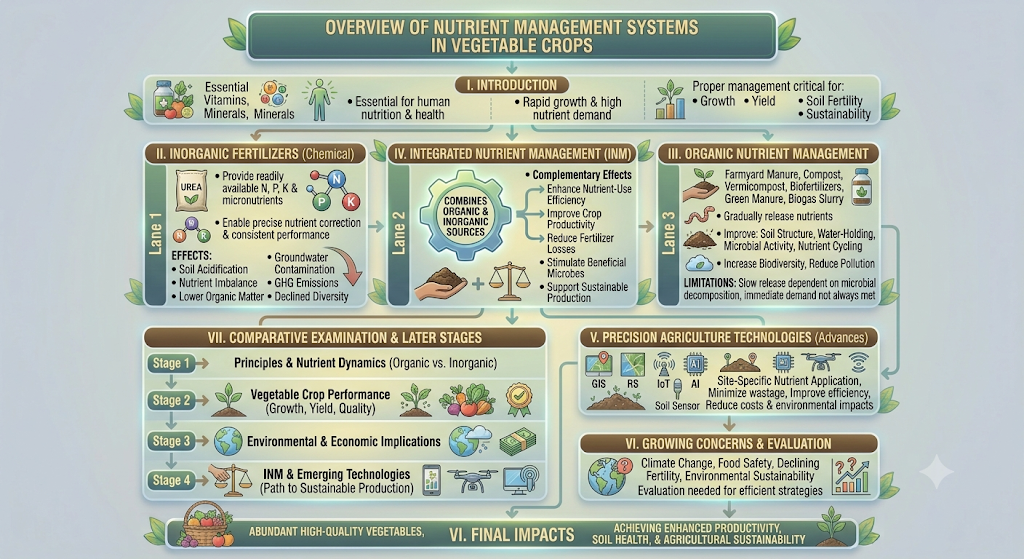
Recent advances in precision agriculture have further improved nutrient management practices. Technologies such as Geographic Information Systems (GIS), Remote Sensing (RS), Internet of Things (IoT), Artificial Intelligence (AI), drone-based crop monitoring, soil nutrient sensors, and decision-support systems enable site-specific nutrient application according to crop requirements. These technologies minimize nutrient wastage, improve fertilizer-use efficiency, reduce production costs, and decrease environmental impacts.
Growing concerns regarding climate change, food safety, declining soil fertility, and environmental sustainability have increased interest in evaluating the comparative performance of organic and inorganic nutrient management systems. Understanding their effects on vegetable growth, yield, quality, soil properties, economic returns, and ecological sustainability is essential for developing efficient nutrient management strategies.
This paper comparatively examines the principles and nutrient dynamics of organic and inorganic nutrient management, evaluates their effects on vegetable crop performance, discusses environmental and economic implications, and explores integrated nutrient management and emerging technologies for sustainable vegetable production.
Principles, Sources, and Nutrient Dynamics of Organic and Inorganic Nutrient Management#
Nutrient management is one of the most important components of vegetable crop production because vegetables have high nutrient requirements due to their rapid growth, short life cycle, and continuous biomass accumulation. Efficient nutrient management ensures balanced plant nutrition, improves crop productivity, enhances product quality, and maintains long-term soil fertility. Organic and inorganic nutrient management systems differ considerably in their nutrient sources, release patterns, mechanisms of nutrient availability, and influence on soil health.
Organic nutrient management relies on naturally occurring nutrient sources obtained from plant, animal, and microbial materials. Common organic amendments include farmyard manure (FYM), compost, vermicompost, poultry manure, green manure, crop residues, biogas slurry, oil cakes, bone meal, and biofertilizers such as Rhizobium, Azotobacter, Azospirillum, phosphate-solubilizing bacteria (PSB), potassium-solubilizing bacteria (KSB), and arbuscular mycorrhizal fungi (AMF). These materials not only supply essential macro- and micronutrients but also improve soil organic matter content and stimulate beneficial microbial activity.
The nutrients present in organic materials are generally in complex organic forms and become available only after microbial decomposition and mineralization. Soil microorganisms convert organic nitrogen into ammonium and nitrate, organic phosphorus into available phosphate, and organic sulfur into sulfate through biological processes. Consequently, nutrient release from organic fertilizers is gradual and synchronized with microbial activity, soil temperature, moisture, and environmental conditions. This slow-release characteristic minimizes nutrient losses while providing sustained nutrition throughout crop growth.
In contrast, inorganic nutrient management involves the application of chemically manufactured fertilizers containing readily available nutrients. Common fertilizers include urea, ammonium sulfate, diammonium phosphate (DAP), single superphosphate (SSP), muriate of potash (MOP), potassium sulfate, calcium nitrate, zinc sulfate, borax, and other micronutrient formulations. These fertilizers dissolve rapidly in soil water, allowing immediate nutrient absorption by plant roots and supporting rapid vegetative growth.
One of the primary advantages of inorganic fertilizers is their precise nutrient composition. Farmers can calculate and apply exact nutrient quantities based on crop requirements and soil test recommendations. Immediate nutrient availability enables quick correction of nutrient deficiencies and promotes higher yields, especially in nutrient-demanding vegetable crops such as tomato, cabbage, cauliflower, onion, potato, cucumber, capsicum, spinach, and brinjal.
Despite these advantages, continuous dependence on inorganic fertilizers without adequate organic matter addition may adversely affect soil health. Excessive fertilizer application often leads to nutrient imbalances, soil acidification, reduced microbial diversity, declining organic carbon, nutrient leaching, groundwater contamination, and increased greenhouse gas emissions. Therefore, sustainable nutrient management requires careful fertilizer planning and balanced nutrient application.
The nutrient dynamics of organic and inorganic systems differ significantly. Organic amendments release nutrients slowly over extended periods, improving nutrient retention and reducing leaching losses. They enhance soil cation exchange capacity, aggregation, water-holding capacity, aeration, and microbial activity, thereby improving long-term soil fertility. Inorganic fertilizers provide rapid nutrient availability but are more susceptible to volatilization, runoff, denitrification, and leaching if not applied efficiently.
Modern agriculture increasingly promotes Integrated Nutrient Management (INM), which combines organic and inorganic nutrient sources to exploit the advantages of both systems. Organic amendments improve soil physical, chemical, and biological properties, while inorganic fertilizers provide immediate nutrient availability during critical crop growth stages. This integrated approach enhances nutrient-use efficiency, maintains soil fertility, increases crop productivity, and reduces environmental degradation.
Overall, understanding the principles, nutrient sources, and nutrient dynamics of organic and inorganic nutrient management is fundamental for developing efficient, sustainable, and economically viable vegetable production systems capable of meeting future food demands while conserving soil and environmental quality.
Comparative Effects of Organic and Inorganic Nutrient Management on Growth, Yield, and Quality of Vegetable Crops#
Organic and inorganic nutrient management systems exert distinct influences on the growth, yield, and quality of vegetable crops because they differ in nutrient availability, release patterns, and effects on soil properties. Numerous field experiments have demonstrated that both systems offer unique advantages, while integrated nutrient management often provides the most balanced and sustainable production outcomes.
Vegetative growth is generally more rapid under inorganic nutrient management due to the immediate availability of essential nutrients, particularly nitrogen, phosphorus, and potassium. Chemical fertilizers supply nutrients in soluble forms that are readily absorbed by plant roots, resulting in faster seedling establishment, greater plant height, increased leaf area, enhanced chlorophyll synthesis, and vigorous vegetative development. Crops such as tomato, cabbage, cauliflower, spinach, onion, and potato often exhibit accelerated growth when balanced chemical fertilizers are applied according to recommended doses.
In contrast, organic nutrient management promotes gradual and sustained plant growth through the slow release of nutrients during microbial decomposition. Organic manures improve soil aeration, water-holding capacity, microbial activity, and root development, creating favorable conditions for continuous nutrient uptake. Although initial growth may be slower than under inorganic fertilization, plants frequently develop stronger root systems and better long-term vigor due to improved soil health.
Crop yield performance also varies between the two systems. Inorganic fertilizers generally produce higher short-term yields because they meet crop nutrient requirements immediately during critical growth stages. Rapid nutrient availability supports flowering, fruit development, and biomass accumulation, making chemical fertilizers particularly effective in intensive vegetable production systems.
However, long-term studies indicate that continuous dependence on inorganic fertilizers without organic amendments may reduce soil fertility and eventually limit productivity. Organic nutrient management often produces moderate but stable yields by maintaining soil organic matter, enhancing microbial diversity, and improving nutrient cycling. The gradual improvement of soil fertility contributes to sustainable production over multiple cropping seasons.
Many studies report that Integrated Nutrient Management (INM), which combines organic manures with recommended doses of inorganic fertilizers, consistently achieves superior results. Organic amendments improve soil properties and nutrient retention, while chemical fertilizers supply readily available nutrients during periods of high crop demand. This complementary relationship enhances nutrient-use efficiency, increases yield, and maintains long-term soil productivity.
Organic nutrient management is widely recognized for improving the quality of vegetable produce. Vegetables grown under organic systems often contain higher concentrations of vitamin C, antioxidants, phenolic compounds, flavonoids, carotenoids, minerals, and dry matter. Improved nutritional quality results from balanced nutrient availability and enhanced soil biological activity. Organic vegetables are also preferred by many consumers because of lower chemical residues and environmentally friendly production practices.
Inorganic fertilization can produce vegetables with excellent size, uniformity, and marketable appearance when nutrients are applied judiciously. However, excessive nitrogen fertilization may increase nitrate accumulation in leafy vegetables such as spinach, lettuce, and cabbage, potentially affecting food safety and nutritional quality. Balanced fertilizer management is therefore essential to maintain both productivity and product quality.
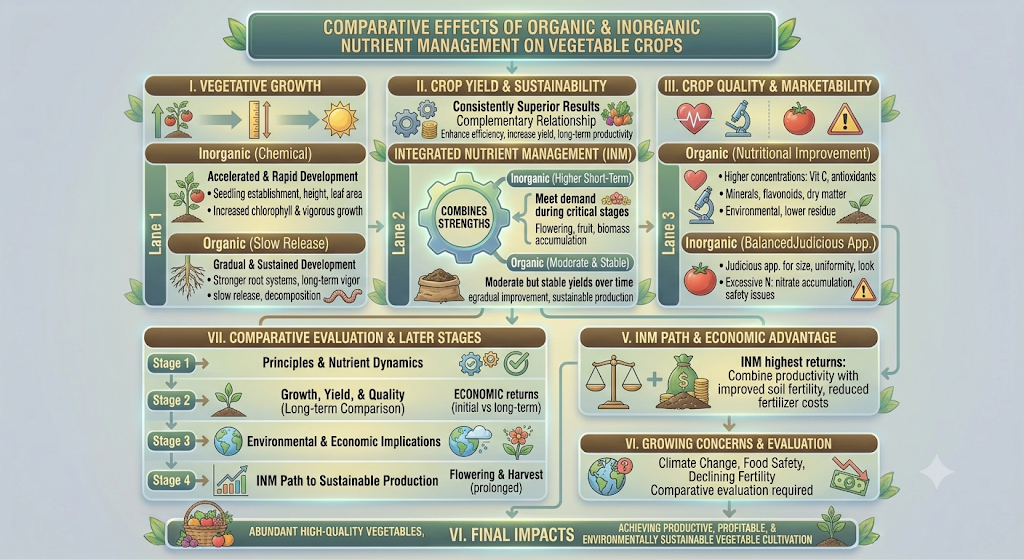
Nutrient management also influences flowering, fruiting, and harvest duration. Organic amendments improve soil moisture retention and microbial activity, supporting prolonged flowering and fruit development. In fruiting vegetables such as tomato, chilli, brinjal, cucumber, and capsicum, integrated nutrient management often enhances fruit size, fruit weight, total soluble solids, shelf life, and overall marketability.
From an economic perspective, inorganic fertilizers provide rapid returns through higher initial yields but require continuous external input purchases. Organic nutrient management reduces dependence on synthetic fertilizers by utilizing locally available organic resources, although larger quantities and additional labor may be required for preparation and application. Integrated nutrient management often offers the highest economic returns by combining increased productivity with improved soil fertility and reduced fertilizer costs over time.
Overall, comparative evaluation indicates that inorganic fertilizers support immediate crop growth and high short-term yields, whereas organic nutrient management enhances soil health, crop quality, and long-term sustainability. Integrated nutrient management successfully combines the strengths of both systems, making it one of the most effective approaches for achieving productive, profitable, and environmentally sustainable vegetable cultivation.
Academic Achievement, Learning Engagement and Educational Equity in Contemporary Education#
The increasing demand for high-quality vegetables and sustainable agricultural practices has intensified the debate regarding the environmental, economic, and long-term sustainability of organic and inorganic nutrient management systems. Although both approaches contribute to crop production, their impacts on soil health, natural resources, environmental quality, and farm profitability differ considerably. Evaluating these perspectives is essential for designing nutrient management strategies that ensure food security while conserving ecological resources.
From an environmental perspective, organic nutrient management is generally regarded as more sustainable because it utilizes renewable biological resources and improves soil ecological functions. Organic amendments such as farmyard manure, compost, vermicompost, green manure, crop residues, and biofertilizers increase soil organic carbon, enhance microbial diversity, and stimulate natural nutrient cycling. Improved soil structure reduces erosion, increases water infiltration, and enhances water-holding capacity, thereby minimizing nutrient losses through runoff and leaching. Organic farming also reduces dependence on synthetic fertilizers, lowering the risk of groundwater contamination and environmental pollution.
In contrast, excessive or unbalanced use of inorganic fertilizers may result in several environmental problems. Large quantities of nitrogen fertilizers can lead to nitrate leaching into groundwater, causing water pollution and potential health risks. Phosphorus runoff contributes to eutrophication of lakes and rivers, promoting excessive algal growth and deterioration of aquatic ecosystems. In addition, nitrogen fertilizer application is associated with emissions of nitrous oxide, a potent greenhouse gas that contributes to climate change. Continuous chemical fertilizer use without adequate organic matter inputs may also reduce soil organic carbon, microbial diversity, and long-term soil fertility.
From a soil health perspective, organic nutrient management provides multiple long-term benefits. Organic amendments improve soil aggregation, porosity, aeration, moisture retention, cation exchange capacity, and biological activity. Beneficial microorganisms such as nitrogen-fixing bacteria, phosphate-solubilizing bacteria, and mycorrhizal fungi enhance nutrient availability and strengthen soil fertility. These improvements create a productive soil ecosystem capable of supporting sustainable vegetable cultivation over successive cropping seasons.
Economically, both systems have distinct advantages and limitations. Inorganic fertilizers provide rapid nutrient availability and generally produce higher short-term yields, making them attractive for commercial vegetable production. Their standardized nutrient composition allows precise nutrient management and predictable crop responses. However, increasing fertilizer prices, repeated application requirements, and dependence on external inputs often raise production costs. Long-term soil degradation resulting from excessive fertilizer use may further reduce profitability.
Organic nutrient management often involves lower expenditure on synthetic fertilizers by utilizing locally available organic materials such as animal manure, crop residues, compost, and farm waste. Although labor requirements for preparation, transportation, and application may be higher, improvements in soil fertility, reduced input dependency, premium market prices for organic vegetables, and enhanced consumer demand frequently improve long-term farm profitability.
Integrated Nutrient Management (INM) provides an economically and environmentally balanced alternative. By combining organic amendments with recommended doses of inorganic fertilizers, INM increases nutrient-use efficiency, reduces fertilizer costs, improves soil fertility, and sustains crop productivity. The integration of biofertilizers and organic matter with chemical fertilizers minimizes nutrient losses while maintaining balanced plant nutrition.
Recent advances in precision nutrient management further enhance sustainability. Technologies such as soil testing, Geographic Information Systems (GIS), Remote Sensing (RS), Internet of Things (IoT) sensors, Artificial Intelligence (AI), drones, and variable-rate fertilizer application enable farmers to apply nutrients according to actual crop requirements. These technologies reduce unnecessary fertilizer use, improve nutrient-use efficiency, lower production costs, and minimize environmental impacts.
Overall, comparative evaluation indicates that while inorganic fertilizers effectively support intensive vegetable production, organic nutrient management contributes significantly to environmental conservation, soil health, and long-term sustainability. Integrated Nutrient Management combines the strengths of both systems and represents the most practical strategy for achieving productive, profitable, and environmentally responsible vegetable production.
Challenges, Integrated Nutrient Management, and Future Prospects#
Although both organic and inorganic nutrient management systems have contributed significantly to vegetable production, each faces several challenges that affect productivity, resource-use efficiency, and long-term sustainability. Addressing these limitations through Integrated Nutrient Management (INM) and modern agricultural technologies is essential for developing resilient and environmentally sustainable vegetable production systems.
One of the major challenges associated with organic nutrient management is the relatively slow release of nutrients. Since nutrients become available only after microbial decomposition and mineralization, they may not meet the immediate nutrient demand of fast-growing vegetable crops such as tomato, cabbage, cauliflower, cucumber, spinach, onion, and potato. Nutrient composition of organic manures also varies depending on the source, decomposition stage, and handling practices, making accurate nutrient management difficult. In addition, large quantities of organic materials are often required to meet crop nutrient requirements, increasing transportation, storage, and labor costs.
In contrast, inorganic nutrient management provides readily available nutrients but presents challenges related to environmental sustainability. Continuous and excessive use of chemical fertilizers may lead to soil acidification, nutrient imbalance, decline in soil organic matter, reduced microbial diversity, groundwater contamination, and greenhouse gas emissions. Inefficient fertilizer application also increases nutrient losses through volatilization, runoff, and leaching, reducing fertilizer-use efficiency and increasing production costs.
To overcome these limitations, Integrated Nutrient Management (INM) has emerged as one of the most effective approaches for sustainable vegetable cultivation. INM combines organic manures, biofertilizers, crop residues, compost, vermicompost, and green manures with recommended doses of inorganic fertilizers to provide balanced plant nutrition. Organic sources improve soil physical, chemical, and biological properties, while inorganic fertilizers supply immediately available nutrients during critical stages of crop growth. This complementary approach improves nutrient-use efficiency, enhances crop productivity, and sustains soil fertility over the long term.
Biofertilizers such as Rhizobium, Azotobacter, Azospirillum, phosphate-solubilizing bacteria (PSB), potassium-solubilizing bacteria (KSB), and arbuscular mycorrhizal fungi (AMF) play an increasingly important role within integrated nutrient management systems. These beneficial microorganisms improve biological nitrogen fixation, nutrient solubilization, root growth, and soil microbial diversity, thereby reducing dependence on synthetic fertilizers while maintaining high crop yields.
Recent advances in precision agriculture are transforming nutrient management practices. Soil nutrient sensors, Geographic Information Systems (GIS), Remote Sensing (RS), Global Positioning System (GPS), Internet of Things (IoT) devices, Artificial Intelligence (AI), drones, and variable-rate fertilizer application systems enable farmers to apply nutrients according to spatial and temporal crop requirements. Precision nutrient management minimizes fertilizer wastage, improves nutrient-use efficiency, reduces environmental pollution, and increases economic returns.
Future research is increasingly focused on developing climate-smart nutrient management strategies capable of maintaining productivity under changing climatic conditions. Innovations such as nano-fertilizers, slow-release fertilizers, controlled-release nutrient formulations, microbial consortia, biochar-based fertilizers, and AI-supported decision-support systems are expected to improve nutrient efficiency while reducing environmental impacts. These technologies will enhance nutrient availability, reduce greenhouse gas emissions, and support resilient vegetable production systems. Government policies promoting soil testing, balanced fertilizer use, organic farming, integrated nutrient management, precision agriculture, farmer training, and financial incentives will be critical for encouraging widespread adoption. Strengthening agricultural extension services, research institutions, and public-private partnerships will facilitate technology transfer and improve farmer awareness regarding sustainable nutrient management practices.
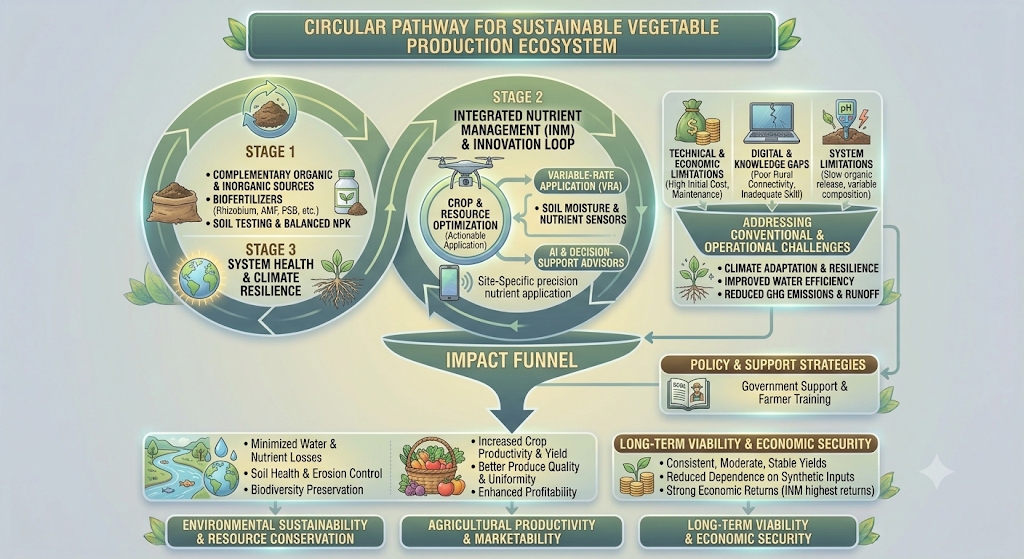
Overall, Integrated Nutrient Management represents the most practical and scientifically validated approach for combining the advantages of organic and inorganic nutrient sources. Supported by modern technologies and appropriate policy interventions, it offers a sustainable pathway toward improving vegetable productivity, conserving soil health, protecting the environment, and ensuring long-term agricultural sustainability.
Conclusion#
Efficient nutrient management is fundamental to achieving high productivity, superior quality, and long-term sustainability in vegetable crop production. This comparative evaluation demonstrates that both organic and inorganic nutrient management systems play important roles in supplying essential nutrients required for plant growth, development, and yield. However, their effectiveness differs with respect to nutrient availability, soil health, environmental impact, economic returns, and sustainability.
Inorganic fertilizers provide readily available nutrients that support rapid vegetative growth, early crop establishment, and high short-term yields. Their precise nutrient composition allows farmers to correct nutrient deficiencies quickly and achieve predictable crop responses. Nevertheless, excessive and continuous dependence on chemical fertilizers can adversely affect soil fertility, reduce soil organic matter, increase nutrient losses, contribute to greenhouse gas emissions, and contaminate water resources through leaching and runoff. These environmental concerns highlight the need for more balanced nutrient management practices.
Organic nutrient management offers several long-term advantages by improving soil structure, increasing soil organic carbon, enhancing microbial diversity, and promoting natural nutrient cycling. Organic amendments such as farmyard manure, compost, vermicompost, green manure, crop residues, and biofertilizers improve soil fertility while producing vegetables with enhanced nutritional quality and reduced chemical residues. Although nutrient release from organic sources is slower and may not always satisfy the immediate nutrient demand of intensive vegetable crops, their contribution to sustainable agriculture remains significant.
Among the different approaches, Integrated Nutrient Management (INM) has emerged as the most effective strategy because it combines the strengths of both organic and inorganic nutrient sources. Organic amendments maintain soil health and improve nutrient retention, while inorganic fertilizers provide readily available nutrients during critical crop growth stages. This integrated approach improves nutrient-use efficiency, enhances crop productivity, maintains long-term soil fertility, reduces fertilizer losses, and minimizes environmental degradation.
The adoption of modern technologies further strengthens sustainable nutrient management. Precision agriculture tools such as Geographic Information Systems (GIS), Remote Sensing (RS), Internet of Things (IoT), Artificial Intelligence (AI), drone-based monitoring, soil nutrient sensors, and decision-support systems enable site-specific fertilizer application according to crop requirements. These technologies improve fertilizer-use efficiency, reduce production costs, and minimize environmental pollution while maintaining high yields.
Despite considerable progress, several challenges remain, including inconsistent nutrient availability from organic materials, rising fertilizer costs, declining soil fertility, climate variability, limited farmer awareness, and inadequate extension services. Continued research, quality standards, farmer training, and supportive government policies are essential to encourage wider adoption of sustainable nutrient management practices.
In conclusion, neither organic nor inorganic nutrient management alone can fully address the challenges of modern vegetable production. A balanced approach through Integrated Nutrient Management, supported by precision agriculture and climate-smart technologies, provides the most sustainable solution for achieving high productivity, improved vegetable quality, environmental conservation, and long-term soil health. Such integrated strategies will play a vital role in ensuring food security, enhancing farmer livelihoods, and promoting resilient agricultural systems capable of meeting future global nutritional demands.
Works Cited#
- Food and Agriculture Organization. (2022). The State of Food and Agriculture 2022. FAO.
- Brady, N. C., & Weil, R. R. (2017). The Nature and Properties of Soils (15th ed.). Pearson.
- Tisdale, S. L., Nelson, W. L., Beaton, J. D., & Havlin, J. L. (2018). Soil Fertility and Fertilizers. Pearson.
- Indian Council of Agricultural Research. (2022). Integrated Nutrient Management for Vegetable Crops. ICAR.
- National Horticulture Board. (2023). Indian Horticulture Database. Government of India.
- Fageria, N. K. (2014). Nitrogen Management in Crop Production. CRC Press.
- Palm, C., Myers, R., & Nandwa, S. (1997). Combined Use of Organic and Inorganic Nutrient Sources. Replenishing Soil Fertility in Africa, 193–217.
- Giller, K. E. (2001). Nitrogen Fixation in Tropical Cropping Systems. CABI.
- Singh, G., et al. (2021). Integrated Nutrient Management in Vegetable Crops. Indian Journal of Agricultural Sciences.
- FAO. (2021). Soil Fertility Management Guidelines. FAO.
- World Bank. (2023). Climate-Smart Agriculture for Sustainable Food Systems. World Bank.
- IPCC. (2023). Climate Change 2023: Synthesis Report. IPCC.
- Liakos, K. G., Busato, P., Moshou, D., Pearson, S., & Bochtis, D. (2018). Machine Learning in Agriculture. Sensors, 18(8), 2674.
- Wolfert, S., Ge, L., Verdouw, C., & Bogaardt, M. J. (2017). Big Data in Smart Farming. Agricultural Systems, 153, 69–80.
- ESRI. (2023). ArcGIS Pro Documentation. Environmental Systems Research Institute.
- CABI. (2022). Soil Fertility and Nutrient Management Compendium. CAB International.
- Journal of Plant Nutrition. (2023). Organic and Inorganic Nutrient Management in Vegetable Crops. Journal of Plant Nutrition.
- Agricultural Reviews. (2023). Advances in Integrated Nutrient Management. Agricultural Reviews.
- Scientia Horticulturae. (2023). Sustainable Nutrient Management for Vegetable Production. Scientia Horticulturae.
- Frontiers in Sustainable Food Systems. (2023). Precision Nutrient Management and Sustainable Agriculture. Frontiers in Sustainable Food Systems.