Abstract
Vermicompost has emerged as one of the most effective organic soil amendments for improving soil quality, enhancing crop productivity, and promoting sustainable agricultural practices. Produced through the biological decomposition of organic wastes by earthworms and associated microorganisms, vermicompost is rich in essential plant nutrients, beneficial microorganisms, humic substances, enzymes, and plant growth regulators. Unlike conventional organic manures, vermicompost possesses superior physical, chemical, and biological properties that improve soil fertility while reducing dependence on synthetic fertilizers. Numerous studies have demonstrated that the application of vermicompost significantly enhances soil structure, water-holding capacity, aeration, porosity, cation exchange capacity, and microbial activity. It also increases the availability of essential nutrients such as nitrogen, phosphorus, potassium, calcium, magnesium, and micronutrients, thereby improving nutrient uptake and crop performance. In addition to improving soil physico-chemical characteristics, vermicompost stimulates root development, photosynthesis, flowering, fruiting, and overall crop productivity through the release of plant growth-promoting substances. Its continuous application contributes to long-term soil health, carbon sequestration, and environmental sustainability by recycling organic wastes and minimizing chemical fertilizer use. However, large-scale adoption of vermicompost is constrained by factors such as limited production capacity, labor-intensive preparation, transportation costs, and inconsistent quality. This paper examines the influence of vermicompost application on soil physico-chemical properties and crop productivity, highlighting its mechanisms of action, agronomic benefits, challenges, and future prospects as an important component of sustainable and climate-resilient agriculture.
- Vermicompost
- Soil Fertility
- Soil Physico-Chemical Properties
- Crop Productivity
- Earthworms
- Organic Farming
- Sustainable Agriculture
- Nutrient Availability
- Soil Health
- Organic Amendments
Introduction#
The increasing demand for food production, coupled with concerns over environmental degradation and declining soil fertility, has intensified the search for sustainable agricultural practices that enhance productivity without compromising natural resources. Intensive cultivation and the excessive use of chemical fertilizers have significantly increased crop yields over the past several decades; however, these practices have also contributed to soil degradation, nutrient imbalance, reduced organic matter content, declining microbial diversity, groundwater contamination, and loss of ecosystem services. Consequently, the adoption of environmentally friendly soil management practices has become essential for ensuring long-term agricultural sustainability. Among the various organic soil amendments available, vermicompost has gained widespread recognition due to its remarkable ability to improve soil health and crop productivity.
Vermicompost is a nutrient-rich organic fertilizer produced through the decomposition of biodegradable organic materials by earthworms and associated microorganisms. Earthworm species such as *Eisenia fetida*, *Eudrilus eugeniae*, and *Perionyx excavatus* convert agricultural residues, animal manures, kitchen waste, and other organic materials into a finely stabilized product known as vermicompost. Compared with conventional compost, vermicompost contains higher concentrations of plant-available nutrients, beneficial microorganisms, humic substances, vitamins, enzymes, amino acids, and plant growth regulators. These components collectively improve soil fertility and stimulate plant growth through multiple biological and biochemical processes.
The application of vermicompost positively influences both the physical and chemical properties of soil. It enhances soil aggregation, reduces bulk density, increases porosity, improves water-holding capacity, and facilitates better root penetration. Chemically, vermicompost enriches the soil with essential macronutrients such as nitrogen, phosphorus, potassium, calcium, magnesium, and sulfur, as well as micronutrients including iron, zinc, manganese, copper, and boron. It also increases cation exchange capacity, buffers soil pH, and enhances nutrient retention, thereby improving nutrient availability throughout the crop growth period.
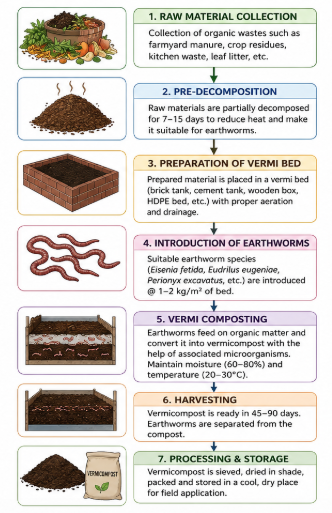
Figure: Vermicompost Production Process
In addition to its beneficial effects on soil properties, vermicompost significantly improves crop growth and productivity. Numerous studies have reported enhanced seed germination, vigorous root development, increased plant height, higher chlorophyll content, improved flowering, greater fruit and grain yield, and better produce quality following vermicompost application. These benefits are largely attributed to improved nutrient availability, enhanced microbial activity, and the presence of naturally occurring plant growth-promoting substances such as auxins, gibberellins, and cytokinins.
Vermicompost also contributes to environmental sustainability by recycling biodegradable wastes into valuable organic fertilizer. This process reduces landfill accumulation, minimizes greenhouse gas emissions associated with waste disposal, and lowers dependence on synthetic fertilizers whose production is energy-intensive and environmentally damaging. Furthermore, regular application of vermicompost improves soil organic carbon sequestration and promotes biodiversity by supporting beneficial soil microorganisms and earthworm populations.
Despite these advantages, several factors continue to limit the widespread adoption of vermicompost. Production requires appropriate earthworm species, suitable organic substrates, careful moisture management, and considerable labor inputs. Large-scale commercialization is often constrained by limited production capacity, transportation costs, quality variability, and insufficient awareness among farmers. Addressing these challenges through technological innovations, quality standards, extension services, and policy support will be essential for expanding vermicompost use in modern agriculture.
Considering its numerous agronomic, environmental, and economic benefits, vermicompost has become an indispensable component of sustainable nutrient management and organic farming systems. This paper examines the influence of vermicompost application on soil physico-chemical properties and crop productivity by evaluating its production processes, mechanisms of action, effects on soil quality, crop performance, and future prospects for sustainable agricultural development.
Vermicompost: Production, Composition, and Characteristics#
Vermicompost is a biologically stabilized organic manure produced through the joint action of earthworms and microorganisms during the decomposition of organic waste materials. It is considered one of the most efficient and environmentally friendly organic fertilizers because it converts biodegradable waste into a nutrient-rich product that enhances soil fertility and promotes sustainable crop production. Compared with traditional compost, vermicompost contains higher concentrations of available nutrients, beneficial microorganisms, enzymes, vitamins, humic substances, and plant growth-promoting compounds, making it an ideal amendment for improving soil health and agricultural productivity.
The production of vermicompost begins with the collection of suitable organic materials such as farmyard manure, crop residues, vegetable and fruit wastes, kitchen waste, sugarcane trash, leaf litter, sawdust, and other biodegradable agricultural by-products. These materials are partially decomposed before introducing earthworms to reduce excessive heat generated during the initial stages of decomposition. Partial decomposition creates a favorable environment for earthworm survival and accelerates the conversion of organic matter into fine, stable vermicompost.
Several earthworm species are commonly used in vermicomposting, including Eisenia fetida (red wiggler), Eudrilus eugeniae (African nightcrawler), and Perionyx excavatus (Indian blue earthworm). These species are highly efficient decomposers due to their rapid feeding, reproduction, and adaptability to different environmental conditions. Earthworms consume organic matter, which is fragmented and digested within their alimentary canal. During digestion, microorganisms and digestive enzymes break down complex organic compounds into simpler forms. The resulting casts, commonly referred to as vermicast, contain finely processed organic matter enriched with readily available nutrients and beneficial microbial populations.
The vermicomposting process generally requires adequate moisture (60–80%), moderate temperatures ranging between 20°C and 30°C, proper aeration, and protection from direct sunlight and heavy rainfall. Under favorable conditions, mature vermicompost can be produced within 45 to 90 days, depending on the type of substrate, earthworm species, and environmental conditions. The final product is dark brown to black in color, has a granular texture, possesses an earthy smell, and is free from unpleasant odors, indicating complete stabilization of organic matter.
Vermicompost is characterized by its rich nutrient composition. It contains appreciable quantities of essential macronutrients such as nitrogen (N), phosphorus (P), potassium (K), calcium (Ca), magnesium (Mg), and sulfur (S), along with micronutrients including iron (Fe), zinc (Zn), manganese (Mn), copper (Cu), and boron (B). These nutrients are present in plant-available forms, allowing crops to absorb them efficiently throughout the growing season. The slow and steady release of nutrients minimizes losses through leaching and volatilization while improving nutrient-use efficiency.
In addition to mineral nutrients, vermicompost contains abundant populations of beneficial microorganisms, including nitrogen-fixing bacteria, phosphate-solubilizing bacteria, actinomycetes, fungi, and other decomposers that continue to improve soil biological activity after application. It also contains humic acids, fulvic acids, amino acids, vitamins, enzymes, and naturally occurring plant growth regulators such as auxins, gibberellins, and cytokinins. These bioactive compounds stimulate seed germination, root development, cell division, flowering, and overall plant growth.
The physical characteristics of vermicompost also contribute significantly to soil improvement. Its porous structure increases soil aeration, enhances water-holding capacity, improves aggregation, and reduces bulk density. These properties create favorable conditions for root growth and microbial activity while minimizing soil compaction and erosion. Furthermore, vermicompost exhibits a high cation exchange capacity, enabling the soil to retain and gradually release nutrients according to crop requirements. One of the most important advantages of vermicompost is its environmentally sustainable nature. It promotes the recycling of agricultural and household organic wastes, reducing landfill accumulation and environmental pollution. By converting waste into valuable organic fertilizer, vermicomposting supports circular agriculture and reduces dependence on chemical fertilizers.
Overall, the production process, nutrient-rich composition, and superior physical, chemical, and biological characteristics make vermicompost an indispensable organic amendment for sustainable agriculture. Its application not only improves soil fertility but also enhances crop productivity, environmental quality, and long-term agricultural resilience.
Influence of Vermicompost on Soil Physico-Chemical Properties#
The application of vermicompost has a profound influence on the physico-chemical properties of soil, making it one of the most valuable organic amendments for sustainable agriculture. Soil quality determines the productivity and resilience of cropping systems, and continuous use of chemical fertilizers without adequate organic inputs often leads to declining soil fertility, poor structure, nutrient imbalance, and reduced biological activity. Vermicompost addresses these issues by improving the physical, chemical, and biological characteristics of soil, thereby creating a favorable environment for plant growth and nutrient uptake.
One of the most significant physical benefits of vermicompost is its ability to improve soil structure. The organic matter present in vermicompost binds soil particles into stable aggregates, enhancing soil aggregation and reducing the risk of compaction. Well-aggregated soils possess better porosity, allowing improved movement of air and water throughout the root zone. Enhanced soil structure also facilitates deeper root penetration, enabling plants to access nutrients and moisture more efficiently. Vermicompost significantly reduces bulk density while increasing soil porosity. Lower bulk density creates loose and friable soil conditions that support seed germination and unrestricted root development. Increased pore spaces improve soil aeration by allowing oxygen to reach plant roots and beneficial microorganisms. Proper aeration promotes root respiration and stimulates microbial decomposition of organic matter, thereby enhancing nutrient cycling within the soil ecosystem.
Another important contribution of vermicompost is the improvement of water-holding capacity. Organic matter present in vermicompost acts like a sponge, absorbing and retaining substantial quantities of water. This stored moisture becomes available to plants during dry periods, reducing irrigation requirements and improving drought tolerance. Enhanced moisture retention is particularly beneficial in sandy soils, which typically exhibit poor water-holding capacity. Improved water infiltration also minimizes surface runoff and soil erosion, thereby conserving valuable topsoil.
Chemically, vermicompost enriches soil with a wide range of essential plant nutrients. It contains readily available forms of nitrogen, phosphorus, potassium, calcium, magnesium, sulfur, and important micronutrients such as zinc, iron, copper, manganese, and boron. Unlike synthetic fertilizers that release nutrients rapidly, vermicompost provides a slow and continuous supply of nutrients throughout the crop growth cycle. This gradual nutrient release reduces nutrient losses through leaching and volatilization while increasing fertilizer-use efficiency. Vermicompost also enhances the cation exchange capacity (CEC) of soil. Higher CEC enables soil particles to retain positively charged nutrient ions, preventing their loss through drainage and making them available for plant uptake over longer periods. Improved nutrient retention contributes to balanced plant nutrition and sustained soil fertility.
The application of vermicompost positively influences soil pH, particularly in degraded or acidic soils. The buffering capacity of organic matter moderates fluctuations in soil acidity and alkalinity, creating a more favorable environment for nutrient availability and microbial activity. Balanced soil pH increases the availability of phosphorus and micronutrients while reducing the toxicity of certain harmful elements such as aluminum in acidic soils. An equally important effect of vermicompost is its ability to stimulate soil biological activity. It introduces diverse populations of beneficial microorganisms, including bacteria, fungi, actinomycetes, and enzymes that participate in organic matter decomposition and nutrient mineralization. These microorganisms improve nitrogen fixation, phosphorus solubilization, and decomposition of organic residues, thereby accelerating nutrient cycling. Increased microbial diversity also suppresses soil-borne pathogens, contributing to healthier crop growth.
Vermicompost further enhances soil organic carbon by increasing the accumulation of stable organic matter. Higher organic carbon improves soil fertility, promotes carbon sequestration, and strengthens the resilience of agricultural soils against climate change. Organic carbon also supports long-term soil productivity by improving aggregate stability, nutrient retention, and moisture conservation. Numerous field studies have demonstrated that regular application of vermicompost leads to sustained improvements in soil fertility and productivity across a wide range of cropping systems. When integrated with balanced fertilization and other sustainable management practices, vermicompost significantly enhances soil quality while reducing dependence on synthetic fertilizers.
Overall, vermicompost serves as an effective soil conditioner that improves the physical, chemical, and biological properties of soil. Its ability to enhance soil structure, nutrient availability, water retention, microbial activity, and long-term fertility makes it an indispensable component of sustainable soil management and environmentally responsible agricultural production.
Effect of Vermicompost on Crop Growth and Productivity#
Vermicompost has been widely recognized for its positive effects on crop growth, development, yield, and produce quality across a diverse range of agricultural crops. The nutrient-rich composition of vermicompost, combined with its beneficial microorganisms, humic substances, enzymes, and plant growth regulators, creates an ideal environment for healthy plant development. Its regular application enhances physiological, biochemical, and metabolic activities within plants, resulting in increased productivity and improved crop quality.
One of the earliest responses to vermicompost application is improved seed germination and seedling establishment. The readily available nutrients and growth-promoting compounds present in vermicompost stimulate early root emergence and vigorous seedling growth. Healthy seedlings establish quickly, enabling plants to utilize soil moisture and nutrients more efficiently during subsequent growth stages.
Vermicompost significantly enhances vegetative growth by improving nutrient availability and stimulating root development. Crops receiving vermicompost often exhibit greater plant height, increased leaf area, higher chlorophyll content, stronger stems, and greater dry matter accumulation compared to untreated crops. Enhanced chlorophyll synthesis increases photosynthetic efficiency, enabling plants to produce more carbohydrates that support continuous vegetative and reproductive growth. The beneficial microorganisms present in vermicompost also improve root architecture by promoting root elongation, branching, and root hair formation. A well-developed root system increases the plant's capacity to absorb water and nutrients from a larger volume of soil. Consequently, crops become more resilient to drought stress, nutrient deficiencies, and adverse environmental conditions. Numerous studies have demonstrated significant improvements in flowering, fruiting, and grain formation following vermicompost application. Plant growth regulators such as auxins, gibberellins, and cytokinins naturally present in vermicompost stimulate cell division, flowering initiation, fruit set, and seed development. Improved nutrient availability during reproductive stages contributes to higher numbers of flowers, pods, grains, or fruits, ultimately increasing crop yield.
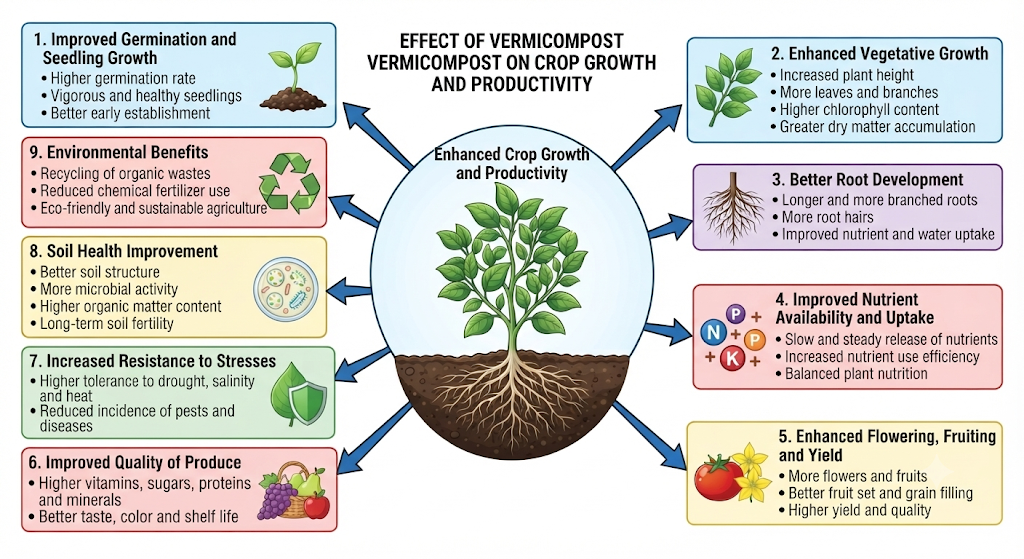
Major field crops such as rice, wheat, maize, sorghum, pearl millet, soybean, chickpea, pigeon pea, mustard, sunflower, groundnut, sugarcane, and cotton have shown remarkable yield improvements following vermicompost application. In cereal crops, vermicompost increases tillering, ear length, grain number, grain weight, and overall grain yield. Leguminous crops exhibit improved nodulation, pod formation, seed weight, and protein content, while oilseed crops produce higher seed yield and oil quality due to balanced nutrient availability. Vermicompost also improves the quality of agricultural produce. Fruits and vegetables grown with vermicompost often contain higher concentrations of vitamins, sugars, antioxidants, proteins, and essential minerals. Improved nutritional quality increases market value while enhancing consumer health. In addition, vermicompost reduces nitrate accumulation in edible plant parts, making produce safer for consumption. Another important benefit is the increased resistance of crops to pests, diseases, and environmental stresses. Beneficial microorganisms suppress harmful pathogens through competition and the production of antimicrobial compounds. Improved soil health and balanced plant nutrition strengthen natural plant defense mechanisms, reducing disease incidence and minimizing the need for chemical pesticides. The integration of vermicompost with chemical fertilizers and other organic amendments under integrated nutrient management systems often produces superior results compared to the application of either source alone. Vermicompost enhances fertilizer-use efficiency by reducing nutrient losses and maintaining nutrient availability over extended periods. This integrated approach lowers production costs while improving soil fertility and environmental sustainability.Long-term field experiments have consistently demonstrated that continuous vermicompost application contributes to stable crop productivity by maintaining soil health and nutrient balance. Unlike excessive chemical fertilizer use, which may gradually deteriorate soil quality, vermicompost supports sustainable agricultural production through continuous improvement of soil biological activity and organic matter content.
Overall, vermicompost significantly enhances crop growth, yield, and quality by improving nutrient availability, root development, photosynthetic activity, and resistance to environmental stresses. Its widespread adoption offers an environmentally friendly strategy for achieving sustainable agricultural productivity while maintaining long-term soil fertility and ecosystem health.
Challenges, Limitations, and Future Prospects of Vermicompost Application#
Vermicompost has gained widespread recognition as an effective organic amendment for improving soil fertility, enhancing crop productivity, and promoting sustainable agriculture. Despite its numerous agronomic and environmental benefits, the large-scale adoption of vermicompost remains constrained by several technical, economic, and institutional challenges. Understanding these limitations is essential for developing appropriate strategies that encourage wider adoption and maximize the benefits of vermicompost in modern farming systems. One of the primary challenges associated with vermicompost production is the availability of suitable organic raw materials. Although agricultural residues, animal manure, kitchen waste, and agro-industrial by-products are commonly used, their availability varies across regions and seasons. In many rural areas, crop residues are utilized as livestock feed, fuel, or bedding material, leaving limited quantities for vermicomposting. Similarly, inconsistent waste segregation in urban areas often results in contamination of organic materials with plastics, metals, and other non-biodegradable substances, reducing the quality of the final product. Another major limitation is the labor-intensive nature of vermicompost production. Successful vermicomposting requires regular monitoring of moisture, temperature, aeration, and earthworm health. Earthworms are highly sensitive to unfavorable environmental conditions such as excessive heat, waterlogging, direct sunlight, and chemical contamination. Maintaining optimal conditions demands continuous supervision and skilled labor, making large-scale production more challenging than conventional composting.
The slow production process also limits the commercial availability of vermicompost. Depending on the substrate, earthworm species, and environmental conditions, the conversion of organic waste into mature vermicompost generally takes between 45 and 90 days. This relatively long production period may not satisfy the high nutrient demand of intensive cropping systems, especially during peak planting seasons. Economic factors further influence adoption. Although vermicompost reduces long-term fertilizer costs, the initial investment required for constructing vermicomposting units, purchasing earthworms, and establishing infrastructure may discourage small and marginal farmers. Transportation costs also become significant because vermicompost has a relatively high bulk density compared with concentrated chemical fertilizers. These costs increase further when production units are located far from agricultural fields.
Quality variability is another important concern. The nutrient composition of vermicompost depends largely on the type of organic waste used, earthworm species, composting methods, and management practices. Lack of standardized production protocols may result in products with inconsistent nutrient concentrations and microbial populations. Inadequate quality control can reduce farmer confidence and limit commercial acceptance. Establishing national quality standards and certification systems would improve product reliability and market competitiveness. Limited awareness and extension support also restrict widespread adoption. Many farmers remain unfamiliar with the agronomic benefits, application methods, recommended doses, and economic advantages of vermicompost. Inadequate extension services, limited demonstration programs, and insufficient technical guidance reduce farmers' willingness to replace or supplement chemical fertilizers with organic alternatives. Strengthening agricultural extension systems and conducting farmer training programs are essential for increasing awareness and adoption.
Despite these constraints, the future prospects of vermicompost remain highly encouraging. Growing global interest in organic farming, regenerative agriculture, climate-smart agriculture, and sustainable nutrient management has substantially increased the demand for high-quality organic amendments. Governments and international organizations are increasingly promoting vermicomposting as an effective waste management strategy that supports circular economy principles while improving agricultural sustainability.
Recent technological advancements are making vermicompost production more efficient and commercially viable. Mechanized shredding, automated moisture control systems, improved vermibeds, and enhanced earthworm breeding techniques have increased production efficiency and product consistency. Integration of vermicompost with biofertilizers, microbial inoculants, and precision nutrient management offers additional opportunities to enhance crop productivity while reducing dependence on chemical fertilizers. Future research should focus on developing standardized production technologies, identifying highly efficient earthworm species, improving nutrient enrichment techniques, and evaluating crop-specific application rates under different agro-climatic conditions. Supportive government policies, financial incentives, quality certification, and strengthened farmer education programs will further encourage adoption.
Overall, while vermicompost application faces several production and adoption challenges, continuous technological innovation, policy support, and growing environmental awareness position it as a key component of sustainable agriculture and integrated nutrient management systems.
Conclusion#
Vermicompost has emerged as one of the most valuable organic amendments for achieving sustainable agricultural production while improving soil health and environmental quality. Produced through the biological activity of earthworms and beneficial microorganisms, vermicompost provides a rich source of plant nutrients, organic matter, microbial populations, enzymes, and naturally occurring plant growth regulators. These characteristics distinguish it from conventional organic manures and make it an effective tool for enhancing soil fertility and crop productivity. The discussion presented in this paper demonstrates that vermicompost significantly improves the physical, chemical, and biological properties of soil. It enhances soil aggregation, reduces bulk density, increases porosity, improves water-holding capacity, and promotes better root penetration. Chemically, vermicompost enriches the soil with essential macro- and micronutrients while increasing cation exchange capacity and buffering soil pH. These improvements ensure greater nutrient availability, reduced nutrient losses, and enhanced fertilizer-use efficiency throughout the crop growth cycle.
Vermicompost also plays a crucial role in stimulating soil biological activity. The introduction of beneficial microorganisms accelerates organic matter decomposition, nutrient mineralization, nitrogen fixation, phosphorus solubilization, and overall nutrient cycling. Enhanced microbial diversity creates a healthy rhizosphere environment that supports vigorous root growth and suppresses several soil-borne pathogens. Consequently, continuous vermicompost application contributes to long-term soil fertility and improved ecosystem resilience. The positive effects of vermicompost on crop growth and productivity are equally significant. Numerous studies have confirmed improvements in seed germination, vegetative growth, chlorophyll content, flowering, fruiting, grain formation, and overall crop yield across cereals, pulses, oilseeds, vegetables, fruits, and commercial crops. The presence of plant growth-promoting substances such as auxins, gibberellins, and cytokinins further enhances physiological processes that support healthy crop development. In addition, vermicompost improves the nutritional quality of agricultural produce while increasing resistance to pests, diseases, and environmental stresses. From an environmental perspective, vermicompost offers multiple ecological benefits by recycling biodegradable wastes into valuable organic fertilizer. This process reduces landfill accumulation, minimizes environmental pollution, lowers greenhouse gas emissions associated with waste disposal and chemical fertilizer production, and promotes carbon sequestration in agricultural soils. These contributions make vermicompost an essential component of climate-smart and environmentally sustainable farming systems.
Despite its numerous advantages, several factors continue to limit widespread adoption. Limited availability of quality organic raw materials, labor-intensive production methods, inconsistent product quality, transportation costs, inadequate farmer awareness, and lack of standardized production protocols remain important challenges. Addressing these constraints requires coordinated efforts involving scientific research, technological innovation, extension services, quality assurance systems, and supportive government policies. Financial incentives, training programs, and improved market infrastructure can further encourage farmers to adopt vermicompost-based nutrient management. Future developments in mechanized vermicomposting, enriched vermicompost formulations, microbial fortification, and integration with biofertilizers and precision agriculture technologies are expected to enhance the effectiveness and commercial viability of vermicompost. Continued research on crop-specific recommendations and region-specific production techniques will strengthen its role in sustainable agriculture.
In conclusion, vermicompost represents an environmentally safe, economically feasible, and scientifically validated approach to improving soil physico-chemical properties and crop productivity. Its widespread adoption can contribute significantly to sustainable food production, conservation of natural resources, waste recycling, and long-term agricultural resilience. Promoting vermicompost through research, education, policy support, and farmer participation will be essential for ensuring productive and environmentally responsible agricultural systems in the future.
Works Cited#
- Atiyeh, R. M., Arancon, N. Q., Edwards, C. A., & Metzger, J. D. (2002). The influence of earthworm-processed pig manure on plant growth and productivity. Bioresource Technology, 84(1), 7–14.
- Arancon, N. Q., & Edwards, C. A. (Eds.). (2011). Vermiculture Technology: Earthworms, Organic Wastes, and Environmental Management. CRC Press.
- Chaoui, H. I., Zibilske, L. M., & Ohno, T. (2003). Effects of earthworm casts and compost on soil microbial activity and plant growth. Soil Biology and Biochemistry, 35(2), 295–302.
- Domínguez, J., & Edwards, C. A. (2011). Biology and ecology of earthworm species used for vermicomposting. In Vermiculture Technology. CRC Press.
- Edwards, C. A., Arancon, N. Q., & Sherman, R. (2011). Vermiculture Technology. CRC Press.
- Gajalakshmi, S., & Abbasi, S. A. (2004). Earthworms and vermicomposting. Indian Journal of Biotechnology, 3(4), 486–494.
- Lazcano, C., & Domínguez, J. (2011). The use of vermicompost in sustainable agriculture. In Soil Nutrients. Nova Science Publishers.
- Lim, S. L., Lee, L. H., & Wu, T. Y. (2016). Sustainability of using composting and vermicomposting technologies. Journal of Cleaner Production, 111, 262–278.
- Pathma, J., & Sakthivel, N. (2012). Microbial diversity of vermicompost bacteria. SpringerPlus, 1, 26.
- Sinha, R. K., Herat, S., Bharambe, G., & Brahambhatt, A. (2009). Vermiculture and sustainable agriculture. American-Eurasian Journal of Agricultural & Environmental Sciences, 5, 1–55.
- Singh, R., Sharma, R. R., Kumar, S., Gupta, R. K., & Patil, R. T. (2008). Vermicompost substitution influences growth and yield. Bioresource Technology, 99(17), 8505–8511.
- Srivastava, P., Gupta, M., & Sharma, S. (2012). Vermicompost and soil fertility. Journal of Environmental Biology, 33(3), 607–612.
- Subler, S., Edwards, C. A., & Metzger, J. D. (1998). Comparing vermicomposts and composts. Bioresource Technology, 66(1), 63–70.
- Tripathi, G., & Bhardwaj, P. (2004). Comparative studies on vermicomposting. Bioresource Technology, 92(3), 275–283.
- Yadav, A., Gupta, R., Garg, V. K., & Prakash, K. (2013). Vermicomposting process and nutrient dynamics. Waste Management, 33(6), 1320–1330.
- Ansari, A. A., & Ismail, S. A. (2012). Role of earthworms in sustainable agriculture. International Journal of Agricultural Research, 7(1), 1–18.
- Gupta, P. K. (2016). Soil, Plant, Water and Fertilizer Analysis. Agrobios.
- Brady, N. C., & Weil, R. R. (2017). The Nature and Properties of Soils (15th ed.). Pearson.
- Food and Agriculture Organization. (2021). Soil Management and Sustainable Crop Production. FAO.
- Lal, R. (2020). Soil organic matter and sustainable agriculture. Journal of Soil and Water Conservation, 75(5), 123A–128A.