Abstract
Organic and conventional farming systems represent two major agricultural approaches adopted worldwide to meet the growing demand for food while addressing concerns related to environmental sustainability, soil health, and agricultural productivity. Conventional farming primarily depends on synthetic fertilizers, chemical pesticides, herbicides, and intensive cultivation practices to maximize crop yield. In contrast, organic farming emphasizes ecological balance through the use of organic manures, compost, crop rotation, biological pest management, and conservation of biodiversity. Although conventional agriculture generally achieves higher short-term yields, its long-term dependence on chemical inputs has raised concerns regarding soil degradation, biodiversity loss, groundwater contamination, and declining soil fertility. Organic farming offers several environmental advantages by improving soil organic matter, enhancing microbial diversity, increasing nutrient cycling, and reducing chemical pollution, but it may face challenges related to lower yields and greater labor requirements under certain conditions. This study presents a comparative assessment of organic and conventional farming systems with particular emphasis on crop performance and soil health. It examines the principles and characteristics of both farming systems, evaluates their influence on crop productivity, soil physical, chemical, and biological properties, analyzes technological innovations supporting sustainable agriculture, and discusses future policy directions for promoting resilient agricultural systems. The study concludes that integrating the strengths of both farming approaches through scientifically balanced management practices can improve agricultural productivity while conserving natural resources. Sustainable farming strategies supported by technological innovation, farmer education, and effective policy interventions are essential for ensuring long-term food security, environmental conservation, and resilient agricultural development.
- Organic Farming
- Conventional Farming
- Crop Performance
- Soil Health
- Sustainable Agriculture
- Soil Fertility
- Organic Manure
- Chemical Fertilizers
- Biodiversity
- Soil Microorganisms
Introduction#
Agriculture plays a fundamental role in ensuring global food security, supporting rural livelihoods, and contributing to economic development. Over the past century, agricultural production has increased dramatically due to scientific advancements, improved crop varieties, mechanization, irrigation, and the widespread use of chemical fertilizers and pesticides. Conventional farming systems have been particularly successful in increasing crop productivity and meeting the food demands of rapidly growing populations. However, intensive agricultural practices have also generated numerous environmental challenges, including declining soil fertility, soil erosion, groundwater contamination, biodiversity loss, greenhouse gas emissions, and reduced ecosystem resilience. Continuous dependence on synthetic fertilizers and pesticides has altered soil biological activity, disrupted nutrient cycling, and contributed to long-term degradation of agricultural ecosystems. These concerns have stimulated growing interest in sustainable farming systems capable of maintaining agricultural productivity while conserving natural resources and protecting environmental quality.
Organic farming has emerged as one of the most important alternatives to conventional agriculture by emphasizing ecological sustainability, soil conservation, biodiversity enhancement, and reduced dependence on synthetic chemical inputs. Organic agriculture relies primarily on natural nutrient sources such as farmyard manure, compost, vermicompost, green manure, crop residues, and biofertilizers to maintain soil fertility. Pest and disease management is achieved through biological control, crop rotation, resistant crop varieties, botanical pesticides, and ecological farming practices rather than synthetic pesticides. These practices improve soil organic matter, stimulate microbial activity, enhance nutrient cycling, increase water-holding capacity, and promote ecological balance. Consequently, organic farming contributes to healthier soils, improved environmental quality, reduced chemical residues, and enhanced biodiversity. Consumer demand for organically produced food has also increased due to growing awareness regarding food safety, environmental protection, and sustainable agricultural practices. Nevertheless, organic farming often faces challenges including relatively lower yields during transition periods, greater labor requirements, higher production costs, certification expenses, and market accessibility issues.
Conventional farming continues to dominate global agricultural production because of its capacity to achieve high yields through efficient nutrient management, improved irrigation, mechanization, and advanced crop protection technologies. The use of synthetic fertilizers provides readily available nutrients that support rapid plant growth and increased productivity, while chemical pesticides effectively control weeds, insects, and plant diseases. Modern conventional farming has also benefited from precision agriculture, improved irrigation technologies, biotechnology, and digital agricultural tools that increase production efficiency. However, excessive dependence on chemical inputs may reduce soil organic carbon, weaken beneficial microbial populations, create nutrient imbalances, and increase environmental pollution through nutrient runoff and pesticide contamination. These concerns have encouraged researchers to evaluate the comparative strengths and limitations of organic and conventional farming systems with respect to long-term agricultural sustainability.
The assessment of crop performance should not be limited solely to yield but should also consider crop quality, nutrient content, resistance to pests and diseases, profitability, resource-use efficiency, and resilience under changing climatic conditions. Similarly, soil health encompasses physical, chemical, and biological characteristics including soil structure, organic carbon, nutrient availability, microbial diversity, water retention, and biological activity. Advances in precision agriculture, Geographic Information Systems (GIS), remote sensing, Artificial Intelligence (AI), Internet of Things (IoT), and sustainable nutrient management now provide opportunities to improve both farming systems through evidence-based management. This study therefore compares organic and conventional farming systems with respect to crop productivity and soil health, evaluates their environmental and economic implications, explores technological innovations supporting sustainable agriculture, and discusses future policy interventions for promoting resilient and environmentally sustainable farming systems. Ultimately, balancing agricultural productivity with ecological sustainability remains essential for achieving long-term food security and conserving natural resources for future generations
Principles and Characteristics of Organic and Conventional Farming Systems#
Organic and conventional farming systems differ significantly in their philosophy, management practices, input utilization, environmental impacts, and approaches to crop production. Both systems aim to achieve agricultural productivity and food security; however, they employ distinct strategies to manage soil fertility, pest control, nutrient supply, and resource utilization. Understanding the principles and characteristics of these farming systems is essential for evaluating their effectiveness in improving crop performance and maintaining long-term soil health. The comparative assessment of these systems provides valuable insights into sustainable agricultural development and resource conservation under changing environmental conditions.
Organic farming is based on the principle of maintaining ecological balance through the use of natural resources and biological processes. It emphasizes soil health, biodiversity conservation, environmental sustainability, and reduced dependence on synthetic agricultural inputs. Organic agriculture relies on organic manures such as farmyard manure, compost, vermicompost, green manure, crop residues, and biofertilizers to supply essential nutrients to crops. Soil fertility is maintained through biological nutrient cycling, crop rotation, intercropping, cover cropping, and conservation practices that improve soil organic matter and microbial activity. Pest and disease management primarily depend on biological control agents, botanical extracts, resistant crop varieties, beneficial insects, and ecological approaches rather than synthetic pesticides. Organic farming promotes diversified cropping systems that enhance ecosystem stability, increase biodiversity, and reduce vulnerability to pests and climatic stresses. The emphasis on maintaining soil organic carbon, enhancing microbial populations, improving water retention, and reducing chemical contamination contributes significantly to long-term agricultural sustainability. Organic certification standards also regulate production practices to ensure compliance with environmental and food safety requirements. As a result, organically produced food is often perceived as safer and environmentally friendly due to the absence of synthetic pesticide residues and genetically modified organisms.
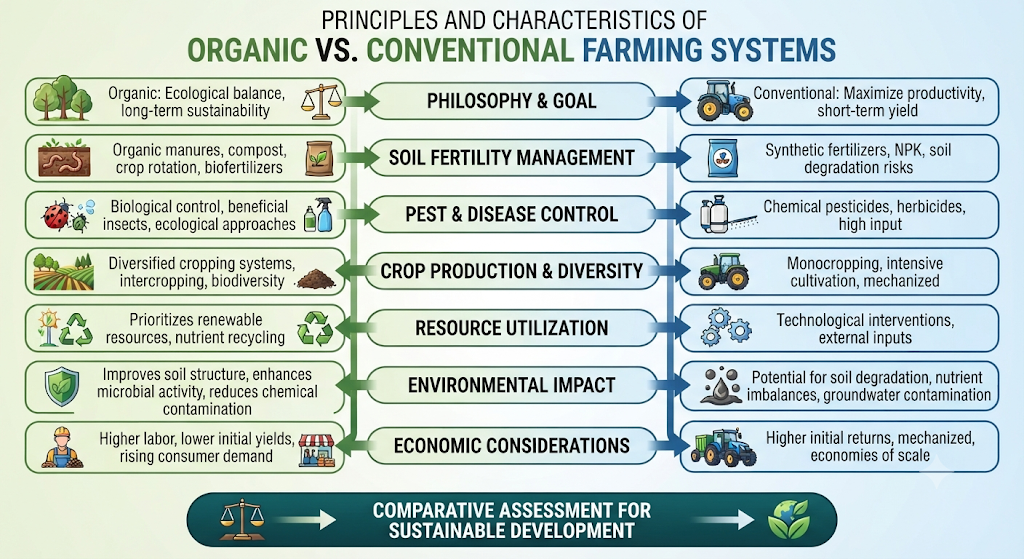
Conventional farming, in contrast, is primarily designed to maximize agricultural productivity through intensive use of modern technologies and external inputs. It relies heavily on synthetic fertilizers, chemical pesticides, herbicides, improved crop varieties, irrigation systems, and mechanized operations to achieve high yields. Chemical fertilizers provide readily available nutrients such as nitrogen, phosphorus, and potassium that support rapid plant growth and increased productivity. Pesticides and herbicides effectively control weeds, insects, and diseases, thereby minimizing crop losses and improving production efficiency. Conventional farming often employs monocropping systems and intensive cultivation practices that facilitate mechanization and large-scale production. Advances in biotechnology, precision agriculture, hybrid seed development, and irrigation technologies have further enhanced the productivity and profitability of conventional agriculture. However, excessive dependence on synthetic inputs may contribute to soil degradation, nutrient imbalances, loss of beneficial microorganisms, groundwater contamination, pesticide resistance, and environmental pollution. Continuous cultivation without adequate replenishment of organic matter may also reduce soil organic carbon and weaken long-term soil fertility. Despite these concerns, conventional agriculture remains the dominant farming system globally because of its capacity to produce high yields and support large-scale food production.
The two farming systems also differ substantially in their resource management approaches and environmental impacts. Organic farming prioritizes renewable resources, nutrient recycling, biodiversity conservation, and ecological resilience, whereas conventional farming emphasizes productivity through technological and chemical interventions. Organic systems generally improve soil structure, enhance microbial activity, increase carbon sequestration, and support ecosystem services such as pollination and biological pest control. Conventional systems often achieve greater short-term productivity but may generate environmental externalities if nutrient and pesticide applications are not carefully managed. Economic considerations also influence adoption decisions. Organic farming may involve higher labor requirements and lower initial yields, particularly during transition periods, while conventional farming typically provides more immediate economic returns through higher productivity. However, rising consumer demand for organic products and increasing awareness of environmental sustainability have enhanced the economic attractiveness of organic agriculture in many regions. Ultimately, both farming systems possess distinct strengths and limitations, and their comparative evaluation provides a foundation for identifying sustainable agricultural strategies that balance productivity, profitability, environmental conservation, and long-term soil health.
Comparative Assessment of Crop Performance and Soil Health under Organic and Conventional Farming Systems#
Crop performance and soil health are the two most important indicators used to evaluate the sustainability and effectiveness of agricultural production systems. Organic and conventional farming influence these parameters through different nutrient management practices, crop protection methods, and soil management strategies. While conventional farming generally emphasizes maximizing short-term productivity through synthetic inputs, organic farming focuses on maintaining long-term soil fertility and ecological balance. A comparative assessment of these systems demonstrates that each possesses distinct advantages and limitations depending on climatic conditions, crop type, soil characteristics, and management practices. Therefore, evaluating both crop productivity and soil quality provides a comprehensive understanding of their contribution to sustainable agricultural development.
Conventional farming generally produces higher crop yields during the initial years of cultivation due to the rapid availability of nutrients supplied through synthetic fertilizers and the effective control of weeds, pests, and diseases using chemical pesticides. Crops receive readily available nitrogen, phosphorus, and potassium during critical growth stages, resulting in faster vegetative growth, increased biomass accumulation, and higher grain production. High-yielding crop varieties, mechanized farming, precision irrigation, and advanced crop protection measures further contribute to greater productivity in conventional agricultural systems. Consequently, conventional farming has played a significant role in improving global food production and ensuring food security. However, long-term dependence on chemical fertilizers without sufficient organic matter replenishment often leads to declining fertilizer-use efficiency, nutrient imbalances, soil acidification, and reduced soil biological activity. Continuous monocropping and intensive cultivation may also increase pest resistance, reduce biodiversity, and elevate production costs associated with fertilizers and pesticides. Furthermore, excessive chemical applications contribute to groundwater contamination, nutrient runoff, greenhouse gas emissions, and environmental degradation, raising concerns regarding the long-term sustainability of conventional agriculture.
Organic farming, although sometimes producing relatively lower yields during the initial transition period, offers substantial advantages in terms of soil health, crop quality, and ecosystem sustainability. Organic nutrient sources such as farmyard manure, compost, vermicompost, green manure, and biofertilizers improve soil organic carbon, enhance nutrient cycling, increase microbial diversity, and strengthen soil structure. These improvements promote better root development, greater water-holding capacity, enhanced nutrient retention, and increased resilience against drought and other climatic stresses. Organic farming also encourages crop diversification, crop rotation, intercropping, and biological pest management, which reduce disease incidence, improve biodiversity, and strengthen ecosystem stability. Numerous studies have reported that organically managed soils contain higher populations of beneficial microorganisms, earthworms, fungi, and other soil organisms responsible for decomposition and nutrient mineralization. Increased biological activity enhances soil fertility naturally and supports sustainable crop production over the long term. In addition, organically produced crops often contain lower pesticide residues and may exhibit improved nutritional quality, antioxidant content, and consumer acceptability, thereby increasing their market value in premium markets.
The comparison of soil health indicators clearly demonstrates the long-term ecological benefits of organic farming. Organic agricultural systems generally exhibit higher soil organic matter content, improved aggregate stability, greater microbial biomass, enhanced enzymatic activity, better moisture retention, and increased carbon sequestration compared to conventional systems. These characteristics improve soil resilience against erosion, nutrient depletion, and climatic variability while supporting sustainable agricultural productivity. Conventional farming, when practiced responsibly with balanced fertilizer application, conservation tillage, residue management, and precision agriculture technologies, can also maintain satisfactory soil fertility while achieving high yields. Increasingly, researchers advocate integrated farming approaches that combine the productivity advantages of conventional agriculture with the ecological benefits of organic farming. Precision nutrient management, integrated pest management, conservation agriculture, crop residue recycling, organic amendments, and balanced fertilizer application enable farmers to optimize both crop performance and soil health. Modern technologies such as Artificial Intelligence (AI), Geographic Information Systems (GIS), Internet of Things (IoT) sensors, remote sensing, drones, and digital soil health monitoring further improve decision-making by enabling site-specific management practices tailored to local soil and crop conditions. Therefore, rather than viewing organic and conventional farming as competing systems, future agricultural development should focus on integrating their complementary strengths to achieve higher productivity, improved soil fertility, environmental sustainability, and long-term food security.
Technological Innovations and Sustainable Nutrient Management Strategies#
Technological advancements have significantly transformed nutrient management practices by enabling farmers to optimize fertilizer application, improve soil health, increase nutrient-use efficiency, and promote sustainable agricultural production. Traditional nutrient management methods often relied on uniform fertilizer recommendations without considering variations in soil fertility, crop nutrient requirements, and environmental conditions. Such generalized practices frequently resulted in excessive fertilizer use, nutrient imbalances, reduced fertilizer-use efficiency, increased production costs, and environmental degradation. Modern technologies now facilitate site-specific nutrient management, allowing farmers to apply the right nutrient source at the appropriate rate, time, and place according to crop demand. Precision agriculture has emerged as one of the most effective technological approaches supporting Integrated Nutrient Management (INM) by combining digital technologies, scientific data analysis, and automated decision-making systems to improve nutrient application accuracy. These innovations not only increase crop productivity but also minimize nutrient losses, reduce greenhouse gas emissions, and protect soil and water resources from contamination.
One of the most important technological innovations in sustainable nutrient management is the integration of Precision Agriculture with Geographic Information Systems (GIS), Global Positioning Systems (GPS), Remote Sensing, and Internet of Things (IoT) technologies. GIS enables spatial mapping of soil nutrient variability across agricultural fields, allowing farmers to identify nutrient-deficient zones and apply fertilizers accordingly. GPS-guided machinery supports precise fertilizer placement and minimizes overlapping applications, thereby reducing input wastage. Remote sensing using satellites and drones provides real-time information regarding crop vigor, chlorophyll content, canopy health, nutrient deficiencies, and moisture status through vegetation indices such as the Normalized Difference Vegetation Index (NDVI). IoT-based soil sensors continuously monitor soil moisture, pH, electrical conductivity, temperature, and nutrient concentrations, transmitting real-time data to cloud-based platforms for analysis. Artificial Intelligence (AI) and Machine Learning (ML) algorithms further process these datasets to generate customized fertilizer recommendations, predict nutrient deficiencies, optimize irrigation schedules, and forecast crop nutrient requirements under varying climatic conditions. Decision Support Systems (DSS) and mobile-based agricultural advisory platforms provide farmers with location-specific guidance regarding fertilizer doses, timing of application, and integrated nutrient management practices, thereby improving nutrient-use efficiency while reducing environmental impacts.
Biotechnological innovations have also strengthened sustainable nutrient management by improving nutrient availability and enhancing soil biological activity. The use of biofertilizers, including nitrogen-fixing bacteria (Rhizobium, Azotobacter, Azospirillum), phosphate-solubilizing microorganisms (PSB), potassium-solubilizing bacteria, arbuscular mycorrhizal fungi (AMF), and plant growth-promoting rhizobacteria (PGPR), enhances nutrient mobilization and reduces dependence on synthetic fertilizers. These beneficial microorganisms improve root development, increase nutrient absorption, stimulate plant growth through phytohormone production, and enhance resistance to environmental stress. Advances in biotechnology have also facilitated the development of crop varieties with improved nutrient-use efficiency, enabling plants to utilize available nutrients more effectively while maintaining high productivity under nutrient-limited conditions. Controlled-release fertilizers, nano-fertilizers, polymer-coated fertilizers, and micronutrient-enriched formulations represent additional technological innovations that gradually release nutrients according to crop demand, thereby minimizing nutrient losses through volatilization, runoff, and leaching. Organic waste recycling technologies—including vermicomposting, composting, biochar production, and integrated waste management—convert agricultural residues and livestock waste into valuable organic fertilizers, promoting circular nutrient economy and reducing environmental pollution.
Sustainable nutrient management also depends on supportive institutional policies and farmer capacity building. Governments should promote soil testing programmes, digital soil health cards, nutrient budgeting, climate-smart agricultural extension services, and precision farming initiatives to encourage efficient nutrient management. Investments in agricultural research, digital infrastructure, rural internet connectivity, and farmer training programmes will facilitate widespread adoption of advanced nutrient management technologies. Public-private partnerships can accelerate technology transfer, improve access to precision farming equipment, and develop affordable digital advisory services for smallholder farmers. Financial incentives, subsidies for organic inputs, and support for biofertilizer production can further encourage sustainable nutrient management practices. International organizations such as the Food and Agriculture Organization (FAO), International Fertilizer Association (IFA), and CGIAR continue promoting integrated nutrient management through research, policy guidance, and global knowledge-sharing initiatives. Ultimately, the integration of modern technologies with scientifically balanced nutrient management practices offers a sustainable pathway for enhancing crop productivity, restoring soil fertility, conserving natural resources, reducing environmental degradation, and ensuring long-term agricultural sustainability under changing climatic conditions
Future Perspectives and Policy Interventions for Sustainable Farming Systems#
The future of agriculture depends on developing farming systems that can simultaneously ensure food security, maintain soil fertility, conserve biodiversity, and adapt to climate change. As the global population continues to grow and natural resources become increasingly limited, agricultural systems must transition toward sustainable production models that balance productivity with environmental conservation. Both organic and conventional farming systems possess valuable strengths, and future agricultural development should focus on integrating the most effective practices from each approach. Sustainable farming should emphasize efficient resource utilization, soil restoration, climate resilience, technological innovation, and farmer-centered policy support. Such an integrated strategy will contribute to long-term agricultural productivity while minimizing environmental degradation and enhancing ecosystem services.
Technological advancements will play a central role in shaping future farming systems. Artificial Intelligence (AI), Machine Learning (ML), Internet of Things (IoT), Geographic Information Systems (GIS), remote sensing, robotics, blockchain, drones, and precision agriculture technologies will enable farmers to make informed, data-driven decisions regarding irrigation, nutrient management, pest control, and crop monitoring. Smart sensors will continuously assess soil moisture, nutrient availability, temperature, and crop growth, while AI-based decision support systems will provide real-time recommendations for sustainable farm management. Precision nutrient application, automated irrigation systems, and satellite-based crop monitoring will improve input-use efficiency and reduce environmental pollution. Organic farming will benefit from advances in biological pest control, biofertilizers, microbial inoculants, composting technologies, and climate-resilient crop varieties. Similarly, conventional farming will continue improving sustainability through controlled-release fertilizers, integrated pest management, conservation tillage, residue recycling, and environmentally friendly crop protection technologies. These innovations will increase productivity while preserving soil health and reducing greenhouse gas emissions.
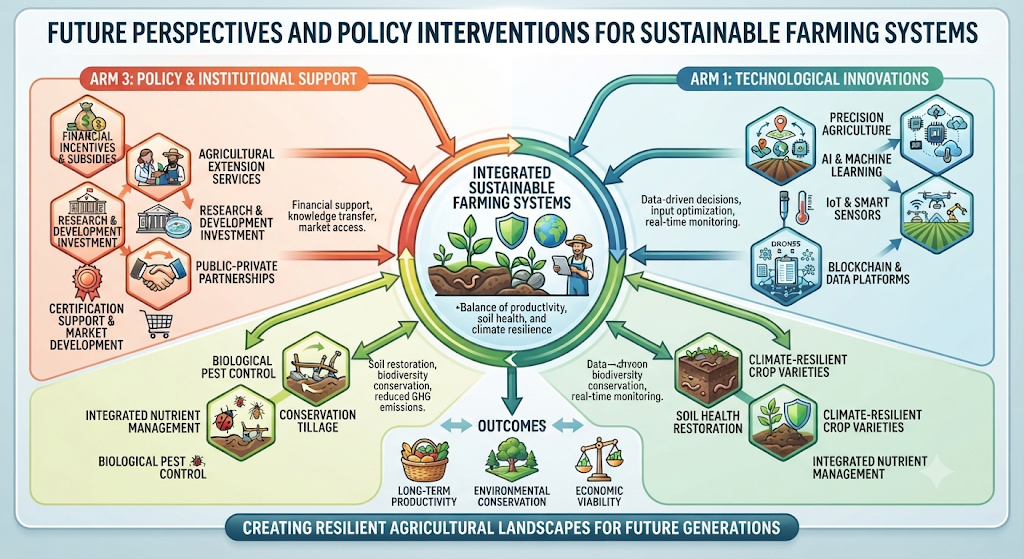 Government policies and institutional support are essential for accelerating the adoption of sustainable farming practices. National agricultural policies should prioritize soil health restoration, climate-smart agriculture, precision farming, integrated nutrient management, conservation agriculture, and organic farming promotion. Financial incentives, subsidies for sustainable agricultural inputs, affordable agricultural credit, crop insurance, and certification support should be provided to encourage farmers to adopt environmentally responsible farming methods. Strengthening agricultural extension services, farmer field schools, digital advisory platforms, and vocational training programmes will improve farmers’ technical knowledge and facilitate technology adoption. Investments in agricultural research should focus on developing locally adapted farming systems, climate-resilient crop varieties, sustainable nutrient management strategies, and eco-friendly pest management technologies. Public-private partnerships can strengthen agricultural innovation by supporting research commercialization, technology transfer, digital infrastructure, and market development for sustainably produced agricultural commodities. International organizations such as the Food and Agriculture Organization (FAO), IFOAM, CGIAR, and the World Bank should continue supporting collaborative research, climate financing, and knowledge-sharing initiatives that promote sustainable agriculture worldwide. Ultimately, future farming systems should combine scientific innovation, ecological sustainability, economic viability, and social inclusion to create resilient agricultural landscapes capable of meeting global food demands while conserving natural resources for future generations
Conclusion#
The comparative assessment of organic and conventional farming systems demonstrates that both approaches play significant roles in modern agriculture, each offering distinct advantages and facing specific limitations. Conventional farming has contributed substantially to global food production by achieving high crop yields through the use of improved crop varieties, synthetic fertilizers, chemical pesticides, mechanization, and advanced irrigation technologies. These practices have enabled countries to address increasing food demand and improve agricultural productivity over the past several decades. However, prolonged dependence on intensive chemical inputs has also resulted in soil degradation, nutrient imbalances, biodiversity loss, groundwater contamination, greenhouse gas emissions, and declining soil biological activity in many agricultural regions. Such environmental concerns have highlighted the need for farming systems that not only maximize productivity but also maintain soil health, conserve natural resources, and promote ecological sustainability. Organic farming has emerged as a sustainable alternative by emphasizing natural nutrient cycling, biodiversity conservation, ecological balance, and reduced dependence on synthetic agricultural inputs.
This study highlights that organic farming offers considerable long-term benefits for soil health through improvements in soil organic matter, microbial diversity, nutrient cycling, aggregate stability, water-holding capacity, and carbon sequestration. Organic management practices such as crop rotation, compost application, green manuring, biological pest control, and residue recycling contribute significantly to maintaining productive and resilient agricultural ecosystems. Although organic farming may produce relatively lower yields during transition periods and require greater labor inputs, it enhances environmental sustainability and supports the production of high-quality agricultural products with minimal chemical residues. Conversely, conventional farming generally achieves higher short-term crop productivity and greater production efficiency due to readily available nutrients and effective crop protection measures. Nevertheless, excessive use of chemical fertilizers and pesticides without appropriate soil conservation practices may reduce long-term soil fertility and increase environmental risks. Therefore, neither farming system alone represents a universal solution to contemporary agricultural challenges. Instead, sustainable agricultural development requires scientifically balanced management strategies that integrate the strengths of both systems.
Technological innovation has become a critical factor in improving the sustainability of both organic and conventional farming. Precision agriculture, Artificial Intelligence (AI), Machine Learning (ML), Geographic Information Systems (GIS), Internet of Things (IoT), remote sensing, drones, and satellite monitoring enable farmers to optimize irrigation, nutrient management, pest control, and crop monitoring based on real-time field conditions. These technologies improve resource-use efficiency, reduce production costs, minimize environmental pollution, and support evidence-based agricultural decision-making. Organic farming also benefits from advances in biofertilizers, biological pest management, composting technologies, and climate-resilient crop varieties, while conventional farming increasingly incorporates precision nutrient management, controlled-release fertilizers, and integrated pest management practices to reduce environmental impacts. Effective government policies, agricultural extension programmes, financial incentives, farmer education, and research investments remain essential for promoting widespread adoption of sustainable farming practices. Public-private partnerships and international collaboration should continue supporting innovation, technology transfer, soil health restoration, and climate-smart agricultural development. Ultimately, the future of global agriculture lies not in choosing between organic and conventional farming but in integrating the most effective practices from both systems. Such an approach will enhance crop productivity, improve soil fertility, conserve biodiversity, strengthen climate resilience, ensure long-term food security, and promote environmentally sustainable agricultural development for future generations.
Works Cited#
- Food and Agriculture Organization of the United Nations. (2024). The State of Food and Agriculture 2024: Innovation for Sustainable Agricultural Systems. Rome: FAO.
- International Federation of Organic Agriculture Movements. (2023). The World of Organic Agriculture: Statistics and Emerging Trends. Bonn: IFOAM.
- Research Institute of Organic Agriculture. (2024). The World of Organic Agriculture: Statistics and Emerging Trends 2024. Frick, Switzerland: FiBL.
- Food and Agriculture Organization of the United Nations. (2023). Sustainable Soil Management for Food Security. Rome: FAO.
- Consultative Group on International Agricultural Research. (2024). Sustainable Agriculture and Soil Health Research Report. Montpellier: CGIAR.
- United Nations Environment Programme. (2024). Global Environment Outlook: Sustainable Agriculture and Soil Health. Nairobi: UNEP.
- Indian Council of Agricultural Research. (2023). Organic Farming and Sustainable Agriculture in India. New Delhi: ICAR.
- World Bank. (2024). Transforming Food Systems for Sustainable Development. Washington, DC: World Bank.
- Organisation for Economic Co-operation and Development. (2023). Policies for Sustainable Agriculture and Food Systems. Paris: OECD Publishing.
- United Nations Development Programme. (2023). Human Development Report 2023/24. New York: UNDP.
- Reganold, John P.., & Wachter, Jonathan M.. (2016). Organic agriculture in the twenty-first century. Nature Plants, 2, 15221.
- Seufert, Verena., Ramankutty, Navin., & Foley, Jonathan A.. (2012). Comparing the yields of organic and conventional agriculture. Nature, 485(7397), 229–232.
- Ponisio, Lauren C.., et al. (2015). Diversification practices reduce organic to conventional yield gap. Proceedings of the Royal Society B, 282(1799), 20141396.
- Mäder, Paul., et al. (2002). Soil fertility and biodiversity in organic farming. Science, 296(5573), 1694–1697.
- Lori, Markus., et al. (2017). Organic farming enhances soil microbial abundance and activity. PLOS ONE, 12(7), e0180442.
- Tuomisto, Hanna L.., et al. (2012). Environmental impacts of organic farming: A meta-analysis. Journal of Environmental Management, 112, 309–320.
- Gattinger, Andreas., et al. (2012). Enhanced topsoil carbon stocks under organic farming. Proceedings of the National Academy of Sciences, 109(44), 18226–18231.
- Drinkwater, Laurie E.., et al. (1995). Fundamental differences between conventional and organic farming systems. Nature, 396(6709), 262–265.
- Pretty, Jules. (2008). Agricultural sustainability: Concepts, principles, and evidence. Philosophical Transactions of the Royal Society B: Biological Sciences, 363(1491), 447–465.
- Tilman, David., et al. (2002). Agricultural sustainability and intensive production practices. Nature, 418(6898), 671–677.