Abstract
Conservation agriculture (CA) has emerged as an environmentally sustainable and economically viable farming system capable of addressing the growing challenges of food security, climate change, soil degradation, and declining agricultural productivity. Based on the principles of minimum soil disturbance, permanent soil cover, and diversified crop rotations, conservation agriculture seeks to improve soil health while enhancing the efficient utilization of natural resources. The adoption of CA practices has gained momentum worldwide due to their potential to increase crop productivity, reduce production costs, conserve soil moisture, and improve resilience against climatic variability. Numerous studies have demonstrated that conservation agriculture contributes to higher water-use efficiency, enhanced nutrient availability, improved soil organic carbon, and reduced greenhouse gas emissions compared to conventional tillage systems. Moreover, these practices support sustainable intensification by maintaining long-term soil fertility and minimizing environmental degradation. However, the effectiveness of conservation agriculture varies across agro-climatic regions, crop types, soil characteristics, and management practices. Factors such as limited awareness, initial investment costs, inadequate mechanization, residue management challenges, and socio-economic constraints often hinder its widespread adoption, particularly in developing countries. This paper examines the influence of conservation agriculture practices on crop productivity and resource use efficiency by analyzing their impact on soil health, water conservation, nutrient dynamics, energy use, and environmental sustainability. It also discusses the major challenges associated with adoption and highlights future opportunities for promoting climate-smart and sustainable agricultural systems. The study concludes that conservation agriculture offers a practical pathway toward achieving productive, resource-efficient, and environmentally resilient agriculture for future generations.
- Conservation Agriculture
- Crop Productivity
- Resource Use Efficiency
- Soil Health
- Minimum Tillage
- Crop Residue Management
- Crop Rotation
- Water Use Efficiency
- Sustainable Agriculture
- Climate-Smart Agriculture
Introduction#
Agriculture remains the backbone of food security and rural livelihoods across the world. However, increasing population pressure, shrinking natural resources, climate change, soil degradation, declining groundwater levels, and environmental pollution have significantly challenged the sustainability of conventional agricultural systems. Traditional intensive farming practices, particularly repeated tillage, excessive use of chemical fertilizers, residue burning, and indiscriminate irrigation, have contributed to the deterioration of soil structure, loss of biodiversity, nutrient depletion, and declining crop productivity. These challenges necessitate the adoption of sustainable agricultural practices capable of maintaining high productivity while conserving natural resources for future generations.
Conservation agriculture (CA) has emerged as one of the most effective approaches for sustainable agricultural development. The Food and Agriculture Organization (FAO) defines conservation agriculture as a farming system based on three interconnected principles: minimum mechanical soil disturbance, permanent organic soil cover, and diversified crop rotations or crop diversification. Unlike conventional farming systems that rely heavily on intensive tillage, conservation agriculture emphasizes preserving soil structure and biological activity, thereby improving soil health and long-term productivity.The adoption of conservation agriculture has expanded considerably across developed and developing countries due to its multiple agronomic, economic, and environmental benefits. Farmers implementing conservation agriculture often experience improved soil moisture retention, reduced erosion, enhanced soil organic matter, increased microbial activity, better nutrient cycling, and lower production costs. The retention of crop residues on the soil surface acts as a protective mulch, reducing evaporation, suppressing weed growth, moderating soil temperature, and improving water infiltration. Similarly, diversified crop rotations help break pest and disease cycles while enhancing nutrient availability and soil fertility. Crop productivity is one of the primary indicators of agricultural success. Several studies have demonstrated that conservation agriculture either maintains or gradually increases crop yields compared to conventional tillage, particularly after the transition period. Improved soil structure and enhanced biological activity facilitate better root growth, nutrient uptake, and water availability, resulting in healthier crops and greater resilience to drought and extreme weather events. Although yield improvements may vary depending on climate, soil type, crop species, and management practices, long-term adoption generally contributes to stable and sustainable production. Resource use efficiency has become an increasingly important objective in modern agriculture because natural resources such as land, water, energy, and nutrients are becoming increasingly scarce. Conservation agriculture improves water-use efficiency by enhancing soil infiltration and reducing evaporation losses. It also increases nutrient-use efficiency through better nutrient retention and microbial mineralization while reducing fuel consumption by minimizing tillage operations. Consequently, farmers can achieve higher productivity with lower input costs, making conservation agriculture both economically attractive and environmentally sustainable.
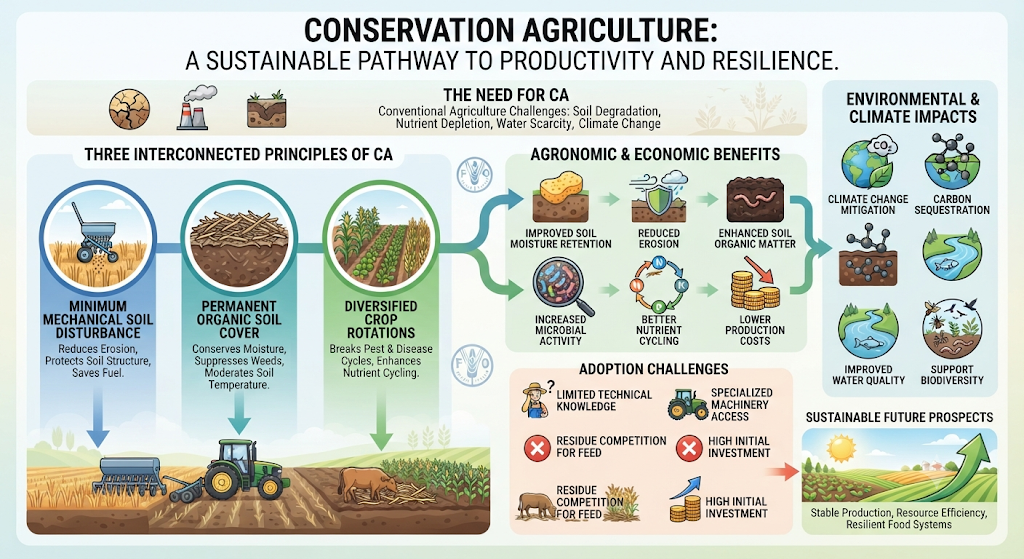
In addition to improving agricultural productivity, conservation agriculture plays a significant role in mitigating climate change. Reduced soil disturbance minimizes carbon losses, while continuous residue retention promotes carbon sequestration in soils. These practices contribute to lowering greenhouse gas emissions and improving ecosystem resilience. Furthermore, conservation agriculture supports biodiversity by creating favorable habitats for beneficial soil organisms, earthworms, insects, and microorganisms that contribute to nutrient cycling and soil fertility.Despite its numerous advantages, conservation agriculture faces several barriers to widespread adoption, including limited technical knowledge, inadequate access to specialized machinery, residue competition for livestock feed, high initial investment costs, and location-specific management challenges. Effective policy support, farmer training, extension services, and technological innovations are therefore essential to promote large-scale adoption. Considering the urgent need for sustainable food production systems, conservation agriculture offers a scientifically proven approach for enhancing crop productivity while improving the efficient utilization of natural resources. This paper examines the influence of conservation agriculture practices on crop productivity and resource use efficiency by exploring their principles, agronomic benefits, environmental impacts, adoption challenges, and future prospects for sustainable agricultural development.
Principles and Components of Conservation Agriculture#
Conservation agriculture (CA) is a sustainable farming approach designed to improve agricultural productivity while conserving natural resources and maintaining environmental quality. Unlike conventional farming systems that rely on intensive soil cultivation, conservation agriculture is founded on three interrelated principles: minimum mechanical soil disturbance, permanent soil cover, and diversified crop rotations. These principles work synergistically to enhance soil health, optimize resource use, and ensure long-term agricultural sustainability. The successful implementation of conservation agriculture requires integrating these components according to local climatic conditions, soil characteristics, cropping systems, and farmers' socio-economic circumstances.
The first principle, minimum mechanical soil disturbance, involves reducing or eliminating conventional tillage through practices such as zero tillage or reduced tillage. Excessive tillage disrupts soil aggregates, accelerates organic matter decomposition, increases erosion, and reduces soil moisture retention. By minimizing soil disturbance, conservation agriculture preserves soil structure, enhances microbial activity, improves water infiltration, and promotes the formation of stable soil aggregates. Zero tillage also reduces fuel consumption, machinery wear, and labor costs, thereby increasing farm profitability while lowering greenhouse gas emissions associated with field operations.The second principle emphasizes permanent soil cover through the retention of crop residues, cover crops, or mulch. Maintaining continuous soil cover protects the soil from erosion caused by wind and water while reducing surface runoff and moisture evaporation. Crop residues act as a natural insulating layer that moderates soil temperature, suppresses weed growth, and improves water conservation. As residues gradually decompose, they contribute organic matter and essential nutrients, thereby enhancing soil fertility and supporting beneficial microbial populations. Cover crops additionally improve nitrogen fixation, reduce nutrient leaching, and provide habitat for beneficial insects and soil organisms, contributing to improved ecosystem health.The third principle involves diversified crop rotations and crop diversification, which enhance soil fertility and reduce pest, disease, and weed pressure. Continuous monocropping often leads to nutrient depletion, increased pest incidence, and declining soil quality. Rotating cereals with legumes, oilseeds, and other crops improves nutrient cycling, particularly nitrogen availability through biological nitrogen fixation by legumes. Diverse crop rotations also interrupt pest and disease life cycles, reduce dependence on chemical pesticides, and promote greater biodiversity within agricultural ecosystems. Consequently, crop diversification contributes to stable yields and improved resilience under changing climatic conditions.
In addition to these three core principles, conservation agriculture incorporates several complementary management practices. These include precision nutrient management, integrated weed management, efficient irrigation techniques, integrated pest management, and mechanized residue handling. Precision farming technologies enable farmers to apply fertilizers and water according to crop requirements, thereby minimizing input wastage and maximizing productivity. Similarly, integrated pest and weed management strategies reduce reliance on synthetic chemicals while preserving ecological balance.
The adoption of conservation agriculture also requires appropriate farm machinery, particularly seed drills capable of direct seeding into crop residues without prior tillage. Modern zero-till seed drills ensure proper seed placement and germination while minimizing soil disturbance. Mechanization plays a vital role in increasing operational efficiency and encouraging wider adoption of conservation agriculture, especially in large-scale farming systems.The effectiveness of conservation agriculture depends on site-specific adaptation and long-term commitment. During the initial years of adoption, farmers may experience transitional challenges such as increased weed pressure, temporary yield fluctuations, and residue management issues. However, as soil biological activity improves and organic matter accumulates, the benefits become increasingly evident through enhanced productivity, reduced production costs, improved soil fertility, and greater resilience against drought and climate variability.
Overall, the principles and components of conservation agriculture collectively establish a sustainable production system that balances economic profitability, environmental protection, and social well-being. Their integrated implementation provides a strong foundation for achieving long-term food security and efficient resource management in modern agriculture.
Influence of Conservation Agriculture on Crop Productivity#
Crop productivity is a fundamental measure of agricultural performance and food security. Conservation agriculture significantly influences crop productivity by improving soil physical, chemical, and biological properties, thereby creating favorable conditions for crop growth and development. Although yield responses vary according to climate, soil type, crop species, and duration of adoption, extensive research demonstrates that conservation agriculture can maintain or enhance crop productivity while reducing production costs and environmental degradation.One of the primary mechanisms through which conservation agriculture improves crop productivity is by enhancing soil structure. Reduced tillage minimizes soil compaction and preserves natural soil aggregates, allowing better root penetration and improved aeration. Healthy soil structure increases water infiltration and storage capacity, enabling crops to access moisture during dry periods. Improved root development also facilitates efficient nutrient uptake, resulting in stronger plant growth and higher yields.Conservation agriculture also increases soil organic matter, which serves as the foundation of soil fertility. Crop residue retention and reduced soil disturbance promote the accumulation of organic carbon, improving nutrient availability and cation exchange capacity. Organic matter enhances microbial activity, supports earthworm populations, and stimulates nutrient mineralization processes essential for crop growth. As soil fertility improves over time, crops become more productive and resilient to environmental stress.
Water availability is another critical determinant of crop productivity. Permanent soil cover reduces evaporation losses and increases rainwater infiltration, leading to improved soil moisture conservation. In rainfed agriculture, where rainfall variability often limits production, conservation agriculture provides a significant advantage by ensuring a more consistent supply of water throughout the growing season. Enhanced water-use efficiency enables crops to better withstand drought conditions, reducing yield losses associated with climate variability. Crop residue retention further contributes to productivity by regulating soil temperature. Residues act as an insulating layer that protects soil from excessive heat during summer and minimizes temperature fluctuations during cooler periods. Stable soil temperatures promote seed germination, root development, and microbial activity, creating optimal conditions for crop establishment and growth. Diversified crop rotations play an equally important role in increasing crop productivity. Rotating cereals with legumes enhances biological nitrogen fixation, reducing dependence on synthetic nitrogen fertilizers while improving soil fertility. Crop rotation also interrupts the life cycles of pests, diseases, and weeds, decreasing crop damage and minimizing pesticide requirements. Healthier crops experience lower stress levels and allocate more energy toward grain production, ultimately improving yields. Several long-term field experiments conducted across Asia, Europe, North America, and Australia have demonstrated that conservation agriculture often produces yields comparable to or higher than those achieved under conventional tillage systems. In regions experiencing water scarcity, conservation agriculture frequently outperforms conventional methods because improved moisture retention supports crop growth during prolonged dry spells. Crops such as wheat, maize, rice, soybean, chickpea, and pulses have shown significant productivity improvements under well-managed conservation agriculture systems. The economic benefits associated with increased productivity further strengthen the attractiveness of conservation agriculture. Reduced fuel consumption, lower labor requirements, fewer tillage operations, and optimized input use contribute to lower production costs while maintaining or increasing yields. Consequently, farmers often experience higher net returns despite modest initial investments in specialized machinery or training. However, the productivity benefits of conservation agriculture are not always immediate. During the initial transition period, temporary yield reductions may occur due to changes in soil biological processes, weed dynamics, or nutrient availability. Effective residue management, timely weed control, proper crop rotation, and adequate technical support are essential for overcoming these transitional challenges. Once the system stabilizes, long-term productivity generally improves substantially.
Overall, conservation agriculture enhances crop productivity by improving soil health, conserving water, increasing nutrient availability, reducing environmental stress, and promoting sustainable farming systems capable of meeting future food security demands.
Resource Use Efficiency under Conservation Agriculture#
Resource use efficiency has become one of the most important indicators of sustainable agricultural development because increasing food production must be achieved using limited land, water, energy, and nutrient resources. Conservation agriculture significantly improves the efficiency with which these resources are utilized, thereby reducing production costs, minimizing environmental impacts, and enhancing long-term agricultural sustainability.
Water is among the most critical agricultural resources, and conservation agriculture greatly improves water-use efficiency. Reduced tillage and continuous soil cover increase rainwater infiltration while decreasing runoff and evaporation losses. Crop residues function as mulch, maintaining soil moisture for longer periods and ensuring greater water availability during crop growth. Enhanced moisture conservation allows farmers to reduce irrigation frequency and maintain crop productivity even under drought conditions. Consequently, conservation agriculture has become particularly valuable in semi-arid and water-scarce regions where efficient water management is essential.Another major contribution of conservation agriculture lies in improving nutrient-use efficiency. Conventional tillage often accelerates nutrient losses through erosion, runoff, and leaching. In contrast, conservation agriculture preserves soil structure and organic matter, allowing nutrients to remain available within the root zone. Crop residues gradually decompose, releasing essential nutrients such as nitrogen, phosphorus, potassium, and micronutrients over time. Crop rotations involving legumes further enhance nitrogen availability through biological nitrogen fixation, reducing dependence on synthetic fertilizers and lowering production costs. Energy-use efficiency is also substantially improved under conservation agriculture. Conventional farming requires multiple tillage operations involving tractors and heavy machinery, resulting in high fuel consumption and labor requirements. Conservation agriculture minimizes field operations through zero or reduced tillage, thereby reducing diesel use, machinery wear, labor expenses, and operational time. Lower fossil fuel consumption also contributes to reduced greenhouse gas emissions, supporting climate change mitigation efforts. Land-use efficiency improves because healthier soils produce more stable yields over extended periods. Improved soil fertility, enhanced biological activity, and better moisture retention enable farmers to maximize production from existing agricultural land without expanding cultivation into environmentally sensitive ecosystems. Sustainable intensification through conservation agriculture therefore contributes to both food security and biodiversity conservation. Conservation agriculture also enhances soil resource efficiency by preventing erosion and maintaining long-term soil fertility. Permanent soil cover protects the soil surface from the erosive effects of rainfall and wind, while reduced tillage preserves soil aggregates and biological habitats. Higher levels of soil organic carbon improve nutrient-holding capacity, water retention, and microbial diversity, ensuring that soil remains productive for future generations.
Weed, pest, and disease management become more resource-efficient when integrated conservation agriculture practices are followed. Diversified crop rotations reduce pest populations naturally, while healthy soils support beneficial microorganisms that suppress soil-borne pathogens. Although integrated weed management remains necessary during early adoption stages, long-term ecological balance reduces dependence on herbicides and pesticides, lowering production costs and environmental contamination. The environmental resource efficiency associated with conservation agriculture extends beyond individual farms. Reduced greenhouse gas emissions, increased carbon sequestration, improved groundwater recharge, decreased sedimentation of rivers, and enhanced biodiversity contribute to broader ecosystem sustainability. These environmental services have become increasingly valuable as governments seek climate-resilient agricultural systems capable of supporting sustainable development goals.
Despite these advantages, maximizing resource use efficiency requires appropriate management practices, access to suitable machinery, farmer training, and supportive agricultural policies. Site-specific nutrient management, timely residue handling, precision irrigation, and effective extension services are essential for realizing the full potential of conservation agriculture. Digital agriculture technologies, remote sensing, and precision farming tools are expected to further improve resource-use efficiency by enabling farmers to make informed management decisions based on real-time field conditions.
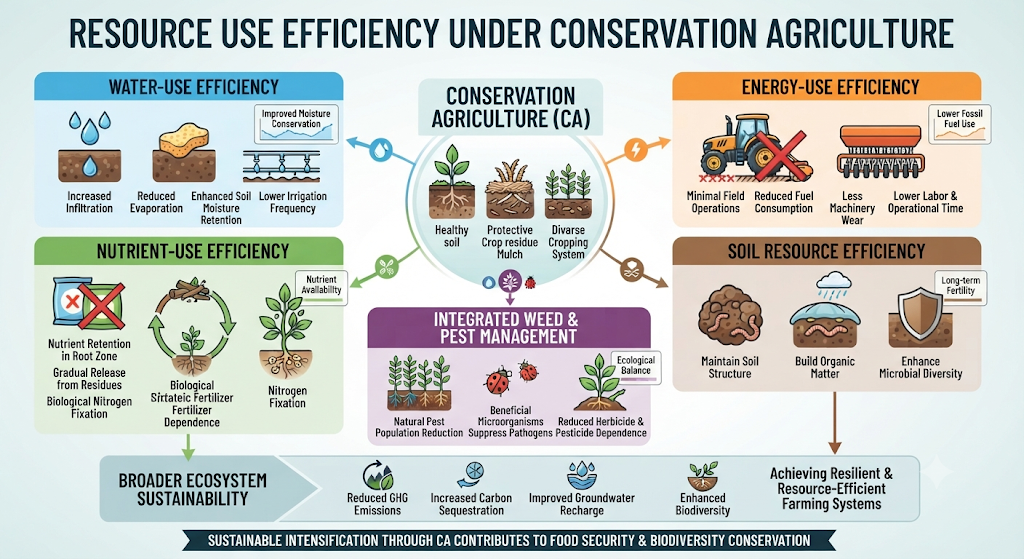
Overall, conservation agriculture provides an integrated framework for improving the efficient utilization of water, nutrients, energy, land, and soil resources while maintaining agricultural productivity and environmental sustainability. Its widespread adoption represents a critical strategy for achieving resilient and resource-efficient farming systems in the face of increasing global food demand and climate uncertainty.
Challenges, Adoption Constraints, and Future Prospects of Conservation Agriculture#
Despite the well-documented agronomic, economic, and environmental benefits of conservation agriculture (CA), its large-scale adoption remains uneven across different regions of the world. While many developed countries have successfully integrated conservation agriculture into mainstream farming systems, adoption in developing nations is often constrained by technical, socio-economic, institutional, and environmental challenges. Understanding these barriers is essential for designing effective policies and strategies that can promote the widespread implementation of conservation agriculture and maximize its contribution to sustainable agricultural development.
One of the major challenges is the limited awareness and technical knowledge among farmers regarding conservation agriculture principles and management practices. Many farmers continue to rely on conventional tillage because they are unfamiliar with zero tillage, crop residue management, and diversified crop rotations. Inadequate extension services and insufficient farmer training further restrict the dissemination of scientific knowledge, making farmers hesitant to adopt unfamiliar technologies.
Another important constraint is the high initial investment required for specialized farm machinery. Equipment such as zero-till seed drills, residue management implements, and precision planting machines can be expensive, especially for small and marginal farmers. Limited access to credit, subsidies, and mechanization services discourages investment in conservation agriculture technologies. Custom hiring centers and government-supported machinery banks can help overcome these financial barriers by providing affordable access to modern equipment.
Crop residue management presents another significant challenge, particularly in mixed crop-livestock farming systems. In many developing countries, crop residues serve as valuable livestock fodder, fuel, or raw material for household purposes. Consequently, farmers often remove residues from fields instead of retaining them as protective mulch. This practice reduces the effectiveness of conservation agriculture by limiting soil cover, organic matter accumulation, and moisture conservation. Developing alternative fodder resources and promoting balanced residue management practices can help address this issue.
During the transition period, conservation agriculture may also present management difficulties. Weed populations often increase in the absence of conventional tillage, requiring integrated weed management strategies involving crop rotation, cover crops, mulching, and judicious herbicide use. Similarly, temporary reductions in crop yields may occur during the first few years as soil biological processes stabilize and soil organic matter gradually accumulates. Such short-term challenges may discourage farmers who expect immediate economic returns.
The effectiveness of conservation agriculture also depends on site-specific climatic and soil conditions. Practices that perform well in one agro-ecological region may not produce similar results elsewhere. Variations in rainfall patterns, soil texture, temperature, and cropping systems require locally adapted management practices. Therefore, region-specific research and participatory field demonstrations are necessary to optimize conservation agriculture practices under diverse environmental conditions. Institutional and policy-related factors further influence adoption. Inadequate policy support, weak agricultural extension networks, limited research funding, and insufficient market incentives often slow the diffusion of conservation agriculture technologies. Governments can play a crucial role by formulating supportive policies, offering financial incentives, strengthening extension services, and encouraging public-private partnerships to facilitate technology transfer.
Despite these challenges, the future prospects of conservation agriculture remain highly promising. Advances in digital agriculture, precision farming, remote sensing, artificial intelligence, and climate-smart technologies are creating new opportunities to improve the efficiency and effectiveness of conservation agriculture systems. Precision nutrient management, sensor-based irrigation scheduling, drone-assisted crop monitoring, and satellite-based decision support systems enable farmers to optimize input use while reducing environmental impacts. Growing global concern over climate change, food security, soil degradation, and water scarcity has also increased international support for conservation agriculture. Organizations such as the Food and Agriculture Organization (FAO), research institutions, and national governments continue to promote conservation agriculture as a key strategy for achieving sustainable development goals. Future research should focus on developing location-specific technologies, improving residue management options, enhancing mechanization for smallholders, and strengthening policy frameworks that encourage farmer participation.
Overall, addressing technical, economic, institutional, and social constraints through coordinated efforts will significantly accelerate the adoption of conservation agriculture, enabling farming systems to become more productive, resilient, resource-efficient, and environmentally sustainable.
Conclusion#
Conservation agriculture has emerged as one of the most effective approaches for achieving sustainable agricultural development in the face of growing global challenges such as climate change, soil degradation, water scarcity, and increasing food demand. By integrating the principles of minimum soil disturbance, permanent soil cover, and diversified crop rotations, conservation agriculture promotes a balanced farming system that simultaneously enhances productivity, conserves natural resources, and protects environmental quality. Unlike conventional agricultural practices that often result in declining soil fertility and inefficient resource utilization, conservation agriculture provides a scientifically validated framework for improving long-term agricultural sustainability. The findings discussed in this paper demonstrate that conservation agriculture positively influences crop productivity through improvements in soil structure, organic matter content, nutrient cycling, microbial activity, and moisture retention. These improvements create favorable growing conditions that enable crops to utilize water and nutrients more efficiently while increasing resilience to drought, heat stress, and other climatic extremes. Although yield improvements may not always be immediate during the transition period, long-term adoption generally results in stable or higher crop productivity compared with conventional tillage systems. An equally significant contribution of conservation agriculture lies in enhancing resource use efficiency. Improved water infiltration, reduced evaporation, greater nutrient retention, lower fuel consumption, and efficient land utilization collectively reduce production costs while minimizing environmental degradation. The reduction in greenhouse gas emissions, increased soil carbon sequestration, and protection of biodiversity further strengthen the role of conservation agriculture in climate change mitigation and adaptation. These ecological benefits extend beyond individual farms by contributing to healthier ecosystems and improved environmental resilience.
Despite its considerable advantages, the adoption of conservation agriculture continues to face several barriers, including limited farmer awareness, inadequate extension services, high initial investment costs, residue management challenges, and the need for specialized machinery. Addressing these obstacles requires coordinated efforts from governments, research institutions, extension agencies, and the private sector. Financial incentives, capacity-building programs, access to affordable mechanization, and location-specific research can significantly enhance farmer confidence and accelerate adoption.
Technological innovations such as precision agriculture, remote sensing, artificial intelligence, geographic information systems, and digital advisory platforms offer promising opportunities to improve the implementation of conservation agriculture. These technologies enable farmers to make informed decisions regarding irrigation, fertilizer application, weed management, and crop monitoring, thereby maximizing productivity while minimizing resource wastage. Furthermore, integrating conservation agriculture with other climate-smart agricultural practices can strengthen farming systems against future environmental uncertainties. Policy support also remains a critical factor in expanding conservation agriculture. Governments should formulate long-term policies that encourage sustainable land management, promote conservation incentives, strengthen agricultural research, and facilitate collaboration among farmers, scientists, and policymakers. Public awareness campaigns and farmer field schools can further increase knowledge dissemination and encourage community participation in sustainable farming initiatives.
In conclusion, conservation agriculture represents a practical and scientifically sound pathway toward achieving sustainable food production while preserving natural resources for future generations. Its ability to improve crop productivity, increase resource use efficiency, enhance environmental quality, and strengthen climate resilience makes it an indispensable component of modern agricultural systems. Continued investment in research, innovation, education, and supportive policies will be essential for realizing the full potential of conservation agriculture and ensuring global food and environmental security in the decades ahead.
Works Cited#
- Blanco-Canqui, H., & Lal, R. (2008). Principles of Soil Conservation and Management. Springer.
- Derpsch, R., Friedrich, T., Kassam, A., & Li, H. (2010). Current status of adoption of no-till farming in the world. International Journal of Agricultural and Biological Engineering, 3(1), 1–25.
- Erenstein, O. (2002). Crop residue mulching in tropical and semi-tropical countries. Agriculture, Ecosystems & Environment, 100(1), 17–37.
- Food and Agriculture Organization. (2011). Save and Grow: A Policymaker's Guide to Sustainable Intensification of Smallholder Crop Production. FAO.
- Food and Agriculture Organization. (2017). Conservation Agriculture. FAO.
- Giller, K. E., Witter, E., Corbeels, M., & Tittonell, P. (2009). Conservation agriculture and smallholder farming in Africa. Field Crops Research, 114(1), 23–34.
- Hobbs, P. R., Sayre, K., & Gupta, R. (2008). The role of conservation agriculture in sustainable agriculture. Philosophical Transactions of the Royal Society B, 363(1491), 543–555.
- Kassam, A., Friedrich, T., Shaxson, F., & Pretty, J. (2009). The spread of conservation agriculture. International Journal of Agricultural Sustainability, 7(4), 292–320.
- Lal, R. (2004). Soil carbon sequestration impacts on global climate change and food security. Science, 304(5677), 1623–1627.
- Lal, R. (2015). Restoring soil quality to mitigate soil degradation. Sustainability, 7(5), 5875–5895.
- Montgomery, D. R. (2007). Dirt: The Erosion of Civilizations. University of California Press.
- Pittelkow, C. M., et al. (2015). Productivity limits and potentials of the principles of conservation agriculture. Nature, 517(7534), 365–368.
- Pretty, J. (2008). Agricultural Sustainability: Concepts, Principles and Evidence. Philosophical Transactions of the Royal Society B.
- Reicosky, D. C. (2015). Conservation agriculture and carbon sequestration. Soil and Tillage Research, 150, 1–3.
- Six, J., Feller, C., Denef, K., Ogle, S. M., Sá, J. C. M., & Albrecht, A. (2002). Soil organic matter and conservation agriculture. Plant and Soil, 241(2), 155–176.
- Thierfelder, C., & Wall, P. C. (2010). Rotations in conservation agriculture systems. Experimental Agriculture, 46(4), 1–18.
- Verhulst, N., Govaerts, B., Verachtert, E., et al. (2010). Conservation agriculture, improving soil quality. Agriculture, Ecosystems & Environment, 137(1–2), 24–35.
- Wall, P. C. (2007). Tailoring conservation agriculture to the needs of small farmers. Journal of Crop Improvement, 19(1–2), 137–155.
- World Bank. (2021). Climate-Smart Agriculture: Overview. World Bank.
- Zhang, X., & Li, L. (2018). Conservation agriculture and sustainable crop production under climate change. Agronomy, 8(6), 87.