Abstract
Integrated Nutrient Management (INM) has emerged as a sustainable agricultural approach that combines organic, inorganic, and biological nutrient sources to improve crop productivity while maintaining long-term soil fertility and environmental quality. The continuous use of chemical fertilizers without adequate replenishment of soil organic matter has resulted in declining soil health, nutrient imbalances, reduced microbial activity, environmental pollution, and diminishing crop productivity in many agricultural regions. Integrated Nutrient Management addresses these challenges by promoting balanced nutrient application through the combined use of chemical fertilizers, farmyard manure, compost, green manure, crop residues, biofertilizers, and other organic amendments. This integrated approach enhances nutrient-use efficiency, improves soil physical, chemical, and biological properties, increases crop yield, and supports sustainable agricultural production. The present study evaluates the role of Integrated Nutrient Management practices in enhancing crop productivity and restoring soil fertility under diverse agroecosystems. It examines the principles and components of INM, analyzes its effects on crop growth, nutrient availability, soil health, and environmental sustainability, explores technological innovations supporting nutrient management, and discusses policy interventions for promoting widespread adoption of sustainable nutrient management practices. The study highlights that integrating scientific research, precision agriculture, digital technologies, farmer education, and supportive agricultural policies can significantly improve nutrient management efficiency while reducing environmental degradation. Ultimately, Integrated Nutrient Management represents a key strategy for achieving sustainable agriculture, improving food security, conserving natural resources, and ensuring long-term agricultural resilience under changing environmental conditions..
- Integrated Nutrient Management
- Soil Fertility
- Crop Yield
- Sustainable Agriculture
- Biofertilizers
- Organic Manure
- Chemical Fertilizers
- Nutrient Use Efficiency
- Soil Health
- Precision Agriculture
Introduction#
Agriculture remains the foundation of global food security, economic development, and rural livelihoods. Sustaining agricultural productivity while conserving natural resources has become one of the greatest challenges facing modern farming systems. Rapid population growth, increasing food demand, declining soil fertility, environmental degradation, and climate change have intensified pressure on agricultural production systems to produce higher yields using limited natural resources. Among the numerous factors affecting agricultural productivity, soil fertility plays a central role because healthy soils provide essential nutrients, water, and biological support necessary for optimal crop growth. However, continuous cultivation, intensive cropping systems, excessive dependence on chemical fertilizers, inadequate organic matter replenishment, soil erosion, nutrient mining, and improper land management have significantly reduced soil fertility across many agricultural regions. Declining soil organic carbon, nutrient imbalances, reduced microbial diversity, soil acidification, salinity, and deterioration of soil structure have negatively affected crop productivity and long-term agricultural sustainability. These challenges have highlighted the need for integrated approaches that improve nutrient availability while preserving soil health and environmental quality.
Traditionally, chemical fertilizers have played a significant role in increasing agricultural production during the Green Revolution by supplying essential macronutrients such as nitrogen, phosphorus, and potassium. Although the use of inorganic fertilizers substantially improved crop yields, excessive and imbalanced fertilizer application has resulted in several environmental and agronomic problems. Continuous dependence on chemical fertilizers without adequate incorporation of organic materials has reduced soil organic matter, weakened soil biological activity, increased nutrient losses through leaching and volatilization, and contributed to groundwater contamination, greenhouse gas emissions, and ecosystem degradation. Moreover, declining fertilizer-use efficiency has increased production costs while reducing economic returns for farmers. These concerns have encouraged researchers and policymakers to promote sustainable nutrient management practices capable of balancing agricultural productivity with environmental conservation. Integrated Nutrient Management (INM) has therefore emerged as an effective strategy that combines inorganic fertilizers with organic manures, crop residues, green manures, compost, vermicompost, biofertilizers, and microbial inoculants to provide balanced plant nutrition while maintaining soil fertility and ecological sustainability.
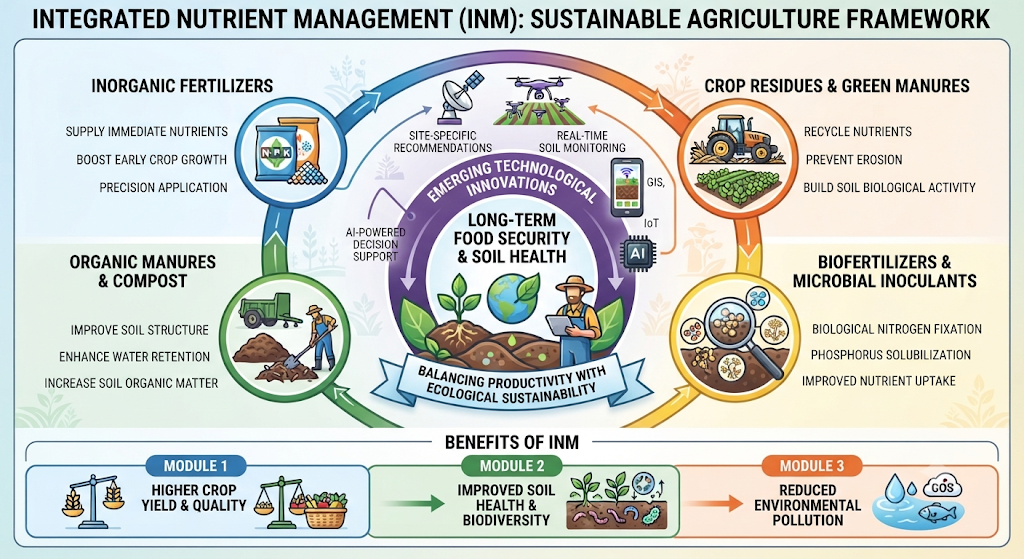
Integrated Nutrient Management aims to optimize nutrient availability throughout the crop growth cycle by synchronizing nutrient release from multiple sources according to crop demand. Organic amendments improve soil structure, water-holding capacity, microbial activity, and nutrient retention, whereas inorganic fertilizers provide readily available nutrients required during critical stages of plant growth. Biofertilizers containing beneficial microorganisms such as Rhizobium, Azotobacter, Azospirillum, phosphate-solubilizing bacteria, and mycorrhizal fungi further enhance nutrient availability through biological nitrogen fixation, phosphorus solubilization, and improved nutrient uptake. Consequently, INM contributes not only to higher crop productivity but also to improved soil biological health, increased nutrient-use efficiency, reduced environmental pollution, and enhanced resilience against climate variability. Recent technological advancements—including precision agriculture, Geographic Information Systems (GIS), remote sensing, Internet of Things (IoT) sensors, Artificial Intelligence (AI), and decision support systems—have further strengthened nutrient management by enabling site-specific fertilizer recommendations and real-time monitoring of soil nutrient status. Governments and international organizations increasingly recognize INM as an essential component of sustainable agricultural development and climate-smart farming systems. This study therefore evaluates the principles, components, benefits, and challenges of Integrated Nutrient Management, examines its contribution to enhancing crop yield and soil fertility, explores emerging technological innovations supporting sustainable nutrient management, and discusses future policy directions for promoting environmentally sustainable and economically viable agricultural systems. Ultimately, the adoption of Integrated Nutrient Management practices will play a crucial role in achieving long-term food security, restoring soil health, conserving natural resources, and ensuring sustainable agricultural development for future generations.
Principles and Components of Integrated Nutrient Management (INM)#
Integrated Nutrient Management (INM) is a holistic approach to plant nutrition that combines chemical fertilizers, organic manures, crop residues, green manures, biofertilizers, and locally available nutrient resources to provide balanced nutrition for crops while maintaining long-term soil fertility and environmental sustainability. Unlike conventional nutrient management systems that rely heavily on inorganic fertilizers, INM emphasizes the efficient utilization of multiple nutrient sources to optimize crop productivity without degrading soil health. The fundamental objective of INM is to achieve sustainable agricultural production by maintaining an appropriate balance between nutrient inputs and outputs while improving nutrient-use efficiency and minimizing environmental pollution. This approach recognizes that no single nutrient source can adequately satisfy crop requirements or sustain soil productivity over extended periods. Therefore, the integration of organic, inorganic, and biological nutrient sources ensures continuous nutrient availability throughout the crop growth cycle while improving soil physical, chemical, and biological properties. By maintaining soil fertility and reducing nutrient losses through leaching, volatilization, erosion, and runoff, Integrated Nutrient Management contributes significantly to sustainable crop production and long-term agricultural resilience.
The effectiveness of INM depends upon the coordinated use of various nutrient sources, each contributing unique benefits to agricultural systems. Chemical fertilizers provide readily available essential macronutrients such as nitrogen (N), phosphorus (P), and potassium (K), enabling rapid crop growth during critical developmental stages. However, excessive dependence on chemical fertilizers may reduce soil organic matter, disrupt microbial activity, and create nutrient imbalances. Organic nutrient sources—including farmyard manure (FYM), compost, vermicompost, poultry manure, green manure, crop residues, and municipal organic waste—improve soil structure, increase organic carbon content, enhance water-holding capacity, stimulate microbial activity, and gradually release nutrients over time. Green manuring with legumes such as Sesbania, Sunhemp, and Dhaincha enriches soil nitrogen through biological nitrogen fixation while improving soil texture and organic matter content. Crop residues recycled into the soil further contribute to nutrient cycling, reduce erosion, conserve soil moisture, and enhance microbial diversity. Biofertilizers constitute another important component of INM by utilizing beneficial microorganisms that improve nutrient availability through biological processes. Nitrogen-fixing bacteria such as Rhizobium, Azotobacter, and Azospirillum, phosphate-solubilizing bacteria (PSB), potassium-solubilizing microorganisms, arbuscular mycorrhizal fungi (AMF), and zinc-solubilizing bacteria enhance nutrient uptake while reducing dependence on synthetic fertilizers. These biological inputs promote sustainable nutrient cycling, improve root development, and strengthen plant resistance to environmental stress.
Integrated Nutrient Management is guided by several scientific principles that ensure efficient nutrient utilization while preserving environmental quality. One fundamental principle involves balanced nutrient application, whereby crops receive appropriate quantities of macro- and micronutrients according to soil nutrient status, crop requirements, and expected yield targets. Soil testing and nutrient budgeting play critical roles in determining site-specific fertilizer recommendations that prevent both nutrient deficiencies and excessive fertilizer application. Another principle emphasizes synchronization between nutrient supply and crop demand, ensuring that nutrients become available when plants require them most during different growth stages. This synchronization minimizes nutrient losses and improves fertilizer-use efficiency. INM also promotes integrated soil fertility management, recognizing that soil health depends not only on nutrient availability but also on soil organic matter, microbial diversity, pH balance, moisture retention, and physical structure. Conservation practices such as crop rotation, cover cropping, minimum tillage, mulching, and residue incorporation complement nutrient management by improving soil quality and preventing degradation. Furthermore, INM supports environmental sustainability by reducing nitrate leaching, greenhouse gas emissions, groundwater contamination, and excessive chemical fertilizer use. Modern technologies—including precision agriculture, Geographic Information Systems (GIS), remote sensing, Internet of Things (IoT) sensors, and Artificial Intelligence (AI)-based nutrient management systems—further enhance INM by enabling real-time monitoring of soil fertility and precise nutrient application. Collectively, these principles establish Integrated Nutrient Management as a scientifically sound, economically viable, and environmentally sustainable strategy capable of enhancing crop productivity, restoring soil fertility, conserving natural resources, and supporting resilient agricultural systems under changing climatic conditions.
Role of Integrated Nutrient Management in Enhancing Crop Yield and Soil Fertility#
Integrated Nutrient Management (INM) plays a crucial role in improving crop productivity while simultaneously restoring and maintaining soil fertility. Sustainable agricultural production depends upon the continuous availability of essential nutrients in appropriate quantities throughout the crop growth cycle. However, prolonged cultivation, intensive cropping, and indiscriminate application of chemical fertilizers have caused nutrient depletion, declining soil organic matter, reduced microbial activity, and deterioration of soil physical properties in many agricultural regions. These changes have lowered fertilizer-use efficiency and negatively affected crop performance. Integrated Nutrient Management addresses these challenges by combining inorganic fertilizers with organic manures, crop residues, green manures, and biofertilizers to create a balanced nutrient supply system. This integrated approach improves nutrient availability, enhances nutrient uptake by plants, and increases fertilizer-use efficiency while reducing nutrient losses through leaching, runoff, and volatilization. As a result, crops receive a continuous and balanced supply of macro- and micronutrients, leading to improved plant growth, higher biomass production, better grain quality, and increased overall yield.
One of the primary advantages of INM is its ability to improve soil physical properties, which are fundamental to sustainable crop production. Organic amendments such as farmyard manure, compost, vermicompost, and crop residues increase soil organic carbon content, improve soil aggregation, reduce bulk density, and enhance porosity. Improved soil structure promotes better root penetration, greater water infiltration, and increased water-holding capacity, enabling crops to withstand periods of moisture stress more effectively. Organic matter also acts as a reservoir of nutrients, gradually releasing essential elements during decomposition and minimizing nutrient losses. Furthermore, conservation of soil moisture through organic mulches and residue incorporation supports plant growth during drought conditions while reducing irrigation requirements. These improvements in soil physical characteristics create a favorable environment for root development and efficient nutrient absorption, ultimately contributing to higher crop productivity. Long-term studies have consistently demonstrated that integrated nutrient management maintains soil productivity more effectively than the exclusive use of chemical fertilizers.
Integrated Nutrient Management also significantly enhances soil chemical and biological fertility. The balanced application of nutrients helps maintain optimal soil pH, increases cation exchange capacity, and improves the availability of essential nutrients such as nitrogen, phosphorus, potassium, sulfur, zinc, iron, and boron. Organic materials reduce nutrient fixation in the soil and enhance nutrient buffering capacity, ensuring a more stable nutrient supply throughout the growing season. Biofertilizers containing beneficial microorganisms—including Rhizobium, Azotobacter, Azospirillum, phosphate-solubilizing bacteria (PSB), and arbuscular mycorrhizal fungi (AMF)—play an important role in biological nitrogen fixation, phosphorus solubilization, and enhanced nutrient mobilization. These microorganisms improve root growth, increase nutrient absorption, stimulate plant hormone production, and suppress certain soil-borne pathogens. Organic amendments further stimulate microbial diversity by providing energy sources for beneficial soil microorganisms involved in decomposition, nutrient mineralization, and humus formation. Enhanced microbial activity accelerates nutrient cycling, improves soil biological health, and strengthens ecosystem resilience. Consequently, INM supports both immediate crop nutrition and long-term soil fertility by sustaining biological processes that are essential for productive agricultural ecosystems.
Beyond improving crop yield and soil health, Integrated Nutrient Management contributes substantially to environmental sustainability and economic profitability. Balanced fertilizer application reduces excessive use of synthetic fertilizers, thereby lowering production costs and minimizing environmental pollution caused by nitrate leaching, eutrophication, greenhouse gas emissions, and soil degradation. Efficient nutrient management decreases dependence on costly chemical inputs while improving nutrient-use efficiency and farm profitability. Farmers also benefit from improved crop quality, enhanced market value, and greater resilience against climatic variability. In addition, INM supports sustainable cropping systems through crop rotation, residue recycling, integrated farming, and conservation agriculture, all of which contribute to long-term agricultural sustainability. Modern technologies such as precision agriculture, remote sensing, Geographic Information Systems (GIS), Artificial Intelligence (AI), and soil testing further enhance nutrient management by enabling site-specific fertilizer recommendations based on crop requirements and soil conditions. Collectively, these benefits demonstrate that Integrated Nutrient Management is a scientifically sound and economically viable strategy for increasing crop yields, restoring soil fertility, conserving natural resources, and promoting sustainable agricultural development in the face of growing food demand and environmental challenges.
Technological Innovations and Sustainable Nutrient Management Strategies#
Technological advancements have significantly transformed nutrient management practices by enabling farmers to optimize fertilizer application, improve soil health, increase nutrient-use efficiency, and promote sustainable agricultural production. Traditional nutrient management methods often relied on uniform fertilizer recommendations without considering variations in soil fertility, crop nutrient requirements, and environmental conditions. Such generalized practices frequently resulted in excessive fertilizer use, nutrient imbalances, reduced fertilizer-use efficiency, increased production costs, and environmental degradation. Modern technologies now facilitate site-specific nutrient management, allowing farmers to apply the right nutrient source at the appropriate rate, time, and place according to crop demand. Precision agriculture has emerged as one of the most effective technological approaches supporting Integrated Nutrient Management (INM) by combining digital technologies, scientific data analysis, and automated decision-making systems to improve nutrient application accuracy. These innovations not only increase crop productivity but also minimize nutrient losses, reduce greenhouse gas emissions, and protect soil and water resources from contamination.
One of the most important technological innovations in sustainable nutrient management is the integration of Precision Agriculture with Geographic Information Systems (GIS), Global Positioning Systems (GPS), Remote Sensing, and Internet of Things (IoT) technologies. GIS enables spatial mapping of soil nutrient variability across agricultural fields, allowing farmers to identify nutrient-deficient zones and apply fertilizers accordingly. GPS-guided machinery supports precise fertilizer placement and minimizes overlapping applications, thereby reducing input wastage. Remote sensing using satellites and drones provides real-time information regarding crop vigor, chlorophyll content, canopy health, nutrient deficiencies, and moisture status through vegetation indices such as the Normalized Difference Vegetation Index (NDVI). IoT-based soil sensors continuously monitor soil moisture, pH, electrical conductivity, temperature, and nutrient concentrations, transmitting real-time data to cloud-based platforms for analysis. Artificial Intelligence (AI) and Machine Learning (ML) algorithms further process these datasets to generate customized fertilizer recommendations, predict nutrient deficiencies, optimize irrigation schedules, and forecast crop nutrient requirements under varying climatic conditions. Decision Support Systems (DSS) and mobile-based agricultural advisory platforms provide farmers with location-specific guidance regarding fertilizer doses, timing of application, and integrated nutrient management practices, thereby improving nutrient-use efficiency while reducing environmental impacts.
Biotechnological innovations have also strengthened sustainable nutrient management by improving nutrient availability and enhancing soil biological activity. The use of biofertilizers, including nitrogen-fixing bacteria (Rhizobium, Azotobacter, Azospirillum), phosphate-solubilizing microorganisms (PSB), potassium-solubilizing bacteria, arbuscular mycorrhizal fungi (AMF), and plant growth-promoting rhizobacteria (PGPR), enhances nutrient mobilization and reduces dependence on synthetic fertilizers. These beneficial microorganisms improve root development, increase nutrient absorption, stimulate plant growth through phytohormone production, and enhance resistance to environmental stress. Advances in biotechnology have also facilitated the development of crop varieties with improved nutrient-use efficiency, enabling plants to utilize available nutrients more effectively while maintaining high productivity under nutrient-limited conditions. Controlled-release fertilizers, nano-fertilizers, polymer-coated fertilizers, and micronutrient-enriched formulations represent additional technological innovations that gradually release nutrients according to crop demand, thereby minimizing nutrient losses through volatilization, runoff, and leaching. Organic waste recycling technologies—including vermicomposting, composting, biochar production, and integrated waste management—convert agricultural residues and livestock waste into valuable organic fertilizers, promoting circular nutrient economy and reducing environmental pollution.
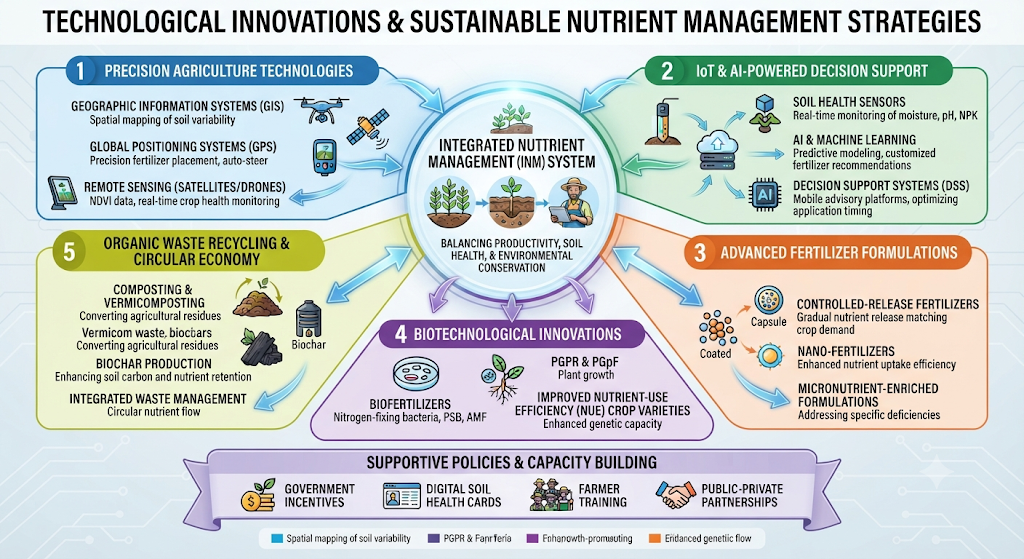 Sustainable nutrient management also depends on supportive institutional policies and farmer capacity building. Governments should promote soil testing programmes, digital soil health cards, nutrient budgeting, climate-smart agricultural extension services, and precision farming initiatives to encourage efficient nutrient management. Investments in agricultural research, digital infrastructure, rural internet connectivity, and farmer training programmes will facilitate widespread adoption of advanced nutrient management technologies. Public-private partnerships can accelerate technology transfer, improve access to precision farming equipment, and develop affordable digital advisory services for smallholder farmers. Financial incentives, subsidies for organic inputs, and support for biofertilizer production can further encourage sustainable nutrient management practices. International organizations such as the Food and Agriculture Organization (FAO), International Fertilizer Association (IFA), and CGIAR continue promoting integrated nutrient management through research, policy guidance, and global knowledge-sharing initiatives. Ultimately, the integration of modern technologies with scientifically balanced nutrient management practices offers a sustainable pathway for enhancing crop productivity, restoring soil fertility, conserving natural resources, reducing environmental degradation, and ensuring long-term agricultural sustainability under changing climatic conditions.
Future Perspectives and Policy Interventions for Integrated Nutrient Management#
The future of sustainable agriculture depends significantly on the efficient management of soil nutrients while preserving environmental quality and ensuring long-term food security. As global demand for agricultural production continues to increase due to rapid population growth, urbanization, and changing dietary patterns, farming systems must adopt nutrient management practices that enhance productivity without degrading natural resources. Integrated Nutrient Management (INM) provides a scientifically sound framework for achieving this balance by combining organic, inorganic, and biological nutrient sources with modern technological innovations. However, the successful implementation of INM requires supportive public policies, continuous scientific research, technological advancement, institutional strengthening, and active participation of farming communities. Future agricultural development should focus on improving nutrient-use efficiency, restoring degraded soils, reducing dependence on chemical fertilizers, enhancing soil biodiversity, and minimizing environmental pollution through climate-smart and resource-efficient nutrient management strategies. Governments, research institutions, international organizations, and private stakeholders must collaborate to develop comprehensive nutrient management programmes that strengthen agricultural resilience under changing climatic conditions.
Technological innovation will continue to play a transformative role in advancing Integrated Nutrient Management. Artificial Intelligence (AI), Machine Learning (ML), Internet of Things (IoT), Geographic Information Systems (GIS), remote sensing, satellite-based monitoring, robotics, and precision agriculture are expected to revolutionize nutrient management by enabling real-time monitoring of soil fertility, crop nutrient requirements, and environmental conditions. Smart nutrient management systems equipped with soil sensors and automated decision-support platforms will provide farmers with location-specific recommendations regarding fertilizer application, irrigation scheduling, and crop management. The increasing adoption of drones, satellite imagery, and digital soil mapping will improve nutrient deficiency diagnosis and facilitate variable-rate fertilizer application, thereby enhancing fertilizer-use efficiency while reducing production costs and environmental impacts. Biotechnology will also contribute significantly through the development of crop varieties possessing higher nutrient-use efficiency, enhanced tolerance to nutrient-deficient soils, and improved resistance to climatic stress. Nano-fertilizers, controlled-release fertilizers, bio-stimulants, microbial inoculants, and advanced biofertilizer formulations will further improve nutrient availability while minimizing nutrient losses and environmental contamination. Organic waste recycling technologies, including vermicomposting, composting, biochar production, and integrated residue management, should be expanded to promote circular nutrient economy and sustainable resource utilization.
Effective policy interventions are equally important for promoting widespread adoption of Integrated Nutrient Management practices. Governments should prioritize soil health restoration by implementing national soil fertility programmes, digital soil health card schemes, mandatory soil testing services, and site-specific nutrient management recommendations. Agricultural extension systems should be strengthened through regular farmer training programmes, field demonstrations, digital advisory platforms, and knowledge dissemination activities that increase awareness regarding balanced nutrient management practices. Financial incentives, subsidies for organic fertilizers and biofertilizers, affordable agricultural credit, and crop insurance programmes can encourage farmers to invest in sustainable nutrient management technologies. Public investment in agricultural research should focus on developing locally adapted nutrient management packages, climate-resilient crop varieties, efficient fertilizer formulations, and precision agriculture technologies suitable for diverse agroecological conditions. Public-private partnerships can accelerate technology transfer, promote digital agriculture, strengthen fertilizer supply chains, and facilitate access to precision farming equipment for smallholder farmers. International organizations such as the Food and Agriculture Organization (FAO), CGIAR, International Fertilizer Association (IFA), and the International Plant Nutrition Institute (IPNI) should continue supporting global collaboration through research, technology transfer, policy development, and capacity-building initiatives. Future policies should also encourage integrated farming systems, conservation agriculture, agroforestry, organic farming, and climate-smart agriculture as complementary approaches that strengthen nutrient cycling and ecological sustainability. Ultimately, achieving sustainable nutrient management requires an integrated strategy that combines scientific innovation, technological advancement, supportive governance, environmental stewardship, farmer participation, and international cooperation. Such a holistic approach will enhance crop productivity, restore soil fertility, conserve natural resources, improve food security, and ensure resilient agricultural systems capable of meeting future global challenges.
Conclusion#
Integrated Nutrient Management has emerged as one of the most effective approaches for achieving sustainable agricultural production while maintaining soil fertility, environmental quality, and long-term food security. The increasing pressure on agricultural systems resulting from rapid population growth, declining soil fertility, climate change, and intensive farming practices has highlighted the limitations of relying exclusively on chemical fertilizers. Continuous application of inorganic fertilizers without adequate replenishment of organic matter has contributed to nutrient imbalances, soil degradation, declining microbial activity, groundwater contamination, and reduced fertilizer-use efficiency. This study demonstrates that Integrated Nutrient Management provides a balanced and scientifically sound solution by combining chemical fertilizers with organic manures, crop residues, green manures, compost, vermicompost, biofertilizers, and beneficial microorganisms. Such integration ensures continuous nutrient availability, improves soil physical, chemical, and biological properties, enhances nutrient-use efficiency, and promotes sustainable crop production. Furthermore, INM strengthens soil resilience by improving soil organic carbon, microbial diversity, water-holding capacity, and nutrient cycling, thereby supporting long-term agricultural productivity.
The study also emphasizes that Integrated Nutrient Management contributes significantly to improving crop yield and restoring soil health through balanced nutrient application and efficient resource utilization. Organic amendments enhance soil structure and moisture retention, while inorganic fertilizers provide readily available nutrients during critical crop growth stages. Biofertilizers further improve nutrient availability through biological nitrogen fixation, phosphorus solubilization, and enhanced nutrient uptake. The integration of these nutrient sources not only increases agricultural productivity but also reduces nutrient losses through leaching, volatilization, and runoff, thereby minimizing environmental pollution. Modern technological innovations—including precision agriculture, Artificial Intelligence (AI), Machine Learning (ML), Geographic Information Systems (GIS), remote sensing, Internet of Things (IoT), and digital decision-support systems—have transformed nutrient management by enabling site-specific fertilizer recommendations, real-time soil monitoring, and efficient resource management. These technologies enhance fertilizer-use efficiency, reduce production costs, improve environmental sustainability, and strengthen farmers' decision-making capabilities. However, technological advancement alone cannot ensure successful implementation of Integrated Nutrient Management. Strong institutional support, agricultural extension services, research investments, farmer education, financial incentives, and effective policy interventions remain essential for promoting large-scale adoption of sustainable nutrient management practices.
Looking forward, future agricultural development should prioritize integrated approaches that combine scientific innovation, climate-smart agriculture, digital technologies, ecological conservation, and participatory governance. Governments should strengthen soil health programmes, expand soil testing services, promote organic farming and biofertilizer production, encourage precision agriculture, and provide financial support for sustainable nutrient management technologies. International organizations, research institutions, universities, private industries, and farming communities should collaborate to develop innovative nutrient management solutions tailored to local agroecological conditions. Greater emphasis should also be placed on farmer training, digital literacy, women’s participation, youth engagement, and community-based resource management to ensure inclusive agricultural development. Ultimately, Integrated Nutrient Management represents a cornerstone of sustainable agriculture because it simultaneously enhances crop productivity, restores soil fertility, conserves natural resources, improves environmental quality, and strengthens food security. By integrating modern technology, balanced nutrient application, effective public policy, and scientific research, agricultural systems can become more productive, resilient, environmentally sustainable, and economically viable, thereby ensuring sustainable development and nutritional security for present and future generations.
Works Cited#
- Food and Agriculture Organization of the United Nations. (2024). The State of Food and Agriculture 2024: Innovation for Sustainable Agricultural Systems. Rome: FAO.
- Food and Agriculture Organization of the United Nations. (2023). Sustainable Soil Management for Food Security. Rome: FAO.
- International Fertilizer Association. (2024). Fertilizer Outlook and Sustainable Nutrient Management Report. Paris: IFA.
- International Fertilizer Development Center. (2023). Integrated Soil Fertility Management for Sustainable Agriculture. Muscle Shoals, AL: IFDC.
- Consultative Group on International Agricultural Research. (2024). Sustainable Soil Health and Nutrient Management Research Report. Montpellier: CGIAR.
- Indian Council of Agricultural Research. (2023). Integrated Nutrient Management in Indian Agriculture. New Delhi: ICAR.
- International Plant Nutrition Institute. (2022). 4R Nutrient Stewardship: Right Source, Right Rate, Right Time, Right Place. Peachtree Corners, GA: IPNI.
- World Bank. (2024). Transforming Food Systems for Sustainable Development. Washington, DC: World Bank.
- United Nations Environment Programme. (2024). Global Environment Outlook: Sustainable Agriculture and Soil Health. Nairobi: UNEP.
- Organisation for Economic Co-operation and Development. (2023). Agricultural Policies for Sustainable Nutrient Management. Paris: OECD Publishing.
- Palm, Cheryl A.., et al. (1997). Combined use of organic and inorganic nutrient sources for soil fertility maintenance and replenishment. Replenishing Soil Fertility in Africa, 193–217.
- Vanlauwe, Bernard., et al. (2010). Integrated Soil Fertility Management: Operational definition and consequences for implementation. Outlook on Agriculture, 39(1), 17–24.
- Gruhn, Peter., Goletti, Francesco., & Yudelman, Montague. (2000). Integrated Nutrient Management, Soil Fertility, and Sustainable Agriculture. Washington, DC: IFPRI.
- Ladha, Prem S.., et al. (2021). Integrated nutrient management for sustainable crop production and soil health. Agronomy, 11(12), 2458.
- Chivenge, Pauline., et al. (2011). Integrated soil fertility management for improved crop productivity in sub-Saharan Africa. Plant and Soil, 339(1–2), 93–107.
- Roy, Rabindra N.., et al. (2006). Plant Nutrition for Food Security: A Guide for Integrated Nutrient Management. Rome: FAO.
- Baligar, Virupax C.., & Fageria, Nand Kumar. (2007). Agronomy and physiology of nutrient use efficiency. Journal of Plant Nutrition, 30(7), 1011–1045.
- Agegnehu, Getachew., et al. (2016). Benefits of integrated nutrient management on crop productivity and soil health. Agriculture, Ecosystems & Environment, 224, 88–98.
- Fageria, Nand Kumar., Baligar, Virupax C.., & Li, Ying. (2008). The role of nutrient-efficient plants in improving crop productivity. Advances in Agronomy, 88, 97–185.
- Pretty, Jules. (2008). Agricultural sustainability: Concepts, principles, and evidence. Philosophical Transactions of the Royal Society B: Biological Sciences, 363(1491), 447–465.