Abstract
Organic nutrient management has become an essential component of sustainable fruit production due to increasing concerns regarding soil degradation, environmental pollution, and excessive dependence on synthetic fertilizers. Organic nutrient sources such as farmyard manure, compost, vermicompost, poultry manure, green manure, crop residues, biofertilizers, and oil cakes improve soil fertility while supplying essential macro- and micronutrients required for healthy plant growth. Unlike chemical fertilizers, organic amendments release nutrients gradually through microbial decomposition, thereby enhancing nutrient-use efficiency, reducing nutrient losses, and improving long-term soil productivity. The application of organic nutrient sources enhances soil physical, chemical, and biological properties by increasing soil organic matter, improving water-holding capacity, promoting beneficial microbial activity, and stimulating nutrient cycling. These improvements support better root development, higher photosynthetic efficiency, increased flowering and fruit set, improved fruit size, enhanced yield, and superior fruit quality characteristics such as total soluble solids, sugar content, vitamin concentration, and shelf life. Organic nutrient management also contributes to climate-smart agriculture by increasing soil carbon sequestration, reducing greenhouse gas emissions, and promoting environmentally sustainable farming practices. Recent advances in Geographic Information Systems (GIS), Remote Sensing (RS), Internet of Things (IoT), artificial intelligence, and precision horticulture have further enhanced nutrient management through site-specific monitoring and decision support. This paper examines various organic nutrient sources, evaluates their effects on growth, yield, and fruit quality, discusses their role in sustainable orchard management, and explores emerging technologies and future prospects for environmentally sustainable fruit production.
- Organic Nutrient Sources
- Fruit Crops
- Organic Farming
- Soil Fertility
- Fruit Quality
- Crop Yield
- Biofertilizers
- Vermicompost
- Sustainable Horticulture
- Precision Agriculture
Introduction#
Fruit crops play an important role in ensuring nutritional security, improving farm income, and supporting sustainable agricultural development. Fruits provide essential vitamins, minerals, dietary fiber, antioxidants, and bioactive compounds that contribute significantly to human health. Increasing consumer demand for safe, nutritious, and chemical-free fruits has encouraged the adoption of environmentally sustainable nutrient management practices. Among these, the use of organic nutrient sources has gained considerable attention because of its ability to improve soil fertility, maintain ecological balance, and enhance fruit quality while reducing dependence on synthetic fertilizers.
Conventional fruit production systems often rely heavily on chemical fertilizers to achieve higher yields. Although these fertilizers provide readily available nutrients, their continuous and excessive use may lead to soil degradation, nutrient imbalance, declining organic matter, groundwater contamination, and reduced microbial diversity. Such problems not only threaten long-term soil productivity but also increase environmental pollution and production costs. Consequently, integrated and organic nutrient management practices have become increasingly important for achieving sustainable fruit production.
Organic nutrient sources include farmyard manure (FYM), compost, vermicompost, poultry manure, green manure, oil cakes, crop residues, bone meal, neem cake, and biofertilizers. These materials supply both macro- and micronutrients while improving soil structure and supporting biological activity. Nutrients are released gradually through microbial decomposition, ensuring a continuous nutrient supply during different stages of crop growth. Organic amendments also increase soil organic carbon, improve cation exchange capacity, enhance water-holding capacity, and stimulate beneficial microorganisms responsible for nutrient cycling.
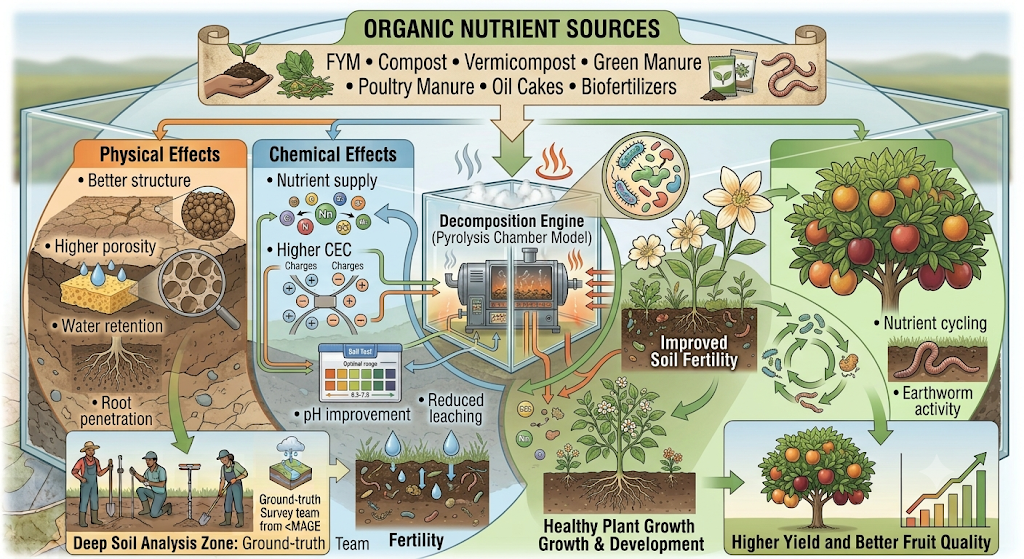
Figure. Organic Nutrient Sources, Characteristics, and Nutrient Release Mechanism
The application of organic nutrient sources positively influences various physiological and biochemical processes in fruit crops. Improved nutrient availability promotes vigorous vegetative growth, better root development, enhanced chlorophyll formation, increased photosynthetic activity, and efficient carbohydrate synthesis. These improvements contribute to higher flowering intensity, improved fruit set, greater fruit retention, and increased yield. Furthermore, organic nutrient management enhances fruit quality by increasing total soluble solids (TSS), sugars, vitamin C content, antioxidant activity, fruit firmness, aroma, flavor, and storage life. These quality improvements increase market value and consumer acceptance.
Organic nutrient management also contributes significantly to environmental sustainability. Recycling agricultural residues and livestock wastes into valuable organic fertilizers reduces waste accumulation while promoting nutrient recycling and carbon sequestration. Organic amendments reduce nutrient leaching, improve fertilizer-use efficiency, lower greenhouse gas emissions, and increase soil biodiversity. Their integration with biofertilizers and conservation practices further strengthens sustainable orchard management and climate resilience.
Recent technological developments have expanded the scope of organic nutrient management in horticulture. Geographic Information Systems (GIS), Remote Sensing (RS), Internet of Things (IoT)-based soil sensors, Artificial Intelligence (AI), drone technology, and precision agriculture now enable site-specific nutrient assessment and optimized application of organic inputs. These technologies improve nutrient-use efficiency, reduce production costs, and support data-driven orchard management.
Despite numerous benefits, widespread adoption of organic nutrient management still faces challenges including slow nutrient release, bulky material handling, variable nutrient composition, limited availability of quality organic inputs, and inadequate farmer awareness. Continued research, policy support, technological innovation, and effective extension services are therefore essential to promote sustainable nutrient management in fruit production systems.
This paper examines the characteristics and mechanisms of organic nutrient sources, evaluates their effects on fruit crop growth, yield, and quality, discusses their contribution to sustainable orchard management, and highlights emerging technologies and future prospects for organic nutrient management in modern horticulture.
Organic Nutrient Sources, Characteristics, and Nutrient Release Mechanisms#
Organic nutrient sources are naturally derived materials that supply essential plant nutrients while improving soil fertility and maintaining ecological balance. Unlike synthetic fertilizers, which provide nutrients in readily available forms, organic amendments release nutrients gradually through biological decomposition and mineralization. This slow and sustained nutrient release improves nutrient-use efficiency, minimizes losses through leaching and volatilization, and supports continuous plant growth. Organic nutrient management has therefore become an important component of sustainable fruit production systems.
Several types of organic nutrient sources are widely used in fruit orchards. Farmyard manure (FYM), prepared from decomposed cattle dung, urine, bedding materials, and farm residues, is one of the oldest and most commonly used organic fertilizers. FYM supplies nitrogen, phosphorus, potassium, calcium, magnesium, sulfur, and several micronutrients while improving soil structure and increasing soil organic matter. Compost, produced through the controlled decomposition of plant residues and organic wastes, provides balanced nutrients and enhances soil microbial activity. Vermicompost, produced through the action of earthworms, is particularly rich in plant-available nutrients, enzymes, vitamins, growth-promoting substances, and beneficial microorganisms.
Other important organic nutrient sources include green manures, oil cakes, poultry manure, bone meal, fish meal, and crop residues. Green manure crops such as sunn hemp, dhaincha, and cowpea are incorporated into the soil before flowering to increase organic matter and biological nitrogen fixation. Oil cakes like neem cake, groundnut cake, and mustard cake supply nutrients while improving soil microbial activity and suppressing certain soil-borne pests. Poultry manure contains comparatively higher concentrations of nitrogen and phosphorus, making it a valuable nutrient source for fruit crops. Biofertilizers such as nitrogen-fixing bacteria, phosphate-solubilizing bacteria, potassium-solubilizing microorganisms, and arbuscular mycorrhizal fungi further enhance nutrient availability and improve plant growth.
Organic nutrient sources improve soil physical properties by increasing soil organic matter content, reducing bulk density, enhancing soil aggregation, and improving porosity. These changes facilitate better root penetration, increase aeration, and improve water infiltration and water-holding capacity. In fruit orchards, improved soil structure promotes deeper root development, enabling trees to access moisture and nutrients more efficiently during dry periods.
The chemical properties of soil are also enhanced through organic nutrient application. Organic amendments increase the cation exchange capacity (CEC) of soils, allowing greater retention of essential nutrients such as nitrogen, phosphorus, potassium, calcium, magnesium, and micronutrients. They help buffer soil pH, reduce nutrient fixation, and minimize nutrient losses through leaching. Organic matter also forms complexes with micronutrients, improving their availability for plant uptake throughout the growing season.
Organic nutrient sources play an equally important role in improving the biological health of soils. During decomposition, organic materials provide energy and carbon to beneficial soil microorganisms responsible for nutrient cycling and organic matter mineralization. Populations of nitrogen-fixing bacteria, phosphate-solubilizing bacteria, actinomycetes, fungi, and earthworms increase significantly in organically managed soils. These organisms produce enzymes, organic acids, vitamins, and plant growth-promoting substances that stimulate root development and improve nutrient absorption.
The mechanism of nutrient release from organic amendments involves microbial decomposition and mineralization. Soil microorganisms break down complex organic compounds into simpler inorganic forms that can be absorbed by plant roots. Nitrogen is converted into ammonium and nitrate, phosphorus becomes more soluble through microbial activity, and potassium is gradually released from decomposing organic residues. Because nutrient release occurs gradually, plants receive a sustained supply of nutrients throughout different growth stages, reducing the risk of nutrient deficiency or toxicity.
Several factors influence the rate of nutrient release, including the carbon-to-nitrogen (C:N) ratio, temperature, soil moisture, aeration, microbial activity, and the degree of decomposition of the organic material. Warm temperatures, adequate moisture, and active microbial populations accelerate mineralization, whereas dry or cold conditions slow nutrient release.
Overall, organic nutrient sources improve soil fertility through integrated physical, chemical, and biological mechanisms. Their gradual nutrient release, enhancement of microbial activity, and improvement of soil structure make them essential components of sustainable nutrient management for fruit crop production.
Effect of Organic Nutrient Sources on Growth, Yield, and Quality of Fruit Crop#
Organic nutrient sources play a significant role in improving the growth, yield, and quality of fruit crops by enhancing soil fertility and providing a balanced supply of essential nutrients. Unlike chemical fertilizers that often supply nutrients for a short duration, organic amendments release nutrients gradually, ensuring continuous availability throughout different stages of plant development. This sustained nutrient supply supports healthy vegetative growth, reproductive development, and fruit maturation while maintaining long-term soil productivity.
One of the primary effects of organic nutrient sources is the promotion of vegetative growth. Improved nutrient availability stimulates cell division, chlorophyll synthesis, and photosynthetic activity, resulting in greater plant height, stem girth, canopy spread, leaf area, and root development. Enhanced root growth enables fruit trees to absorb water and nutrients more efficiently, increasing their tolerance to drought and other environmental stresses. Organic amendments also improve soil moisture retention, allowing trees to maintain physiological activity during periods of limited rainfall.
Organic nutrient management significantly enhances flowering and fruit set. Adequate availability of nitrogen, phosphorus, potassium, calcium, magnesium, boron, and zinc supports flower bud initiation, pollen viability, fertilization, and fruit development. Biofertilizers and vermicompost further stimulate the production of plant growth regulators such as auxins, gibberellins, and cytokinins, which improve flowering intensity and reduce premature flower and fruit drop. Consequently, fruit retention increases, leading to higher fruit yield per tree.
The application of organic nutrient sources positively influences fruit yield by improving nutrient-use efficiency and promoting balanced plant nutrition. Farmyard manure, compost, vermicompost, poultry manure, neem cake, and integrated organic nutrient management have consistently increased yields in mango, banana, citrus, guava, papaya, pomegranate, grape, apple, strawberry, and other fruit crops. Yield improvements result from increased fruit number, larger fruit size, greater fruit weight, and improved overall plant health.
Organic nutrient management also improves fruit quality, which has become increasingly important due to growing consumer demand for nutritious and chemical-free produce. Fruits produced under organic nutrient management often exhibit higher total soluble solids (TSS), sugar content, vitamin C concentration, antioxidants, phenolic compounds, aroma, flavor, and improved color development. Organic amendments promote balanced carbohydrate metabolism and enhance nutrient uptake, contributing to superior taste and nutritional value. Improved calcium availability also enhances fruit firmness, reducing physiological disorders and extending shelf life during storage and transportation.
The beneficial effects of organic nutrient sources are closely associated with improvements in soil microbial activity. Increased populations of nitrogen-fixing bacteria, phosphate-solubilizing microorganisms, mycorrhizal fungi, and decomposer organisms enhance nutrient mineralization and availability. These microorganisms also produce enzymes and plant growth-promoting substances that stimulate root growth and improve nutrient absorption. Healthy microbial communities contribute to greater resilience against soil-borne diseases and improve overall orchard productivity.
Organic nutrient management further strengthens soil health by increasing soil organic carbon, improving aggregation, reducing erosion, enhancing water infiltration, and increasing water-holding capacity. These improvements create favorable growing conditions for fruit trees, particularly in degraded soils or regions experiencing irregular rainfall. Long-term application of organic amendments also reduces dependence on chemical fertilizers, lowers production costs, and minimizes environmental pollution.
Research indicates that integrating organic nutrient sources with biofertilizers and limited chemical fertilizers through Integrated Nutrient Management (INM) often produces better results than the sole use of either organic or inorganic fertilizers. Such integrated approaches ensure balanced nutrient availability, maximize nutrient-use efficiency, and maintain soil fertility over successive cropping seasons.
Overall, organic nutrient sources improve every stage of fruit crop development, from vegetative growth and flowering to fruit yield and post-harvest quality. Their combined effects on soil fertility, microbial activity, nutrient availability, and environmental sustainability make them indispensable components of modern sustainable horticultural production systems.
Organic Nutrient Management for Sustainable Fruit Production and Soil Health#
Sustainable fruit production requires nutrient management practices that maintain soil fertility, conserve natural resources, and minimize environmental degradation while ensuring consistent crop productivity. Organic nutrient management has emerged as an effective strategy for achieving these objectives by integrating organic amendments, biofertilizers, and environmentally friendly cultivation practices. Unlike conventional fertilizer-dependent systems, organic nutrient management enhances long-term soil health while improving the sustainability and profitability of fruit production.
A major advantage of organic nutrient management is its contribution to soil health improvement. Continuous application of farmyard manure, compost, vermicompost, green manure, crop residues, and oil cakes increases soil organic matter, which serves as the foundation of healthy soil ecosystems. Higher organic matter improves soil aggregation, reduces compaction, increases porosity, and enhances water infiltration and water-holding capacity. These improvements create favorable conditions for root growth and nutrient absorption while reducing erosion and runoff.
Organic nutrient sources also strengthen the biological fertility of orchard soils. Increased soil organic carbon provides energy for beneficial microorganisms including nitrogen-fixing bacteria, phosphate-solubilizing bacteria, actinomycetes, mycorrhizal fungi, and earthworms. These organisms accelerate nutrient cycling, improve decomposition of organic materials, produce plant growth-promoting substances, and suppress certain soil-borne pathogens. Enhanced microbial diversity contributes to improved nutrient availability and greater resilience of orchard ecosystems.
An important component of sustainable nutrient management is Integrated Nutrient Management (INM), which combines organic manures, biofertilizers, and balanced chemical fertilizers according to crop requirements. INM ensures continuous nutrient availability while minimizing nutrient losses and reducing dependence on synthetic fertilizers. Numerous studies have demonstrated that integrating vermicompost, farmyard manure, and microbial inoculants with reduced fertilizer doses improves fruit yield, nutrient-use efficiency, and soil fertility more effectively than the exclusive use of either organic or inorganic sources.
Organic nutrient management also supports environmental sustainability by promoting recycling of agricultural residues and livestock wastes. Crop residues, fruit processing wastes, and animal manures are converted into valuable organic fertilizers rather than being burned or discarded. This recycling process reduces environmental pollution, minimizes waste generation, lowers greenhouse gas emissions, and contributes to carbon sequestration through increased soil organic carbon storage. Consequently, organic nutrient management plays a significant role in climate-smart horticulture.
The adoption of precision horticulture technologies has further improved the efficiency of organic nutrient management. Geographic Information Systems (GIS), Remote Sensing (RS), Global Positioning Systems (GPS), Internet of Things (IoT)-based soil sensors, drone technology, and Artificial Intelligence (AI) enable continuous monitoring of soil fertility, moisture status, and nutrient availability. These technologies facilitate site-specific application of organic amendments, improving nutrient-use efficiency while reducing production costs and environmental impacts.
Organic nutrient management also contributes to fruit quality enhancement by promoting balanced nutrition throughout the growing season. Improved availability of macro- and micronutrients enhances flowering, fruit development, sugar accumulation, vitamin synthesis, antioxidant production, fruit firmness, and shelf life. These quality improvements increase consumer acceptance and market value while supporting the growing demand for organically produced fruits.
Despite its numerous advantages, several challenges remain. Organic nutrient sources generally release nutrients more slowly than chemical fertilizers, requiring careful planning and timely application. Large quantities may be required to satisfy crop nutrient demands, and nutrient composition often varies among organic materials. Limited availability of quality organic inputs, labor-intensive handling, and insufficient farmer awareness also restrict widespread adoption.
Future sustainable fruit production will increasingly rely on integrating organic nutrient management with precision agriculture, climate-smart farming, and digital decision-support systems. Continued research, improved composting technologies, farmer education, supportive government policies, and efficient supply chains for quality organic inputs will further strengthen the role of organic nutrient management in environmentally sustainable horticulture. Through these integrated approaches, fruit production systems can maintain high productivity while conserving soil health and protecting natural ecosystems.
Challenges, Emerging Technologies, and Future Prospects of Organic Nutrient Management in Fruit Crops#
Organic nutrient management has gained considerable recognition for promoting sustainable fruit production; however, several technical, economic, and institutional challenges continue to limit its widespread adoption. Overcoming these constraints through scientific innovation, digital technologies, and supportive agricultural policies is essential for maximizing the long-term benefits of organic nutrient management in horticultural systems.
One of the major challenges is the slow release of nutrients from organic materials. Unlike chemical fertilizers that provide nutrients immediately, organic amendments require microbial decomposition before nutrients become available to plants. The rate of nutrient release depends on temperature, soil moisture, microbial activity, and the carbon-to-nitrogen ratio of the organic material. Consequently, improper timing of application may lead to temporary nutrient deficiencies during critical stages of flowering and fruit development.
Another important limitation is the variable nutrient composition of organic nutrient sources. Farmyard manure, compost, vermicompost, poultry manure, green manure, and crop residues differ considerably in their nutrient concentrations depending on feedstock, decomposition stage, storage conditions, and production methods. This variability makes it difficult to determine precise application rates, often resulting in nutrient imbalances or inconsistent crop responses. Standardization of organic manure quality and regular nutrient analysis are therefore essential for effective nutrient management.
The availability and transportation of organic inputs also present practical challenges. Large quantities of organic materials are often required to satisfy the nutrient demands of perennial fruit crops. Collection, composting, storage, transportation, and field application increase labor requirements and production costs. Smallholder farmers may face difficulties accessing quality organic inputs, particularly in regions where livestock populations or composting facilities are limited.
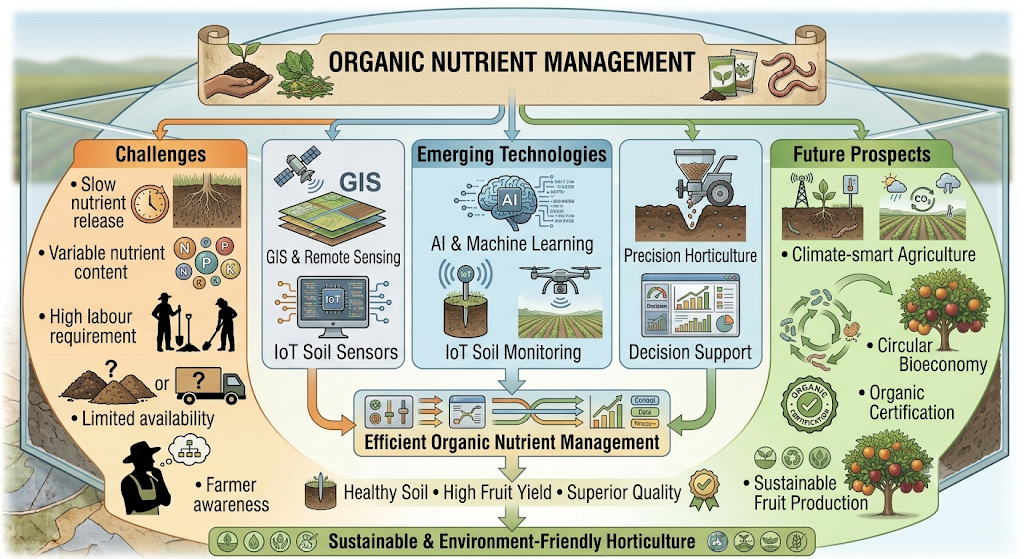
Figure. Challenges, Emerging Technologies, and Future Prospects of Organic Nutrient Management
Recent advances in precision horticulture are helping address these challenges. Geographic Information Systems (GIS) and Remote Sensing (RS) enable the mapping of soil fertility, organic carbon, moisture status, and crop vigor across orchards. These spatial datasets allow site-specific nutrient management by identifying areas requiring additional organic amendments. Precision application improves nutrient-use efficiency while reducing unnecessary input costs.
The Internet of Things (IoT) has introduced smart monitoring systems that continuously measure soil moisture, temperature, pH, electrical conductivity, and nutrient status through wireless sensors. Farmers can access real-time information using mobile applications, enabling timely irrigation and nutrient management decisions. IoT-based monitoring improves synchronization between nutrient release from organic materials and crop nutrient demand.
Artificial Intelligence (AI) and Machine Learning (ML) are increasingly supporting decision-making in organic orchard management. AI algorithms analyze weather conditions, soil properties, historical yield data, and nutrient status to recommend appropriate application rates and timings for organic manures and biofertilizers. Predictive models also help estimate nutrient mineralization rates, crop nutrient requirements, and yield responses under different management scenarios. Drone technology and hyperspectral imaging further assist in monitoring plant health, canopy growth, and nutrient deficiencies across large orchards.
Future prospects of organic nutrient management are closely linked with climate-smart agriculture, precision farming, and the circular bioeconomy. Recycling agricultural residues, livestock manure, fruit processing waste, and other biodegradable materials into compost and vermicompost supports sustainable waste management while reducing environmental pollution. Integration of organic nutrient sources with biofertilizers, conservation agriculture, mulching, precision irrigation, and integrated nutrient management offers significant opportunities for improving soil fertility and long-term orchard productivity.
Policy interventions will also play a vital role in expanding organic nutrient management. Governments should promote compost production units, quality certification systems, farmer training programs, financial incentives, and research on region-specific nutrient recommendations. Public-private partnerships can facilitate the development of efficient supply chains for quality organic inputs while improving access to modern technologies.
Overall, although several challenges remain, advances in digital agriculture, biotechnology, and sustainable resource management provide promising opportunities for improving organic nutrient management in fruit crops. The integration of innovative technologies with traditional organic farming practices will strengthen soil health, increase fruit productivity and quality, enhance climate resilience, and ensure environmentally sustainable horticultural production.
Conclusion#
Organic nutrient management has become an indispensable component of sustainable fruit production by improving soil fertility, enhancing crop productivity, and protecting environmental quality. The increasing demand for safe, nutritious, and environmentally friendly fruits has accelerated the adoption of organic nutrient sources such as farmyard manure, compost, vermicompost, green manure, poultry manure, oil cakes, crop residues, and biofertilizers. These organic inputs not only provide essential plant nutrients but also improve soil physical, chemical, and biological properties, creating a productive and resilient orchard ecosystem.
The discussion presented in this paper demonstrates that organic nutrient sources play a vital role in promoting healthy vegetative growth, efficient root development, improved flowering, higher fruit set, and increased fruit yield. Their gradual nutrient release ensures a continuous supply of essential macro- and micronutrients throughout the crop growth cycle while minimizing nutrient losses through leaching and volatilization. Enhanced nutrient-use efficiency supports balanced plant nutrition and reduces dependence on synthetic fertilizers, contributing to long-term agricultural sustainability.
Organic nutrient management significantly improves soil health by increasing soil organic matter, enhancing aggregation, reducing bulk density, improving water-holding capacity, and increasing cation exchange capacity. These improvements create favorable conditions for root growth and efficient absorption of water and nutrients. At the same time, organic amendments stimulate beneficial soil microorganisms, including nitrogen-fixing bacteria, phosphate-solubilizing bacteria, mycorrhizal fungi, and decomposer organisms. These microorganisms enhance nutrient cycling, organic matter decomposition, enzyme activity, and biological fertility, thereby strengthening the overall health of orchard soils.
The application of organic nutrient sources also contributes to superior fruit quality. Improved nutrient availability and balanced plant nutrition enhance total soluble solids, sugar accumulation, vitamin C content, antioxidants, fruit firmness, aroma, flavor, and shelf life. These quality improvements increase market value while meeting consumer demand for healthy and organically produced fruits. Furthermore, recycling agricultural residues and livestock wastes into organic fertilizers promotes efficient resource utilization, reduces environmental pollution, and supports the principles of a circular bioeconomy.
Modern technological advancements have further strengthened the effectiveness of organic nutrient management. Geographic Information Systems (GIS), Remote Sensing (RS), Internet of Things (IoT)-based soil sensors, Artificial Intelligence (AI), drone technology, and precision horticulture enable site-specific nutrient management, continuous monitoring of soil fertility, and optimized application of organic inputs. These technologies improve resource-use efficiency, reduce production costs, and facilitate informed decision-making for sustainable orchard management.
Despite its numerous advantages, several constraints continue to limit widespread adoption. Slow nutrient release, variability in nutrient composition, bulky transportation requirements, limited availability of quality organic inputs, and inadequate technical knowledge among farmers remain major challenges. Addressing these issues requires continued scientific research, improved composting technologies, quality assurance systems, farmer training, and supportive government policies that encourage sustainable nutrient management practices.
In conclusion, organic nutrient management represents a holistic approach to sustainable fruit production by integrating soil health improvement, environmental conservation, and enhanced crop productivity. Its successful integration with Integrated Nutrient Management (INM), biofertilizers, conservation agriculture, precision farming, and climate-smart horticulture offers immense potential for achieving long-term agricultural sustainability. Continued innovation, institutional support, and farmer participation will ensure that organic nutrient management remains a cornerstone of resilient, profitable, and environmentally sustainable fruit production systems capable of meeting future food and nutritional security demands.
Works Cited#
- Brady, N. C., & Weil, R. R. (2017). The Nature and Properties of Soils (15th ed.). Pearson.
- FAO. (2021). The State of the World's Land and Water Resources for Food and Agriculture – Systems at Breaking Point. Food and Agriculture Organization.
- FAO. (2022). World Fertilizer Trends and Outlook to 2026. Food and Agriculture Organization.
- Marschner, P. (2012). Marschner's Mineral Nutrition of Higher Plants (3rd ed.). Academic Press.
- Lal, R. (2015). Restoring Soil Quality to Mitigate Soil Degradation. Sustainability, 7(5), 5875–5895.
- Ghosh, S. N. (2012). Organic Farming for Horticultural Crops. Naya Prokash.
- Singh, H. P., Chadha, K. L., & others. (2014). Advances in Horticulture. Malhotra Publishing House.
- Yadav, R. L. (2016). Organic Farming and Sustainable Agriculture. Indian Journal of Agronomy, 61(4), 1–12.
- Bhattacharyya, P., et al. (2015). Soil Organic Carbon Dynamics and Sustainable Agriculture. Current Science, 108(3), 443–451.
- Glick, B. R. (2012). Plant Growth-Promoting Bacteria: Mechanisms and Applications. Scientifica, 2012, 1–15.
- Vessey, J. K. (2003). Plant Growth Promoting Rhizobacteria as Biofertilizers. Plant and Soil, 255(2), 571–586.
- Maheshwari, D. K. (Ed.). (2011). Bacteria in Agrobiology: Plant Nutrient Management. Springer.
- Sharma, A., et al. (2017). Vermicompost and Sustainable Crop Production. Agricultural Reviews, 38(3), 221–229.
- Meena, V. S., et al. (2017). Role of Biofertilizers in Sustainable Agriculture and Soil Fertility. Springer.
- UNEP. (2022). Global Environment Outlook. United Nations Environment Programme.
- IPCC. (2023). Climate Change 2023: Synthesis Report. Intergovernmental Panel on Climate Change.
- World Bank. (2023). Water in Agriculture. World Bank.
- International Federation of Organic Agriculture Movements (IFOAM). (2023). The Principles of Organic Agriculture. IFOAM – Organics International.
- ESRI. (2023). ArcGIS Pro Documentation. Environmental Systems Research Institute.
- National Horticulture Board. (2023). Indian Horticulture Database. Government of India.