Abstract
Soil carbon sequestration has emerged as a key strategy for mitigating climate change while improving soil fertility, agricultural productivity, and environmental sustainability. Conservation agriculture, characterized by minimum soil disturbance, permanent soil cover, and diversified crop rotations, plays a vital role in increasing soil organic carbon storage through enhanced biomass production, reduced carbon losses, and improved biological activity. By promoting the accumulation of stable organic matter, conservation agriculture contributes to long-term carbon storage, improved nutrient cycling, greater water retention, enhanced soil structure, and increased resilience of agricultural systems to climatic stresses. The evaluation of soil carbon sequestration potential involves measuring changes in soil organic carbon stocks, carbon inputs from crop residues and roots, decomposition rates, and the influence of management practices on carbon stabilization. Various assessment techniques, including soil sampling, laboratory analysis, remote sensing, simulation models, and geographic information systems (GIS), are increasingly used to estimate carbon sequestration under different agro-ecological conditions. Numerous studies have demonstrated that conservation agriculture significantly enhances soil carbon stocks compared with conventional tillage systems while simultaneously improving crop productivity and reducing greenhouse gas emissions. However, the extent of carbon sequestration depends on climate, soil type, cropping systems, residue management, and long-term management practices. Despite several implementation challenges, conservation agriculture offers considerable opportunities for sustainable land management and climate-smart agriculture. This paper evaluates the potential of soil carbon sequestration under conservation agricultural practices, highlighting its mechanisms, assessment methods, benefits, challenges, and future prospects for sustainable agricultural development.
- Soil Carbon Sequestration
- Conservation Agriculture
- Soil Organic Carbon
- Climate Change Mitigation
- Sustainable Agriculture
- Carbon Storage
- Crop Residue Management
- Zero Tillage
- Soil Health
- Carbon Cycling
Introduction#
Climate change has become one of the most pressing global environmental challenges, primarily driven by increasing concentrations of greenhouse gases in the atmosphere. Carbon dioxide (CO₂), the most significant greenhouse gas, is released through fossil fuel combustion, deforestation, land degradation, and intensive agricultural activities. Modern agricultural practices, particularly excessive tillage and continuous cultivation, accelerate the decomposition of soil organic matter and release substantial quantities of carbon into the atmosphere. Consequently, agricultural soils have shifted from being important carbon sinks to significant carbon sources in many regions. Restoring the carbon storage capacity of soils has therefore become a critical objective for achieving sustainable agriculture and mitigating climate change. Soil carbon sequestration refers to the process of capturing atmospheric carbon dioxide and storing it as soil organic carbon through natural biological and ecological processes. Organic carbon enters the soil through plant residues, root biomass, organic amendments, and microbial activity. A portion of this carbon is stabilized within soil aggregates and humic substances, where it remains stored for extended periods. Increased soil organic carbon not only contributes to climate change mitigation but also improves soil fertility, water retention, nutrient availability, microbial diversity, and overall agricultural productivity.
Conservation agriculture (CA) has emerged as one of the most effective land management approaches for enhancing soil carbon sequestration. Based on the principles of minimum soil disturbance, permanent soil cover, and diversified crop rotations, conservation agriculture reduces soil erosion, minimizes organic matter oxidation, and promotes continuous carbon inputs into the soil. Unlike conventional tillage systems, which disturb soil aggregates and accelerate carbon loss, conservation agriculture protects soil organic matter and facilitates its gradual accumulation over time.The adoption of conservation agriculture has expanded considerably across both developed and developing countries due to its multiple agronomic and environmental benefits. Crop residue retention supplies organic matter that serves as a substrate for soil microorganisms, while diversified crop rotations increase biomass production and root-derived carbon inputs. Reduced tillage preserves soil aggregates that physically protect organic carbon from microbial decomposition. Together, these practices enhance carbon storage while improving soil structure, nutrient cycling, water infiltration, and resilience against drought and erosion. Evaluating the soil carbon sequestration potential under conservation agriculture is essential for understanding its contribution to climate change mitigation and sustainable land management. Assessment involves measuring changes in soil organic carbon stocks, estimating carbon inputs and outputs, monitoring carbon stabilization processes, and evaluating long-term changes in soil properties under different management systems. Advances in soil analytical techniques, remote sensing, geographic information systems (GIS), simulation models, and digital soil mapping have significantly improved the accuracy of carbon sequestration assessments.
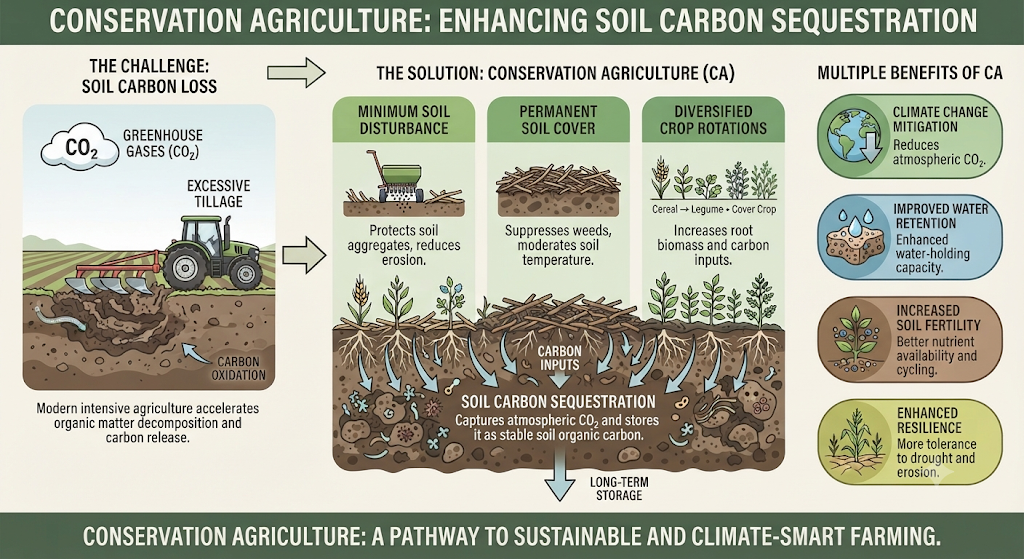
Numerous long-term experiments have demonstrated that conservation agriculture increases soil organic carbon stocks compared with conventional tillage, particularly when residue retention and crop diversification are consistently practiced. However, the rate and extent of carbon sequestration vary depending on climate, soil texture, cropping systems, residue management, topography, and management intensity. Understanding these factors is essential for designing effective carbon management strategies and maximizing the environmental benefits of conservation agriculture. Beyond climate change mitigation, soil carbon sequestration supports sustainable agricultural production by improving soil fertility, enhancing nutrient-use efficiency, increasing water-holding capacity, promoting biodiversity, and strengthening ecosystem resilience. These benefits contribute directly to food security while supporting the objectives of climate-smart agriculture and sustainable development.
This paper evaluates the potential of soil carbon sequestration under conservation agricultural practices by examining its mechanisms, assessment methods, influence on soil health and crop productivity, challenges, and future prospects for promoting sustainable agricultural systems and environmental conservation. Top of Form
Concept of Soil Carbon Sequestration and Principles of Conservation Agriculture#
Soil carbon sequestration refers to the process of capturing atmospheric carbon dioxide (CO₂) and storing it in the soil as organic carbon through natural biological and ecological processes. It is recognized as one of the most effective strategies for mitigating climate change while simultaneously improving soil fertility and agricultural productivity. Carbon enters the soil primarily through plant residues, root biomass, organic amendments, and microbial activity. A portion of this carbon is stabilized within soil aggregates and humus, where it remains stored for extended periods, thereby reducing the concentration of greenhouse gases in the atmosphere. Sustainable land management practices, particularly conservation agriculture, play a critical role in enhancing the soil's capacity to sequester carbon.
Conservation agriculture (CA) is an integrated farming system based on three fundamental principles: minimum soil disturbance, permanent soil cover, and diversified crop rotations. These principles work together to improve soil structure, reduce erosion, conserve moisture, stimulate biological activity, and increase soil organic carbon. Unlike conventional tillage systems, which expose soil organic matter to rapid decomposition and oxidation, conservation agriculture protects the soil surface and promotes the gradual accumulation of stable organic carbon.
The first principle, minimum soil disturbance, involves reducing or eliminating intensive tillage through practices such as zero tillage or minimum tillage. Conventional plowing breaks down soil aggregates and exposes organic matter to oxygen, accelerating microbial decomposition and releasing carbon dioxide into the atmosphere. Reduced tillage minimizes soil disturbance, allowing carbon to remain protected within stable soil aggregates. It also improves soil structure, enhances water infiltration, reduces compaction, and supports beneficial soil organisms such as earthworms and microorganisms that contribute to carbon stabilization.
The second principle, permanent soil cover, emphasizes maintaining continuous protection of the soil surface through crop residues, mulch, or cover crops. Residue retention reduces soil temperature fluctuations, decreases evaporation, suppresses weed growth, and protects the soil from wind and water erosion. As crop residues gradually decompose, they contribute fresh organic matter that increases soil organic carbon content. Cover crops further enhance carbon sequestration by producing additional biomass above and below the ground, improving root-derived carbon inputs, and promoting microbial diversity.
The third principle, diversified crop rotations, involves growing different crops in a planned sequence rather than cultivating the same crop repeatedly. Crop diversification increases the quantity and diversity of organic residues returned to the soil, improving nutrient cycling and supporting diverse microbial communities. Leguminous crops contribute biologically fixed nitrogen, which enhances biomass production and accelerates soil organic matter accumulation. Deep-rooted crops transport carbon into deeper soil layers, where it is more stable and less susceptible to decomposition. Soil carbon sequestration under conservation agriculture is governed by several biological and biochemical mechanisms. Plant residues decompose through microbial activity, producing humic substances that form stable soil organic matter. Root exudates stimulate microbial growth, while fungal hyphae and microbial polysaccharides strengthen soil aggregation, physically protecting organic carbon from rapid decomposition. Improved aggregation also enhances water retention and aeration, creating favorable conditions for sustained microbial activity and nutrient cycling. The rate of carbon sequestration depends on multiple factors, including climate, soil texture, land use, crop type, residue management, moisture availability, and management intensity. Fine-textured soils generally store more organic carbon than sandy soils because clay particles protect organic matter from microbial decomposition. Similarly, cooler climates often favor greater carbon accumulation due to slower decomposition rates.
Overall, soil carbon sequestration represents a vital ecosystem service that supports agricultural sustainability while mitigating climate change. Conservation agriculture enhances this process by increasing organic matter inputs, reducing carbon losses, improving soil biological activity, and maintaining long-term soil health. The integration of conservation agricultural practices into modern farming systems offers significant opportunities for sustainable crop production, environmental conservation, and global climate resilience.
Evaluation of Soil Carbon Sequestration Potential under Conservation Agricultural Practices#
The evaluation of soil carbon sequestration potential is essential for determining the effectiveness of conservation agricultural practices in mitigating climate change and improving soil quality. Soil carbon sequestration potential refers to the capacity of soil to capture atmospheric carbon dioxide and store it as stable soil organic carbon (SOC) over time. Accurate assessment of this potential enables researchers, policymakers, and farmers to understand the long-term environmental and agricultural benefits of conservation agriculture while developing sustainable land management strategies. The primary indicator used to evaluate carbon sequestration is soil organic carbon (SOC) stock. Soil organic carbon represents the quantity of carbon stored in soil organic matter, including decomposed plant residues, microbial biomass, root materials, and humic substances. SOC stocks are generally measured by collecting soil samples from different depths, determining carbon concentration through laboratory analysis, and calculating carbon storage based on soil bulk density and sampling depth. Long-term monitoring of SOC provides valuable information on carbon accumulation under different agricultural practices. Conservation agriculture significantly enhances soil carbon storage through minimum tillage, crop residue retention, and diversified crop rotations. Reduced tillage minimizes soil disturbance, thereby decreasing the oxidation of organic matter and reducing carbon dioxide emissions from the soil. Retention of crop residues increases organic matter inputs that gradually decompose and contribute to stable soil carbon pools. Diverse crop rotations introduce varying root systems and biomass quantities, increasing both above-ground and below-ground carbon inputs that enhance long-term carbon sequestration. Several methods are employed to evaluate soil carbon sequestration under conservation agriculture. Direct field measurements remain the most reliable approach, involving periodic soil sampling and laboratory determination of soil organic carbon using methods such as dry combustion and Walkley–Black oxidation. Repeated sampling over several years enables researchers to estimate annual rates of carbon accumulation and compare different management practices.
In addition to laboratory analysis, simulation models are increasingly used to estimate long-term carbon sequestration. Models such as CENTURY, RothC, DSSAT, APSIM, and DNDC simulate carbon cycling by incorporating information on climate, soil properties, crop management, residue inputs, and decomposition rates. These models help predict future changes in soil carbon under different conservation agricultural scenarios and support decision-making for sustainable land management. Modern technologies such as remote sensing, Geographic Information Systems (GIS), Global Positioning Systems (GPS), and digital soil mapping have significantly improved carbon assessment. Satellite imagery combined with GIS enables researchers to monitor land use, vegetation cover, biomass production, and changes in soil conditions over large geographic areas. These spatial technologies facilitate regional carbon inventory development and improve the efficiency of national greenhouse gas accounting programs.
Evaluation also involves measuring carbon inputs and carbon losses within agricultural ecosystems. Carbon inputs originate from crop residues, root biomass, cover crops, organic manures, compost, and biological activity, whereas carbon losses occur through decomposition, erosion, leaching, and greenhouse gas emissions. Conservation agriculture increases carbon inputs while reducing carbon losses, resulting in a positive carbon balance and gradual accumulation of soil organic carbon. Numerous long-term field studies have demonstrated that conservation agriculture can increase soil organic carbon stocks by approximately 0.2 to 1.0 Mg C ha⁻¹ year⁻¹, depending on climate, soil type, cropping system, residue management, and duration of practice. Fine-textured soils generally exhibit greater carbon stabilization than sandy soils because clay particles physically protect organic matter from microbial decomposition. Similarly, continuous residue retention and diversified crop rotations contribute substantially to carbon accumulation. However, carbon sequestration rates eventually decline as soils approach carbon saturation, where the capacity to store additional carbon becomes limited. Therefore, long-term management and continuous organic matter inputs are necessary to maintain accumulated carbon stocks and prevent carbon losses.
Overall, evaluating soil carbon sequestration under conservation agriculture provides valuable insights into the environmental and agronomic performance of sustainable farming systems. Accurate assessment methods combined with long-term monitoring enable effective climate change mitigation strategies while supporting soil conservation, improved fertility, and sustainable agricultural development.
Influence of Conservation Agriculture on Soil Health, Crop Productivity, and Climate Change Mitigation#
Conservation agriculture (CA) contributes significantly to improving soil health, enhancing crop productivity, and mitigating climate change through its integrated management practices. By emphasizing minimum soil disturbance, permanent soil cover, and diversified crop rotations, conservation agriculture creates favorable conditions for sustainable crop production while promoting long-term environmental conservation. These practices improve the physical, chemical, and biological properties of soil, resulting in increased resilience of agricultural systems to climatic variability and resource degradation.
One of the most important benefits of conservation agriculture is the improvement of soil physical properties. Reduced tillage preserves soil aggregates and minimizes structural degradation caused by repeated plowing. Crop residue retention protects the soil surface against rainfall impact and wind erosion while improving aggregation and porosity. Better soil structure enhances water infiltration, increases water-holding capacity, reduces bulk density, and promotes deeper root penetration. These improvements reduce soil compaction and improve the availability of moisture during drought conditions, thereby supporting consistent crop growth.
Conservation agriculture also enhances the chemical fertility of soil by increasing soil organic carbon and improving nutrient cycling. Crop residues gradually decompose, releasing essential nutrients such as nitrogen, phosphorus, potassium, sulfur, and micronutrients into the soil. Higher organic matter increases the cation exchange capacity (CEC), enabling soils to retain nutrients more effectively and reduce losses through leaching. Improved nutrient retention enhances fertilizer-use efficiency while maintaining long-term soil fertility.
The biological quality of soil is equally enhanced under conservation agriculture. Residue retention and reduced soil disturbance provide favorable habitats for beneficial microorganisms, fungi, earthworms, and other soil fauna. Increased microbial biomass accelerates decomposition, nutrient mineralization, biological nitrogen fixation, and phosphorus solubilization. Earthworm activity further improves soil aggregation, aeration, and organic matter incorporation, strengthening soil biological functions essential for sustainable agriculture. Improved soil health directly contributes to higher crop productivity. Better soil structure and moisture conservation promote uniform seed germination, vigorous root development, efficient nutrient uptake, and increased photosynthetic activity. Crops grown under conservation agriculture often exhibit improved plant height, biomass production, grain filling, and final yield. Numerous long-term studies have reported yield improvements in cereals such as wheat, rice, maize, and barley, particularly in regions experiencing moisture stress. Conservation agriculture also improves resource-use efficiency, including water-use efficiency, nutrient-use efficiency, and energy-use efficiency. Residue mulch reduces soil evaporation, enabling crops to utilize available water more effectively. Reduced tillage decreases fuel consumption and labor requirements while minimizing machinery-induced soil compaction. Efficient nutrient cycling reduces dependence on synthetic fertilizers, lowering production costs and environmental pollution.
An important environmental benefit of conservation agriculture is its contribution to climate change mitigation. Increased soil organic carbon storage removes atmospheric carbon dioxide and stores it within stable soil organic matter. Simultaneously, reduced tillage lowers carbon dioxide emissions associated with soil disturbance. Greater biomass production through cover crops and diversified crop rotations further enhances carbon sequestration. Reduced fuel consumption during field operations also lowers greenhouse gas emissions from agricultural machinery. Conservation agriculture enhances the resilience of farming systems to climate variability and extreme weather events. Improved soil moisture retention helps crops withstand drought, while enhanced infiltration reduces flooding and runoff during heavy rainfall. Stable soil structure minimizes erosion and preserves fertile topsoil, ensuring sustained productivity under changing climatic conditions. Despite these benefits, successful implementation requires proper residue management, crop diversification, weed control, and continuous monitoring of soil fertility. When integrated with balanced nutrient management, precision agriculture, and climate-smart farming practices, conservation agriculture provides a highly effective strategy for sustainable agricultural intensification.
Overall, conservation agriculture simultaneously improves soil health, increases crop productivity, enhances resource-use efficiency, and mitigates climate change through increased soil carbon sequestration. Its adoption offers a practical pathway toward environmentally sustainable, economically viable, and climate-resilient agricultural systems capable of meeting future global food security challenges.
Challenges, Limitations, and Future Prospects of Soil Carbon Sequestration under Conservation Agriculture#
Soil carbon sequestration under conservation agriculture has gained global recognition as an effective strategy for mitigating climate change while improving soil fertility and agricultural sustainability. Despite its proven environmental and agronomic benefits, several technical, economic, climatic, and policy-related challenges limit its widespread adoption. Understanding these constraints and identifying future opportunities are essential for maximizing the carbon sequestration potential of agricultural soils and promoting sustainable land management. One of the primary challenges is the slow rate of soil carbon accumulation. Carbon sequestration is a gradual biological process that often requires several years or even decades before measurable increases in soil organic carbon are observed. Farmers seeking immediate economic returns may therefore hesitate to adopt conservation agricultural practices whose environmental benefits become evident only over the long term. Another important limitation is the variation in sequestration potential across different soils and climatic conditions. Soil texture, mineral composition, rainfall, temperature, cropping systems, and land-use history significantly influence the amount of carbon that can be stored. Clay-rich soils generally stabilize larger quantities of organic carbon than sandy soils because fine particles physically protect organic matter from microbial decomposition. Similarly, warm and humid climates accelerate decomposition rates, reducing the duration of carbon storage compared with cooler regions. The availability and management of crop residues also influence carbon sequestration. Conservation agriculture recommends retaining crop residues on the soil surface; however, in many developing countries, residues are frequently removed for livestock feed, household fuel, or industrial purposes. Limited residue retention reduces organic carbon inputs and weakens the effectiveness of conservation agriculture in increasing soil carbon stocks.
Weed management presents another practical challenge. Reduced tillage often increases weed pressure during the initial years of conservation agriculture. Farmers may become more dependent on herbicides if integrated weed management strategies are not properly implemented. This can increase production costs and raise environmental concerns related to excessive herbicide use.
The measurement and monitoring of soil carbon remain technically demanding. Accurate estimation requires repeated soil sampling, laboratory analysis, determination of bulk density, and long-term monitoring. These procedures are labor-intensive, time-consuming, and costly, making large-scale carbon assessment difficult, particularly in developing countries with limited technical infrastructure. Variations in sampling depth, analytical methods, and spatial soil variability may also affect the accuracy of carbon estimates. Economic and institutional barriers further limit adoption. Establishing conservation agriculture often requires specialized machinery such as zero-till seed drills, residue management equipment, and precision farming tools. Many smallholder farmers lack the financial resources to purchase such equipment. Limited access to credit, inadequate extension services, and insufficient government incentives further discourage investment in conservation agriculture.
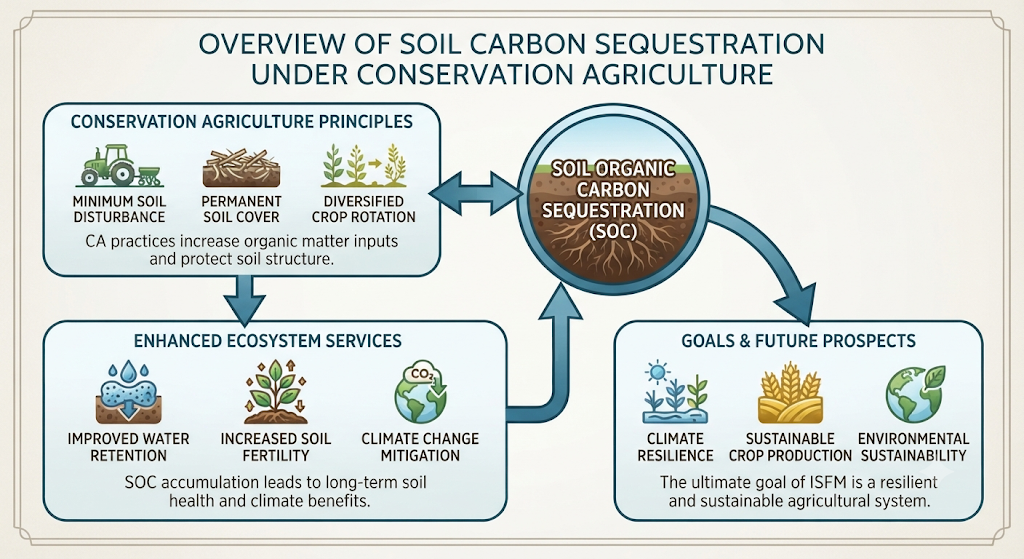
Despite these challenges, the future prospects for soil carbon sequestration remain highly promising. Growing international commitments to climate change mitigation, including the Paris Agreement and national carbon neutrality targets, have increased interest in agricultural carbon management. Carbon sequestration is increasingly recognized as a nature-based solution capable of reducing atmospheric greenhouse gas concentrations while enhancing food security. Rapid advances in remote sensing, Geographic Information Systems (GIS), artificial intelligence (AI), digital soil mapping, precision agriculture, and carbon modeling are improving the efficiency and accuracy of soil carbon assessment. These technologies enable site-specific monitoring, better estimation of carbon stocks, and more effective decision-making for sustainable land management. Future research should prioritize understanding the long-term stability of soil organic carbon, identifying crop varieties that contribute greater root biomass, optimizing residue management, and integrating conservation agriculture with agroforestry, cover cropping, integrated nutrient management, and regenerative agriculture. Such integrated approaches can maximize carbon sequestration while improving overall ecosystem resilience. Supportive government policies, carbon credit mechanisms, farmer incentives, technical training, and expanded extension services will be essential for encouraging wider adoption of conservation agriculture. International collaboration in carbon accounting, research, and climate-smart agriculture can further strengthen global efforts to restore degraded soils and reduce greenhouse gas emissions.
Overall, although several technical and socioeconomic challenges remain, soil carbon sequestration under conservation agriculture offers one of the most practical and sustainable pathways for achieving climate-resilient agriculture, conserving natural resources, and promoting environmentally responsible food production.
Conclusion#
Soil carbon sequestration has become one of the most important ecosystem services for addressing climate change while simultaneously improving soil fertility and agricultural sustainability. Agricultural soils possess enormous potential to store atmospheric carbon dioxide in the form of stable soil organic carbon, thereby reducing greenhouse gas concentrations and enhancing environmental quality. Conservation agriculture, based on the principles of minimum soil disturbance, permanent soil cover, and diversified crop rotations, provides an effective framework for increasing soil carbon storage while maintaining productive and resilient farming systems.
The discussion presented in this paper demonstrates that conservation agricultural practices significantly enhance soil carbon sequestration by increasing organic matter inputs and reducing carbon losses associated with intensive tillage. Crop residue retention, cover crops, diversified crop rotations, and reduced soil disturbance collectively improve soil organic carbon stocks, strengthen soil aggregation, increase water-holding capacity, and stimulate beneficial microbial activity. These improvements create healthier soils capable of supporting sustained agricultural productivity while conserving natural resources. Evaluation of soil carbon sequestration potential is essential for understanding the long-term benefits of conservation agriculture. Reliable assessment methods, including field sampling, laboratory analysis, simulation models, remote sensing, geographic information systems, and digital soil mapping, provide valuable information regarding changes in soil carbon stocks under different management practices. Accurate carbon assessment supports scientific research, climate policy formulation, carbon accounting, and the development of sustainable land management strategies. Beyond climate change mitigation, increased soil organic carbon contributes substantially to improved soil health and crop productivity. Enhanced soil structure, nutrient availability, moisture retention, microbial diversity, and nutrient cycling create favorable conditions for plant growth and increase resilience to drought, erosion, and other environmental stresses. Conservation agriculture therefore offers multiple co-benefits that simultaneously support food security, environmental conservation, and sustainable agricultural development.
Despite these advantages, several challenges continue to influence the adoption and effectiveness of conservation agriculture. Carbon sequestration occurs gradually, and measurable improvements often require long-term management. Variability in climate, soil type, cropping systems, and residue availability affects sequestration rates, while financial limitations, lack of specialized equipment, inadequate technical knowledge, and limited policy support further constrain widespread implementation. Addressing these challenges requires coordinated efforts involving governments, research institutions, extension agencies, and farming communities. Future opportunities are particularly encouraging. Advances in precision agriculture, artificial intelligence, remote sensing, carbon modeling, and digital soil monitoring are improving the accuracy of carbon assessment and supporting site-specific management decisions. Integration of conservation agriculture with agroforestry, cover cropping, integrated nutrient management, regenerative agriculture, and climate-smart farming practices can substantially increase soil carbon storage while improving agricultural resilience. Carbon credit programs and ecosystem service payments may also provide additional financial incentives for farmers to adopt carbon-friendly agricultural practices.
In conclusion, conservation agriculture represents a scientifically proven, environmentally sustainable, and economically viable strategy for enhancing soil carbon sequestration. Its implementation not only contributes to reducing atmospheric carbon dioxide but also improves soil fertility, increases crop productivity, conserves water resources, and strengthens resilience against climate change. Promoting conservation agriculture through research, technological innovation, policy support, farmer education, and international cooperation will be essential for achieving sustainable agricultural systems and global climate goals. The widespread adoption of these practices offers a practical pathway toward restoring soil health, ensuring long-term food security, and creating resilient agricultural landscapes for future generations.
Works Cited#
- Lal, R. (2004). Soil Carbon Sequestration to Mitigate Climate Change. Geoderma, 123(1–2), 1–22.
- Lal, R. (2020). Soil organic matter and sustainable agriculture. Journal of Soil and Water Conservation, 75(5), 123A–128A.
- FAO. (2022). The State of the World's Land and Water Resources for Food and Agriculture. Food and Agriculture Organization.
- FAO. (2017). Conservation Agriculture. Food and Agriculture Organization.
- Paustian, K., Lehmann, J., Ogle, S., et al. (2016). Climate-smart soils. Nature, 532(7597), 49–57.
- Powlson, D. S., Stirling, C. M., Jat, M. L., et al. (2014). Limited potential of no-till agriculture for climate change mitigation. Nature Climate Change, 4(8), 678–683.
- Six, J., Conant, R. T., Paul, E. A., & Paustian, K. (2002). Stabilization mechanisms of soil organic matter. Plant and Soil, 241(2), 155–176.
- Blanco-Canqui, H., & Lal, R. (2008). Principles of Soil Conservation and Management. Springer.
- Brady, N. C., & Weil, R. R. (2017). The Nature and Properties of Soils (15th ed.). Pearson.
- Batjes, N. H. (2014). Total carbon and nitrogen in the soils of the world. European Journal of Soil Science, 65(1), 10–21.
- Minasny, B., Malone, B. P., McBratney, A. B., et al. (2017). Soil carbon 4 per mille. Geoderma, 292, 59–86.
- Smith, P. (2016). Soil carbon sequestration and biochar. Global Change Biology, 22(3), 1315–1324.
- IPCC. (2019). Climate Change and Land. Intergovernmental Panel on Climate Change.
- Jat, M. L., Saharawat, Y. S., & Gupta, R. (2011). Conservation agriculture in cereal systems. Journal of Crop Improvement, 25(5), 1–34.
- Kassam, A., Friedrich, T., Shaxson, F., & Pretty, J. (2009). Conservation agriculture adoption worldwide. Field Actions Science Reports, 3, 1–11.
- Hobbs, P. R., Sayre, K., & Gupta, R. (2008). The role of conservation agriculture. Philosophical Transactions of the Royal Society B, 363(1491), 543–555.
- Palm, C., Blanco-Canqui, H., DeClerck, F., et al. (2014). Conservation agriculture and ecosystem services. Agriculture, Ecosystems & Environment, 187, 87–105.
- Bationo, A., Waswa, B., Kihara, J., & Kimetu, J. (2007). Advances in Integrated Soil Fertility Management in Sub-Saharan Africa. Springer.
- Olson, K. R., Al-Kaisi, M., Lal, R., & Cihacek, L. (2014). Impact of soil erosion on soil carbon. Journal of Soil and Water Conservation, 69(6), 182A–189A.
- Post, W. M., & Kwon, K. C. (2000). Soil carbon sequestration and land-use change. Global Change Biology, 6(3), 317–327.