Abstract
Biofertilizers have emerged as an environmentally sustainable alternative to chemical fertilizers for improving crop productivity, nutrient availability, and soil health. These microbial inoculants contain beneficial microorganisms such as nitrogen-fixing bacteria, phosphate-solubilizing bacteria, potassium-mobilizing microorganisms, arbuscular mycorrhizal fungi, and plant growth-promoting rhizobacteria that enhance nutrient acquisition and stimulate plant growth through natural biological processes. Increasing concerns over soil degradation, excessive chemical fertilizer use, environmental pollution, and declining nutrient-use efficiency have accelerated interest in integrating biofertilizers into sustainable crop production systems. Numerous studies have demonstrated that biofertilizers improve seed germination, root development, vegetative growth, flowering, yield attributes, and overall crop productivity while simultaneously enhancing nutrient uptake and maintaining soil fertility. Their application reduces dependence on synthetic fertilizers, lowers production costs, improves soil microbial diversity, and contributes to climate-smart agriculture by minimizing environmental impacts. The effectiveness of biofertilizers, however, depends on several factors including crop species, soil properties, climatic conditions, microbial strain compatibility, and management practices. Challenges such as inconsistent field performance, limited shelf life, poor awareness among farmers, and inadequate quality control continue to limit their widespread adoption. This paper examines the effect of biofertilizers on plant growth, crop yield, and nutrient uptake in major field crops. It further discusses their mechanisms of action, contribution to soil fertility, current adoption constraints, and future prospects for sustainable agricultural development. The study concludes that biofertilizers represent a vital component of integrated nutrient management and offer significant potential for improving agricultural productivity while conserving environmental resources.
- Biofertilizers
- Nitrogen Fixation
- Phosphate Solubilization
- Plant Growth-Promoting Rhizobacteria
- Nutrient Uptake
- Crop Yield
- Soil Fertility
- Sustainable Agriculture
- Integrated Nutrient Management
- Rhizobium
Introduction#
Agriculture plays a fundamental role in ensuring global food security and supporting the livelihoods of billions of people. To meet the nutritional demands of a rapidly growing population, agricultural production has increasingly relied on chemical fertilizers to enhance crop yields. Although these fertilizers have significantly contributed to increased food production, their excessive and indiscriminate use has resulted in several adverse consequences, including soil degradation, nutrient imbalance, environmental pollution, groundwater contamination, and declining soil microbial diversity. These concerns have intensified the search for environmentally friendly and sustainable nutrient management strategies capable of maintaining crop productivity while preserving soil health. Among the various alternatives available, biofertilizers have emerged as an effective and eco-friendly solution for promoting sustainable agriculture.
Biofertilizers are preparations containing living microorganisms that colonize the rhizosphere or plant tissues and enhance plant growth by increasing the availability and uptake of essential nutrients. Unlike chemical fertilizers that directly supply nutrients to plants, biofertilizers improve nutrient availability through biological processes such as atmospheric nitrogen fixation, phosphate solubilization, potassium mobilization, production of plant growth-promoting substances, and decomposition of organic matter. Common biofertilizers include *Rhizobium*, *Azotobacter*, *Azospirillum*, phosphate-solubilizing bacteria (PSB), potassium-solubilizing bacteria (KSB), cyanobacteria, and arbuscular mycorrhizal fungi (AMF).
The increasing popularity of biofertilizers is closely linked to the concept of sustainable agriculture, which seeks to balance agricultural productivity with environmental conservation. Beneficial microorganisms establish symbiotic or associative relationships with plants, improving nutrient acquisition while stimulating physiological and biochemical processes that enhance plant growth. They also produce phytohormones such as auxins, gibberellins, and cytokinins that encourage root development, increase nutrient absorption, and improve tolerance to abiotic stresses such as drought, salinity, and temperature fluctuations.
Major field crops including rice, wheat, maize, sorghum, pearl millet, soybean, chickpea, pigeon pea, groundnut, mustard, sunflower, and cotton have shown significant improvements in growth and productivity following biofertilizer application. Enhanced root systems, improved chlorophyll content, increased photosynthetic efficiency, better flowering, and higher grain or seed yields are among the commonly reported benefits. Biofertilizers also increase nutrient-use efficiency by improving the availability of nitrogen, phosphorus, potassium, zinc, and other micronutrients, thereby reducing dependence on synthetic fertilizers and lowering production costs.
In addition to improving crop productivity, biofertilizers contribute significantly to soil health. Their continuous application enhances soil microbial diversity, increases soil organic matter decomposition, improves soil structure, and promotes nutrient cycling. Healthy microbial communities create a biologically active soil environment that supports long-term fertility and sustainable crop production. Furthermore, biofertilizers reduce greenhouse gas emissions associated with the manufacture and application of chemical fertilizers, making them an important component of climate-smart agriculture.
Despite these advantages, the widespread adoption of biofertilizers remains limited due to several factors, including inconsistent field performance, poor product quality, limited shelf life, lack of farmer awareness, inadequate extension services, and improper storage and handling. Addressing these constraints through improved microbial formulations, quality assurance, farmer education, and supportive government policies is essential for expanding their use.
Considering the growing need for sustainable nutrient management, biofertilizers offer a promising approach to improving crop growth, yield, nutrient uptake, and soil fertility while minimizing environmental degradation. This paper examines the role of biofertilizers in enhancing agricultural productivity, analyzes their mechanisms of action, evaluates their influence on nutrient uptake in major field crops, and discusses future prospects for integrating biofertilizers into modern agricultural systems.
Types, Characteristics, and Mechanisms of Biofertilizers#
Biofertilizers are living microbial formulations that improve plant growth by increasing the availability of essential nutrients through natural biological processes. Unlike chemical fertilizers, which directly supply nutrients, biofertilizers enhance the soil's biological activity and promote sustainable nutrient cycling. They consist of beneficial bacteria, fungi, algae, and other microorganisms that establish symbiotic or associative relationships with plant roots. Depending on their mode of action and the nutrients they influence, biofertilizers are classified into several categories, each contributing uniquely to crop growth, yield, and soil fertility.
One of the most widely used groups is nitrogen-fixing biofertilizers. Nitrogen is an essential nutrient for plant growth, but atmospheric nitrogen cannot be directly utilized by most plants. Nitrogen-fixing microorganisms convert atmospheric nitrogen into ammonia through biological nitrogen fixation, making it available for plant uptake. Rhizobium forms symbiotic associations with leguminous crops such as soybean, chickpea, pea, lentil, and groundnut by producing root nodules where nitrogen fixation occurs. Free-living bacteria such as Azotobacter and associative bacteria like Azospirillum fix atmospheric nitrogen independently or in association with the roots of cereals, including wheat, maize, rice, sorghum, and millet. Their application reduces the dependence on synthetic nitrogen fertilizers while enhancing crop productivity.
Another important category comprises phosphate-solubilizing microorganisms (PSM), including phosphate-solubilizing bacteria (PSB) and fungi. Although soils often contain substantial quantities of phosphorus, much of it remains unavailable to plants because it is fixed in insoluble forms. Phosphate-solubilizing microorganisms release organic acids and enzymes that convert insoluble phosphates into soluble forms readily absorbed by plant roots. Common phosphate-solubilizing bacteria include species of Bacillus, Pseudomonas, and Burkholderia. Increased phosphorus availability promotes vigorous root development, early plant establishment, flowering, seed formation, and overall crop yield.
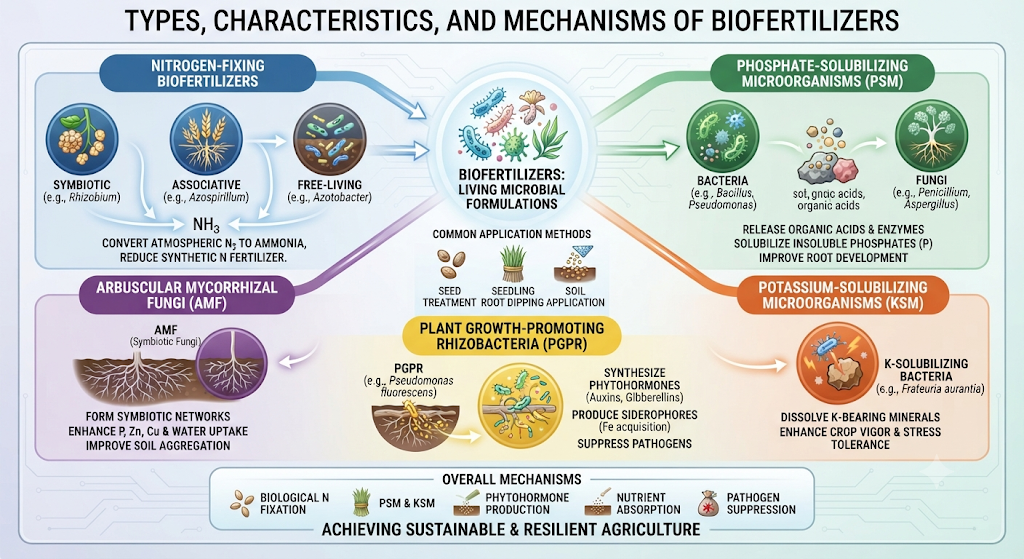
Potassium-solubilizing microorganisms (KSM) also play an important role in improving nutrient availability. Potassium is essential for enzyme activation, photosynthesis, water regulation, and disease resistance. However, a considerable portion of soil potassium remains locked within mineral structures. Potassium-solubilizing bacteria release organic acids that dissolve potassium-bearing minerals and make potassium available for plant uptake. This process improves crop vigor, stress tolerance, and grain quality while reducing the need for chemical potassium fertilizers.
Among fungal biofertilizers, arbuscular mycorrhizal fungi (AMF) are highly beneficial. These fungi establish symbiotic relationships with plant roots by forming extensive networks of fungal hyphae that extend beyond the root zone. This expanded network greatly increases the plant's capacity to absorb phosphorus, zinc, copper, and water from the soil. Mycorrhizal associations also enhance drought tolerance, improve soil aggregation, reduce nutrient losses, and strengthen resistance against certain soil-borne diseases.
Plant Growth-Promoting Rhizobacteria (PGPR) represent another important group of biofertilizers. These beneficial bacteria colonize the rhizosphere and stimulate plant growth through multiple mechanisms. They synthesize plant hormones such as auxins, gibberellins, and cytokinins, which promote root elongation, cell division, and overall plant development. PGPR also produce siderophores that improve iron availability and secrete antibiotics that suppress harmful plant pathogens, thereby contributing to healthier crop growth.
Biofertilizers improve plant performance through several biological mechanisms. These include atmospheric nitrogen fixation, phosphorus and potassium solubilization, production of phytohormones, secretion of growth-promoting enzymes, enhancement of nutrient absorption, suppression of pathogenic microorganisms, and stimulation of beneficial soil microbial communities. Many microorganisms also produce exopolysaccharides that improve soil aggregation, water retention, and root-soil interactions.
The effectiveness of biofertilizers depends on factors such as microbial strain quality, crop species, soil pH, temperature, moisture availability, organic matter content, and proper application methods. Seed treatment, seedling root dipping, and soil application are commonly used techniques to introduce beneficial microorganisms into cropping systems. When integrated with organic manures and balanced fertilizer management, biofertilizers significantly improve soil fertility and support sustainable agricultural production.
Overall, the diverse types and mechanisms of biofertilizers make them indispensable components of integrated nutrient management. Their ability to enhance nutrient availability naturally while improving soil health and reducing environmental pollution highlights their importance in achieving productive, resilient, and environmentally sustainable farming systems.
Effect of Biofertilizers on Growth and Yield of Major Field Crops#
Biofertilizers play a significant role in improving the growth and yield of major field crops by enhancing nutrient availability, stimulating physiological processes, and improving soil biological activity. Beneficial microorganisms present in biofertilizers establish close associations with plant roots, resulting in better nutrient absorption, enhanced root growth, and improved resistance to environmental stresses. These effects collectively contribute to increased biomass production, superior yield attributes, and higher economic returns. Numerous field experiments conducted across different agro-climatic regions have confirmed the positive impact of biofertilizers on cereals, pulses, oilseeds, and commercial crops.
In cereal crops such as rice, wheat, maize, sorghum, and pearl millet, biofertilizers have consistently demonstrated improvements in seed germination, plant height, tiller production, leaf area, chlorophyll content, and dry matter accumulation. Nitrogen-fixing bacteria such as Azotobacter and Azospirillum enhance nitrogen availability, leading to vigorous vegetative growth and increased photosynthetic activity. Phosphate-solubilizing bacteria further improve phosphorus uptake, promoting stronger root systems and efficient nutrient utilization. Consequently, cereal crops often exhibit higher numbers of productive tillers, longer panicles or cobs, increased grain weight, and improved grain yield compared with conventional fertilizer applications alone.
Leguminous crops including soybean, chickpea, pigeon pea, lentil, pea, black gram, green gram, and groundnut benefit greatly from inoculation with Rhizobium. Symbiotic nitrogen fixation within root nodules supplies a substantial portion of the crop's nitrogen requirement, reducing dependence on chemical nitrogen fertilizers. Enhanced nodulation improves protein synthesis, vegetative growth, flowering, pod formation, and seed development. Several studies have reported significant increases in pod number, seed weight, biological yield, and harvest index following the application of Rhizobium in combination with phosphorus-solubilizing microorganisms.
Oilseed crops such as mustard, sunflower, sesame, safflower, and soybean also respond positively to biofertilizer application. Improved nutrient uptake supports better branching, flower production, seed filling, and oil accumulation. Biofertilizers contribute to increased seed yield, oil content, and quality by enhancing the availability of essential nutrients required during reproductive growth. The combined application of nitrogen-fixing and phosphate-solubilizing microorganisms has been particularly effective in maximizing oilseed productivity.
Commercial crops including cotton, sugarcane, tobacco, and potato also show considerable improvements in growth and yield under biofertilizer-based nutrient management. In cotton, inoculation with plant growth-promoting rhizobacteria and mycorrhizal fungi enhances root proliferation, boll formation, fiber quality, and lint yield. Sugarcane responds with increased tillering, cane length, cane diameter, and sugar recovery due to improved nutrient absorption and greater microbial activity in the rhizosphere. Similarly, potato crops exhibit increased tuber size, tuber number, and marketable yield following the application of phosphate-solubilizing bacteria and arbuscular mycorrhizal fungi.
One of the primary reasons for these improvements is the production of plant growth regulators by beneficial microorganisms. Many biofertilizers synthesize auxins, gibberellins, cytokinins, and other bioactive compounds that stimulate cell division, root elongation, and shoot development. A larger and healthier root system enables plants to absorb greater quantities of water and nutrients, thereby improving growth throughout the crop cycle.
Biofertilizers also enhance photosynthetic efficiency by increasing chlorophyll content and improving nutrient availability, particularly nitrogen and magnesium, which are essential components of chlorophyll molecules. Enhanced photosynthesis results in greater carbohydrate production, increased biomass accumulation, and improved translocation of assimilates to developing grains, pods, or fruits.
The combined use of biofertilizers with recommended doses of chemical fertilizers or organic manures often produces better results than either input alone. Integrated nutrient management optimizes nutrient availability while maintaining soil fertility and reducing fertilizer costs. Numerous studies indicate that biofertilizers can partially substitute chemical fertilizers without compromising yield, thereby improving input-use efficiency and farm profitability.
Overall, biofertilizers significantly enhance the growth and yield of major field crops by improving nutrient availability, stimulating physiological activities, strengthening root development, and increasing resilience to environmental stress. Their integration into modern crop production systems offers an effective strategy for achieving sustainable agricultural productivity while reducing dependence on synthetic fertilizers.
Influence of Biofertilizers on Nutrient Uptake and Soil Fertility#
Efficient nutrient uptake is essential for achieving high crop productivity and maintaining long-term soil fertility. Biofertilizers play a crucial role in improving nutrient acquisition by enhancing the biological availability of essential macro- and micronutrients through natural microbial processes. Unlike chemical fertilizers that supply nutrients directly, biofertilizers increase nutrient-use efficiency by stimulating nutrient transformation, mineralization, mobilization, and absorption within the rhizosphere. Their continuous application contributes to sustainable soil fertility by improving soil biological activity, organic matter decomposition, and nutrient cycling.
Nitrogen is one of the most important nutrients influencing crop growth and productivity. Nitrogen-fixing biofertilizers such as Rhizobium, Azotobacter, Azospirillum, and cyanobacteria convert atmospheric nitrogen into ammonia through biological nitrogen fixation. This process supplies plants with an additional source of nitrogen while reducing dependence on synthetic nitrogen fertilizers. Leguminous crops derive a significant portion of their nitrogen requirement from Rhizobium-induced nodules, whereas non-leguminous crops benefit from associative nitrogen-fixing bacteria that colonize the rhizosphere. Enhanced nitrogen availability promotes chlorophyll synthesis, protein formation, vigorous vegetative growth, and improved grain development.
Phosphorus is another essential nutrient that often limits crop production because much of the phosphorus present in soil exists in insoluble forms. Phosphate-solubilizing bacteria and fungi release organic acids, phosphatases, and other enzymes that dissolve fixed phosphorus compounds, making phosphorus readily available for plant uptake. Improved phosphorus nutrition encourages root proliferation, early crop establishment, flowering, seed formation, and energy transfer processes. Enhanced phosphorus uptake also strengthens plant tolerance to environmental stresses and improves overall crop performance.
Biofertilizers also improve the availability of potassium, an essential nutrient responsible for enzyme activation, photosynthesis, osmotic regulation, and disease resistance. Potassium-solubilizing microorganisms release organic acids that weather potassium-bearing minerals and convert unavailable potassium into soluble forms. Adequate potassium nutrition improves water-use efficiency, strengthens plant tissues, enhances grain filling, and increases crop resistance to drought and diseases.
In addition to macronutrients, biofertilizers facilitate the uptake of important micronutrients such as zinc, iron, copper, manganese, and boron. Arbuscular mycorrhizal fungi extend their hyphal networks beyond the root zone, enabling plants to access nutrients from larger soil volumes. Plant growth-promoting rhizobacteria produce siderophores that chelate iron and improve its availability to plants. Improved micronutrient nutrition enhances enzyme activity, photosynthesis, reproductive development, and grain quality.
Biofertilizers positively influence soil fertility by increasing microbial diversity and biological activity. Beneficial microorganisms decompose organic residues, accelerate nutrient mineralization, and contribute to the formation of stable soil organic matter. Increased microbial biomass enhances nutrient cycling and creates a biologically active soil environment that supports sustained crop production. Continuous application of biofertilizers also improves soil aggregation, aeration, porosity, and water-holding capacity, thereby creating favorable conditions for root growth and microbial survival.
Another important contribution of biofertilizers is their role in maintaining soil health while minimizing environmental pollution. Reduced dependence on chemical fertilizers lowers the risk of nutrient leaching, groundwater contamination, soil acidification, and greenhouse gas emissions associated with fertilizer manufacturing and application. Improved nutrient-use efficiency allows crops to utilize available nutrients more effectively, reducing nutrient losses and enhancing overall agricultural sustainability.
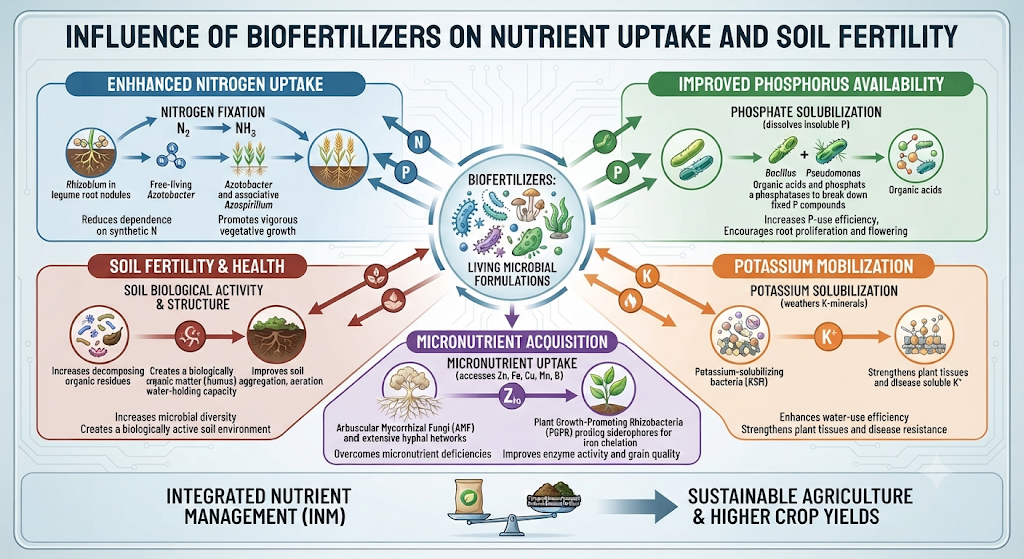
Biofertilizers are particularly effective when integrated with farmyard manure, compost, green manures, and balanced chemical fertilizers under integrated nutrient management systems. Such integrated approaches optimize nutrient availability throughout the crop growth cycle while maintaining long-term soil fertility and improving fertilizer-use efficiency.
Overall, biofertilizers significantly enhance nutrient uptake by increasing the biological availability of essential nutrients, improving root growth, stimulating microbial activity, and strengthening soil fertility. Their contribution to sustainable nutrient management makes them indispensable for environmentally friendly agriculture aimed at achieving high productivity, improved soil health, and long-term food security.
Challenges, Constraints, and Future Prospects of Biofertilizer Use#
Biofertilizers have gained considerable attention as sustainable alternatives to chemical fertilizers due to their ability to improve crop productivity, nutrient availability, and soil health. However, despite their numerous advantages, the adoption of biofertilizers remains limited in many agricultural regions. Several technical, economic, institutional, and environmental challenges restrict their widespread use. Addressing these constraints is essential for realizing the full potential of biofertilizers in sustainable agriculture and ensuring long-term food security.
One of the most significant challenges is the inconsistent performance of biofertilizers under field conditions. Unlike chemical fertilizers, whose effects are relatively predictable, the effectiveness of biofertilizers depends on various environmental factors such as soil type, pH, temperature, moisture content, organic matter, and native microbial populations. Beneficial microorganisms may fail to establish themselves in unfavorable soil conditions, leading to variable crop responses. Consequently, farmers often experience inconsistent yield improvements, reducing their confidence in adopting biofertilizer technologies.
Another major limitation is the short shelf life and storage requirements of microbial inoculants. Since biofertilizers contain living organisms, they require appropriate storage conditions to maintain microbial viability. Exposure to excessive heat, sunlight, or improper handling during transportation and storage can significantly reduce the number of viable microorganisms, thereby affecting product quality and field performance. Developing improved carrier materials, liquid formulations, and advanced packaging technologies can help extend shelf life and improve product stability.
Quality control and standardization remain major concerns in the biofertilizer industry. In several countries, the production and marketing of biofertilizers are inadequately regulated, resulting in the availability of low-quality or contaminated products. Poor-quality inoculants often contain insufficient populations of beneficial microorganisms or ineffective microbial strains, leading to disappointing field results. Establishing stringent quality standards, certification systems, and regular monitoring of manufacturing units is essential for maintaining product reliability and farmer confidence.
Limited farmer awareness and technical knowledge also hinder the adoption of biofertilizers. Many farmers are unfamiliar with the benefits, application methods, storage requirements, and compatibility of different microbial inoculants. Inadequate extension services and limited field demonstrations further restrict technology dissemination. Strengthening agricultural extension programs, organizing farmer training workshops, and establishing demonstration plots can significantly improve awareness and encourage wider adoption.
Economic and infrastructural constraints also influence adoption, particularly among smallholder farmers. Although biofertilizers are generally less expensive than chemical fertilizers, their availability is often limited in rural markets. Inadequate distribution networks, insufficient production facilities, and poor market access reduce farmers' ability to obtain quality biofertilizer products when needed. Public-private partnerships and government support can improve production capacity, supply chains, and accessibility.
Compatibility with existing agricultural practices presents another challenge. Farmers accustomed to intensive chemical fertilizer use may hesitate to integrate biofertilizers due to uncertainty regarding their performance. Successful implementation often requires integrated nutrient management, where biofertilizers are used alongside organic manures and balanced chemical fertilizers. Educating farmers about integrated nutrient management practices is therefore essential for maximizing the benefits of biofertilizers.
Despite these challenges, the future prospects of biofertilizers are highly encouraging. Advances in biotechnology, molecular biology, microbial genomics, and nanotechnology are enabling the development of more efficient and stress-tolerant microbial strains. Liquid biofertilizers, encapsulated microbial formulations, and multi-strain consortia have demonstrated greater stability, longer shelf life, and improved field performance compared to conventional carrier-based products. Precision agriculture and digital farming technologies are also facilitating site-specific nutrient management and optimized biofertilizer application.
Growing global emphasis on climate-smart agriculture, organic farming, regenerative agriculture, and sustainable development has created favorable conditions for expanding biofertilizer use. Governments, research institutions, and international organizations are increasingly promoting biofertilizers through subsidy programs, research funding, quality regulations, and farmer awareness campaigns. Continued investment in scientific research, technology development, policy support, and capacity building will play a crucial role in overcoming existing constraints.
In conclusion, although several technical and institutional challenges continue to limit the widespread adoption of biofertilizers, ongoing technological innovations and supportive policy initiatives provide strong opportunities for their future expansion. Their integration into sustainable farming systems will contribute significantly to improved crop productivity, enhanced soil fertility, reduced environmental pollution, and long-term agricultural sustainability.
Conclusion#
Biofertilizers have become an essential component of sustainable agriculture due to their ability to improve crop growth, increase yield, enhance nutrient uptake, and maintain long-term soil fertility through natural biological processes. As global agriculture faces increasing challenges related to population growth, climate change, soil degradation, declining soil fertility, and excessive dependence on chemical fertilizers, the adoption of environmentally friendly nutrient management strategies has become increasingly important. Biofertilizers offer an effective solution by utilizing beneficial microorganisms that naturally enhance nutrient availability while preserving ecological balance.
The discussion presented in this paper demonstrates that biofertilizers significantly improve plant growth through multiple biological mechanisms, including atmospheric nitrogen fixation, phosphate solubilization, potassium mobilization, production of plant growth-promoting hormones, and enhancement of microbial activity in the rhizosphere. These processes stimulate root development, increase nutrient absorption, improve photosynthetic efficiency, and promote healthy vegetative and reproductive growth. As a result, major field crops such as rice, wheat, maize, soybean, chickpea, groundnut, mustard, cotton, sugarcane, and several other cereals, pulses, oilseeds, and commercial crops exhibit substantial improvements in growth parameters, yield attributes, and final productivity.
An equally important contribution of biofertilizers is their ability to improve nutrient-use efficiency and soil health. Beneficial microorganisms increase the biological availability of essential macro- and micronutrients while enhancing nutrient cycling and organic matter decomposition. Continuous application of biofertilizers improves soil microbial diversity, soil structure, water-holding capacity, and long-term fertility. These improvements not only support sustainable crop production but also reduce nutrient losses through leaching, runoff, and volatilization, thereby minimizing environmental pollution.
Biofertilizers also contribute significantly to reducing dependence on synthetic fertilizers. Their integration with organic manures and balanced fertilizer application under integrated nutrient management systems allows farmers to maintain high crop productivity while lowering input costs and conserving natural resources. Moreover, reduced chemical fertilizer consumption decreases greenhouse gas emissions associated with fertilizer production and application, supporting climate change mitigation efforts and promoting climate-resilient agriculture.
Despite these numerous advantages, several challenges continue to limit the widespread adoption of biofertilizers. Variable field performance, limited shelf life, inadequate quality control, insufficient farmer awareness, poor distribution systems, and unfavorable storage conditions remain major constraints. Addressing these issues requires coordinated efforts involving scientific research, improved microbial formulations, stringent quality assurance, effective extension services, and supportive government policies. Capacity-building programs and farmer education are equally important for increasing confidence in biofertilizer technologies.
Rapid advancements in biotechnology, microbial genomics, precision agriculture, nanotechnology, and digital farming are expected to further improve the effectiveness and reliability of biofertilizers. The development of multi-functional microbial consortia, liquid formulations, stress-tolerant microbial strains, and precision application techniques offers significant opportunities for enhancing agricultural productivity under diverse agro-climatic conditions. These innovations will strengthen the role of biofertilizers in sustainable farming systems and integrated nutrient management strategies.
In conclusion, biofertilizers represent a scientifically proven, environmentally safe, and economically viable approach to improving crop productivity, nutrient uptake, and soil fertility. Their widespread adoption will contribute to sustainable food production, environmental conservation, and long-term agricultural resilience. Continued investment in research, innovation, farmer awareness, and policy support will be essential for maximizing the potential of biofertilizers and ensuring sustainable agricultural development for future generations.
Works Cited#
- Bhattacharyya, P. N., & Jha, D. K. (2012). Plant growth-promoting rhizobacteria (PGPR): Emergence in agriculture. World Journal of Microbiology and Biotechnology, 28(4), 1327–1350.
- Bashan, Y., & de-Bashan, L. E. (2010). How the plant growth-promoting bacterium Azospirillum promotes plant growth. Advances in Agronomy, 108, 77–136.
- Chandini, Kumar, R., & Prakash, O. (2019). The impact of chemical fertilizers on agriculture and environment. International Journal of Current Microbiology and Applied Sciences, 8(10), 2402–2411.
- Food and Agriculture Organization. (2019). The State of the World's Biodiversity for Food and Agriculture. FAO.
- Food and Agriculture Organization. (2022). Biofertilizers and Sustainable Agriculture. FAO.
- Glick, B. R. (2012). Plant growth-promoting bacteria: Mechanisms and applications. Scientifica, 2012, 1–15.
- Lucy, M., Reed, E., & Glick, B. R. (2004). Applications of free-living plant growth-promoting rhizobacteria. Antonie van Leeuwenhoek, 86(1), 1–25.
- Mahanty, T., Bhattacharjee, S., Goswami, M., et al. (2017). Biofertilizers: A potential approach for sustainable agriculture development. Environmental Science and Pollution Research, 24(4), 3315–3335.
- Mishra, D. J., Singh, R., Mishra, U. K., & Kumar, S. S. (2013). Role of biofertilizer in organic agriculture. Research Journal of Recent Sciences, 2, 39–41.
- Rodríguez, H., & Fraga, R. (1999). Phosphate solubilizing bacteria and their role in plant growth. Biotechnology Advances, 17(4–5), 319–339.
- Saharan, B. S., & Nehra, V. (2011). Plant growth-promoting rhizobacteria: A critical review. Life Sciences and Medicine Research, 21, 1–30.
- Singh, J. S., Pandey, V. C., & Singh, D. P. (2011). Efficient soil microorganisms: A new dimension for sustainable agriculture. Agriculture, Ecosystems & Environment, 140(3–4), 339–353.
- Smith, S. E., & Read, D. J. (2008). Mycorrhizal Symbiosis (3rd ed.). Academic Press.
- Subba Rao, N. S. (2017). Biofertilizers in Agriculture and Forestry (4th ed.). MedTech Publishers.
- Vessey, J. K. (2003). Plant growth-promoting rhizobacteria as biofertilizers. Plant and Soil, 255(2), 571–586.
- Yadav, A. N., Verma, P., Singh, B., & Chauhan, V. S. (2017). Plant microbiomes and sustainable agriculture. Plant Gene, 11, 1–12.
- Zaidi, A., Khan, M. S., Ahemad, M., & Oves, M. (2009). Plant growth promotion by phosphate-solubilizing bacteria. Acta Microbiologica et Immunologica Hungarica, 56(3), 263–284.
- Zhang, F., Shen, J., Zhang, J., et al. (2010). Rhizosphere processes and nutrient management. Plant and Soil, 321(1–2), 305–339.
- Adesemoye, A. O., & Kloepper, J. W. (2009). Plant-microbes interactions in enhanced fertilizer-use efficiency. Applied Microbiology and Biotechnology, 85(1), 1–12.
- Kumar, V., Singh, A. K., & Sharma, S. (2021). Biofertilizers: An eco-friendly approach for sustainable agriculture. Journal of Applied and Natural Science, 13(2), 523–533.