Abstract
Soil fertility is a fundamental component of sustainable agricultural production, ecosystem functioning, and environmental conservation. Different land use systems significantly influence soil physical, chemical, and biological properties, thereby affecting nutrient availability, crop productivity, and long-term soil health. Rapid urbanization, deforestation, intensive agriculture, industrialization, and climate change have altered natural land use patterns, resulting in soil degradation, nutrient depletion, erosion, and declining agricultural productivity. Understanding soil fertility status and nutrient dynamics across various land use systems—including agricultural land, forests, grasslands, wetlands, agroforestry systems, and fallow lands—is essential for developing effective soil management strategies. Soil nutrients such as nitrogen, phosphorus, potassium, sulfur, calcium, magnesium, and micronutrients undergo continuous transformation through biological, chemical, and physical processes influenced by vegetation, land management, climate, and microbial activity. Modern technologies including Geographic Information Systems (GIS), Remote Sensing, Artificial Intelligence (AI), Internet of Things (IoT), precision agriculture, and digital soil mapping have improved the assessment of soil fertility by enabling accurate spatial analysis and real-time nutrient monitoring. This study evaluates soil fertility status and nutrient dynamics under different land use systems by examining soil properties, nutrient cycling processes, technological innovations, and sustainable land management practices. The study concludes that appropriate land use planning, integrated nutrient management, precision agriculture, and conservation practices are essential for maintaining soil fertility, improving crop productivity, conserving natural resources, and ensuring sustainable agricultural development under changing environmental conditions.
- Soil Fertility
- Nutrient Dynamics
- Land Use Systems
- Soil Health
- Sustainable Agriculture
- Integrated Nutrient Management
- Soil Organic Carbon
- Precision Agriculture
- Geographic Information Systems
- Remote Sensing
Introduction#
Soil is one of the most valuable natural resources supporting agricultural production, ecosystem stability, biodiversity, and environmental sustainability. It provides essential nutrients, water, oxygen, and physical support necessary for plant growth while serving as a medium for numerous biological and biochemical processes. Soil fertility, defined as the capacity of soil to supply essential nutrients in adequate quantities and balanced proportions for optimum plant growth, directly influences agricultural productivity and food security. However, rapid population growth, intensive cultivation, urban expansion, industrial development, deforestation, and climate change have significantly altered natural land use systems, resulting in widespread soil degradation and declining fertility. Continuous cultivation without proper nutrient replenishment, excessive use of chemical fertilizers, soil erosion, salinity, acidification, and loss of organic matter have reduced soil productivity in many agricultural regions worldwide. Consequently, assessing soil fertility status and understanding nutrient dynamics under different land use systems have become critical priorities for sustainable land management and agricultural development.
Different land use systems influence soil properties through variations in vegetation cover, cropping intensity, management practices, organic matter inputs, erosion rates, and microbial activity. Agricultural lands often experience intensive nutrient extraction because of continuous crop harvesting, whereas forest ecosystems maintain relatively stable nutrient cycles through litter decomposition and organic matter accumulation. Grasslands contribute significantly to soil organic carbon storage through extensive root biomass, while wetlands regulate nutrient transformation through anaerobic microbial processes. Agroforestry systems combine agricultural crops with trees, promoting efficient nutrient recycling, reducing soil erosion, improving soil structure, and increasing biodiversity. Fallow lands provide opportunities for natural soil regeneration through organic matter accumulation and microbial restoration. These diverse land use systems influence the availability and cycling of essential macronutrients such as nitrogen (N), phosphorus (P), potassium (K), sulfur (S), calcium (Ca), magnesium (Mg), and micronutrients including zinc (Zn), iron (Fe), manganese (Mn), copper (Cu), and boron (B). Understanding nutrient transformations under different land uses is essential for developing effective soil fertility management strategies capable of sustaining agricultural productivity while protecting environmental quality.
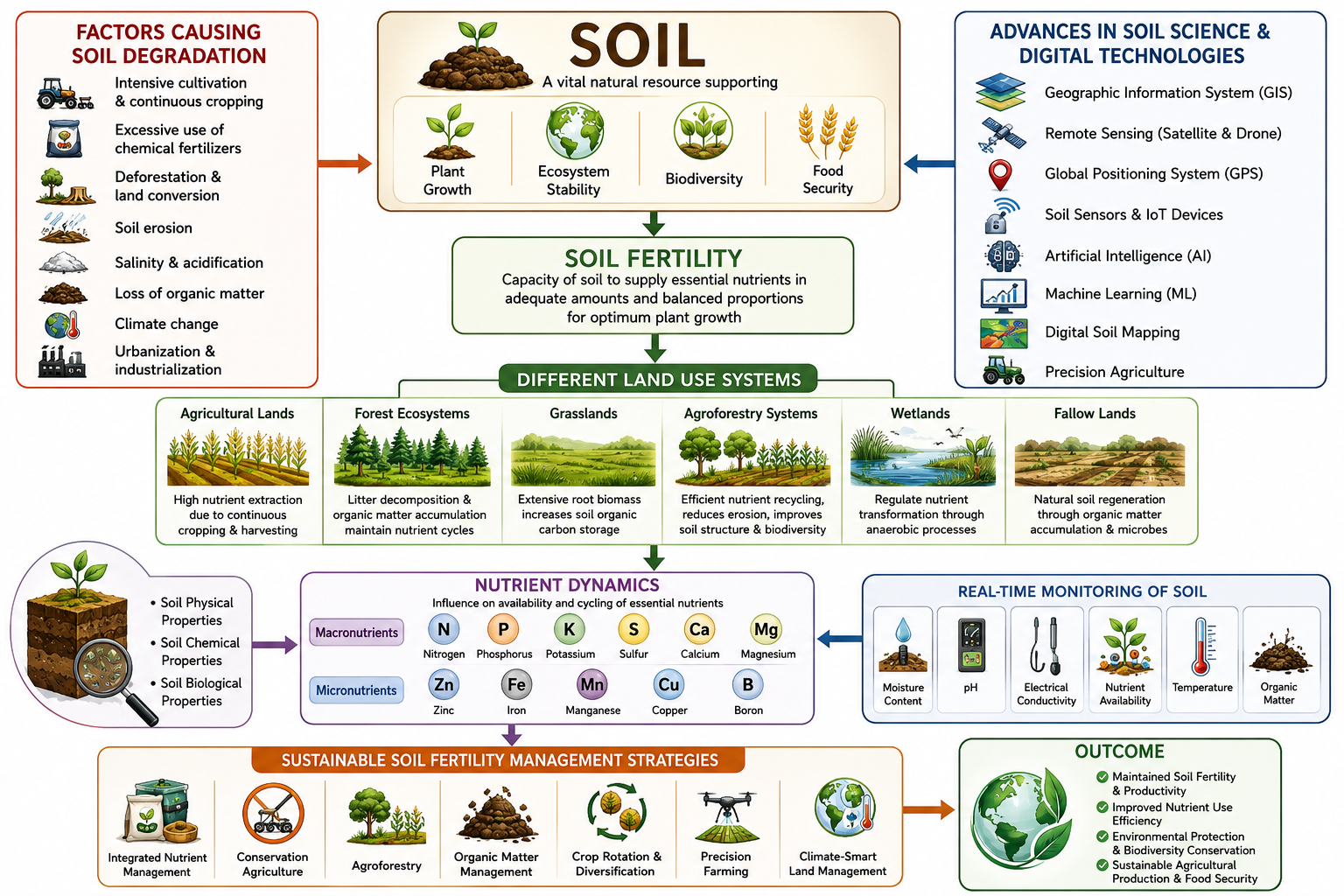
Figure: Conceptual Framework
Advances in soil science, digital agriculture, and geospatial technologies have significantly improved soil fertility assessment and nutrient management. Modern techniques such as Geographic Information Systems (GIS), Remote Sensing, Artificial Intelligence (AI), Machine Learning (ML), Internet of Things (IoT) sensors, Global Positioning Systems (GPS), digital soil mapping, and precision agriculture enable accurate monitoring of soil physical, chemical, and biological properties across large geographical areas. Soil sensors provide real-time information regarding moisture content, pH, electrical conductivity, nutrient availability, temperature, and organic matter status, while satellite imagery and drone-based remote sensing monitor vegetation health, land use changes, and soil degradation. AI-based predictive models integrate these datasets to evaluate spatial variability in soil fertility and recommend site-specific nutrient management practices. Governments and international organizations increasingly promote integrated nutrient management, conservation agriculture, agroforestry, and climate-smart land management as sustainable approaches for maintaining soil fertility under changing climatic conditions. This study therefore assesses soil fertility status and nutrient dynamics across different land use systems, examines the factors influencing soil nutrient availability, evaluates emerging technological innovations supporting soil fertility assessment, and discusses future management strategies for achieving sustainable agricultural production and environmental conservation.
Soil Fertility Indicators and Nutrient Dynamics under Different Land Use System#
Soil fertility is determined by the interaction of physical, chemical, and biological properties that regulate the availability of essential nutrients for plant growth. These properties continuously change under different land use systems because of variations in vegetation cover, cropping intensity, organic matter input, microbial activity, erosion, and management practices. Soil fertility assessment involves evaluating key indicators such as soil texture, bulk density, pH, electrical conductivity (EC), soil organic carbon (SOC), cation exchange capacity (CEC), moisture content, available macronutrients (nitrogen, phosphorus, potassium, sulfur, calcium, and magnesium), micronutrients (zinc, iron, copper, manganese, and boron), and biological parameters including microbial biomass and enzyme activity. Together, these indicators provide valuable information regarding the nutrient-supplying capacity of soil and its long-term sustainability under different land use systems.
Among the chemical indicators, soil pH plays a critical role because it controls nutrient availability, microbial activity, and the solubility of essential elements. Extremely acidic or alkaline soils reduce nutrient uptake and may lead to nutrient deficiencies or toxicities. Soil Organic Carbon (SOC) is another important indicator because it enhances soil structure, improves water-holding capacity, increases cation exchange capacity, and serves as the primary energy source for soil microorganisms. Higher SOC levels generally indicate better soil fertility and greater nutrient retention. Cation Exchange Capacity (CEC) reflects the soil's ability to retain and exchange positively charged nutrients such as potassium, calcium, magnesium, and ammonium, thereby reducing nutrient losses through leaching. Macronutrients such as nitrogen (N), phosphorus (P), and potassium (K) are essential for plant growth, photosynthesis, protein synthesis, root development, flowering, and grain formation. Secondary nutrients and micronutrients also contribute significantly to enzyme activation, chlorophyll synthesis, stress tolerance, and overall crop productivity. Biological indicators, including microbial biomass carbon, earthworm populations, soil respiration, and enzyme activities, reflect the biological health of soil and the efficiency of nutrient cycling processes.
Different land use systems significantly influence these soil fertility indicators. Forest ecosystems generally possess high organic carbon content, stable nutrient cycling, abundant microbial populations, and excellent soil structure because of continuous litter deposition and minimal soil disturbance. Nutrients released during litter decomposition are gradually recycled into the soil, maintaining long-term fertility. Grasslands also exhibit high soil organic matter due to dense root systems that contribute organic residues below ground, improving soil aggregation, moisture retention, and carbon sequestration. In contrast, intensively cultivated agricultural lands often experience nutrient depletion because repeated crop harvesting removes substantial amounts of nitrogen, phosphorus, potassium, and micronutrients. Excessive tillage, continuous monocropping, and improper fertilizer management accelerate soil erosion, organic matter decomposition, and nutrient losses, resulting in declining fertility over time. Agroforestry systems, which integrate trees with crops or livestock, improve nutrient dynamics by enhancing litter fall, biological nitrogen fixation, deep nutrient recycling, and soil microbial diversity. Similarly, fallow lands allow natural vegetation to regenerate soil organic matter, restore microbial communities, and improve nutrient reserves after periods of intensive cultivation.
Nutrient dynamics within these land use systems involve continuous biological, chemical, and physical transformations. Nitrogen undergoes mineralization, immobilization, nitrification, denitrification, volatilization, and biological fixation, whereas phosphorus is influenced by adsorption, precipitation, mineralization, and microbial activity. Potassium continuously cycles between soil solution, exchangeable forms, fixed minerals, and plant uptake. Climate, rainfall, irrigation, temperature, vegetation cover, and land management practices strongly influence these nutrient transformations. Modern technologies such as Geographic Information Systems (GIS), Remote Sensing, Artificial Intelligence (AI), Internet of Things (IoT) sensors, digital soil mapping, and precision agriculture have greatly improved the monitoring of soil fertility indicators and nutrient dynamics. These technologies enable real-time assessment of spatial nutrient variability, allowing site-specific fertilizer recommendations and precision nutrient management. Consequently, understanding soil fertility indicators and nutrient dynamics across different land use systems provides the scientific foundation for developing sustainable soil management strategies that enhance crop productivity, conserve natural resources, improve environmental quality, and support long-term agricultural sustainability.
Influence of Different Land Use Systems on Soil Fertility and Nutrient Dynamics#
Different land use systems have a profound influence on soil fertility, nutrient cycling, and overall ecosystem productivity. Land use determines vegetation cover, root distribution, litter accumulation, microbial diversity, soil disturbance, and management practices, all of which regulate the movement and availability of nutrients within the soil profile. Conversion of natural ecosystems into agricultural fields, urban areas, or industrial landscapes often alters soil structure, reduces organic matter, accelerates erosion, and disrupts natural nutrient cycles. Therefore, comparative assessment of soil fertility under different land use systems provides valuable information for sustainable land management and conservation planning.
Forest ecosystems generally maintain the highest levels of soil fertility because they support continuous nutrient recycling through litter fall, root turnover, and microbial decomposition. Leaves, branches, and organic residues accumulate on the soil surface and gradually decompose, releasing essential nutrients such as nitrogen, phosphorus, potassium, calcium, and magnesium back into the soil. Dense vegetation cover protects soil against erosion, conserves moisture, improves aggregation, and increases soil organic carbon (SOC). Forest soils also support rich microbial communities, fungi, and earthworms that accelerate nutrient mineralization and improve soil biological activity. Consequently, forest land typically exhibits higher cation exchange capacity (CEC), greater nutrient retention, better water-holding capacity, and enhanced carbon sequestration compared with other land use systems.
Agricultural lands, particularly those under intensive cultivation, often experience gradual nutrient depletion due to continuous crop harvesting and repeated soil disturbance. Large quantities of nutrients are removed from the soil through harvested grains, fruits, and biomass, while excessive tillage accelerates decomposition of soil organic matter and increases erosion. Improper fertilizer management, continuous monocropping, residue burning, and inadequate organic amendments further reduce soil fertility over time. Nutrient imbalances may develop because of excessive application of nitrogen fertilizers without adequate phosphorus, potassium, or micronutrient supplementation. However, adoption of sustainable practices such as crop rotation, integrated nutrient management, conservation tillage, cover cropping, residue incorporation, and precision fertilizer application can restore soil fertility and improve nutrient-use efficiency. Well-managed agricultural systems can therefore maintain productive soils while minimizing environmental degradation.
Grasslands, wetlands, agroforestry systems, and fallow lands also contribute significantly to maintaining soil fertility through distinct ecological processes. Grasslands accumulate large amounts of below-ground biomass, improving soil organic carbon, aggregate stability, and water infiltration. Extensive root systems continuously supply organic residues that stimulate microbial activity and nutrient cycling. Wetlands regulate nutrient transformations through anaerobic microbial processes, improving nitrogen and phosphorus retention while reducing nutrient losses. Agroforestry systems, which integrate trees with crops or livestock, enhance nutrient recycling by transferring nutrients from deeper soil layers to the surface through leaf litter and root turnover. Nitrogen-fixing tree species further enrich soil fertility by increasing biological nitrogen fixation, reducing dependence on synthetic fertilizers. Fallow lands provide opportunities for natural soil regeneration through vegetation recovery, organic matter accumulation, microbial restoration, and improved soil structure. Together, these land use systems contribute to long-term sustainability by improving nutrient availability, reducing erosion, conserving biodiversity, and enhancing ecosystem resilience.
Modern assessment of land use impacts on soil fertility increasingly relies on advanced technologies such as Geographic Information Systems (GIS), Remote Sensing, Artificial Intelligence (AI), Machine Learning (ML), Internet of Things (IoT) sensors, and digital soil mapping. These tools enable researchers to monitor changes in soil properties, vegetation cover, nutrient distribution, and land degradation across large geographical areas with high accuracy. Spatial fertility maps generated through GIS and remote sensing support site-specific nutrient management, while AI-based predictive models identify nutrient-deficient zones and recommend appropriate soil management practices. Such technologies improve decision-making, optimize fertilizer use, reduce production costs, and promote sustainable land utilization. Therefore, understanding how different land use systems influence soil fertility and nutrient dynamics is essential for developing integrated land management strategies that maintain soil productivity, improve crop yields, conserve natural resources, and ensure long-term agricultural sustainability.
Modern Techniques for Soil Fertility Assessment and Sustainable Nutrient Management#
Recent advancements in soil science, digital agriculture, and geospatial technologies have revolutionized the assessment of soil fertility and nutrient dynamics. Conventional soil testing methods, although reliable, are often time-consuming, labor-intensive, and limited in spatial coverage. Modern technologies now enable rapid, accurate, and real-time monitoring of soil properties across large agricultural landscapes. These innovations support precision nutrient management by identifying spatial variability in soil fertility and providing site-specific recommendations that improve fertilizer efficiency, reduce environmental pollution, and enhance crop productivity. The integration of Artificial Intelligence (AI), Geographic Information Systems (GIS), Remote Sensing, Internet of Things (IoT), drones, digital soil mapping, and precision agriculture has significantly strengthened sustainable soil management practices.
Geographic Information Systems (GIS) and Remote Sensing have become indispensable tools for evaluating soil fertility across diverse land use systems. GIS integrates spatial information from soil surveys, topography, climate, vegetation, and land use maps to produce detailed soil fertility maps that identify nutrient-deficient and degraded areas. Remote sensing technologies utilize satellite imagery and drone-based multispectral or hyperspectral sensors to monitor vegetation health, soil moisture, land degradation, erosion, and crop nutrient status. Vegetation indices such as the Normalized Difference Vegetation Index (NDVI) and Soil Adjusted Vegetation Index (SAVI) provide indirect estimates of crop vigor and nutrient availability. These geospatial technologies facilitate large-scale soil fertility assessment while reducing the cost and time associated with conventional field surveys.
Artificial Intelligence (AI) and Machine Learning (ML) have further enhanced soil fertility assessment by analyzing large agricultural datasets and predicting nutrient status with high accuracy. Machine learning algorithms such as Random Forest, Support Vector Machine (SVM), Artificial Neural Networks (ANN), Decision Trees, and Extreme Gradient Boosting (XGBoost) process information from soil analyses, weather records, satellite imagery, crop yield data, and management practices to estimate nutrient availability and fertilizer requirements. AI-based decision support systems generate site-specific nutrient recommendations that optimize fertilizer application while minimizing nutrient losses through leaching, volatilization, and runoff. Internet of Things (IoT) sensors installed in agricultural fields continuously monitor soil moisture, pH, electrical conductivity, temperature, nutrient concentrations, and organic matter in real time. These data are transmitted to cloud-based platforms where AI models analyze changing soil conditions and recommend timely irrigation and nutrient management interventions. Precision agriculture technologies further integrate GPS-guided equipment and Variable Rate Technology (VRT) to apply fertilizers only where needed, improving nutrient-use efficiency and reducing production costs.
Sustainable nutrient management combines technological innovation with environmentally responsible agricultural practices. Integrated Nutrient Management (INM) encourages the balanced use of chemical fertilizers, organic manures, compost, green manures, crop residues, and biofertilizers to maintain long-term soil fertility. Conservation agriculture practices—including minimum tillage, residue retention, crop rotation, cover cropping, and agroforestry—improve soil organic carbon, enhance microbial activity, reduce erosion, and strengthen nutrient cycling. Biofertilizers containing nitrogen-fixing bacteria, phosphate-solubilizing microorganisms, and mycorrhizal fungi increase nutrient availability while reducing dependence on synthetic fertilizers. Governments and agricultural organizations increasingly promote digital soil health cards, precision farming technologies, climate-smart agriculture, and sustainable land management policies to improve soil fertility under diverse land use systems. Future research should emphasize explainable AI, digital twins, autonomous soil monitoring, multisensor integration, and predictive nutrient modeling to further improve soil fertility assessment. Ultimately, the combination of advanced technologies with sustainable nutrient management practices offers an effective strategy for maintaining soil health, improving crop productivity, conserving natural resources, and supporting long-term agricultural sustainability.
Recent advancements in soil science, digital agriculture, and geospatial technologies have revolutionized the assessment of soil fertility and nutrient dynamics. Conventional soil testing methods, although reliable, are often time-consuming, labor-intensive, and limited in spatial coverage. Modern technologies now enable rapid, accurate, and real-time monitoring of soil properties across large agricultural landscapes. These innovations support precision nutrient management by identifying spatial variability in soil fertility and providing site-specific recommendations that improve fertilizer efficiency, reduce environmental pollution, and enhance crop productivity. The integration of Artificial Intelligence (AI), Geographic Information Systems (GIS), Remote Sensing, Internet of Things (IoT), drones, digital soil mapping, and precision agriculture has significantly strengthened sustainable soil management practices.
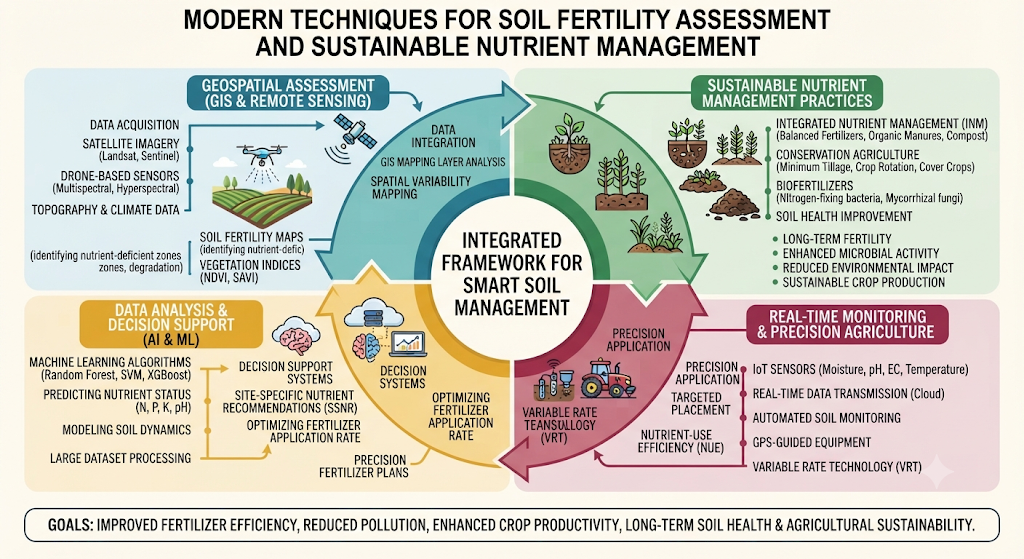
Geographic Information Systems (GIS) and Remote Sensing have become indispensable tools for evaluating soil fertility across diverse land use systems. GIS integrates spatial information from soil surveys, topography, climate, vegetation, and land use maps to produce detailed soil fertility maps that identify nutrient-deficient and degraded areas. Remote sensing technologies utilize satellite imagery and drone-based multispectral or hyperspectral sensors to monitor vegetation health, soil moisture, land degradation, erosion, and crop nutrient status. Vegetation indices such as the Normalized Difference Vegetation Index (NDVI) and Soil Adjusted Vegetation Index (SAVI) provide indirect estimates of crop vigor and nutrient availability. These geospatial technologies facilitate large-scale soil fertility assessment while reducing the cost and time associated with conventional field surveys.
Artificial Intelligence (AI) and Machine Learning (ML) have further enhanced soil fertility assessment by analyzing large agricultural datasets and predicting nutrient status with high accuracy. Machine learning algorithms such as Random Forest, Support Vector Machine (SVM), Artificial Neural Networks (ANN), Decision Trees, and Extreme Gradient Boosting (XGBoost) process information from soil analyses, weather records, satellite imagery, crop yield data, and management practices to estimate nutrient availability and fertilizer requirements. AI-based decision support systems generate site-specific nutrient recommendations that optimize fertilizer application while minimizing nutrient losses through leaching, volatilization, and runoff. Internet of Things (IoT) sensors installed in agricultural fields continuously monitor soil moisture, pH, electrical conductivity, temperature, nutrient concentrations, and organic matter in real time. These data are transmitted to cloud-based platforms where AI models analyze changing soil conditions and recommend timely irrigation and nutrient management interventions. Precision agriculture technologies further integrate GPS-guided equipment and Variable Rate Technology (VRT) to apply fertilizers only where needed, improving nutrient-use efficiency and reducing production costs.
Sustainable nutrient management combines technological innovation with environmentally responsible agricultural practices. Integrated Nutrient Management (INM) encourages the balanced use of chemical fertilizers, organic manures, compost, green manures, crop residues, and biofertilizers to maintain long-term soil fertility. Conservation agriculture practices—including minimum tillage, residue retention, crop rotation, cover cropping, and agroforestry—improve soil organic carbon, enhance microbial activity, reduce erosion, and strengthen nutrient cycling. Biofertilizers containing nitrogen-fixing bacteria, phosphate-solubilizing microorganisms, and mycorrhizal fungi increase nutrient availability while reducing dependence on synthetic fertilizers. Governments and agricultural organizations increasingly promote digital soil health cards, precision farming technologies, climate-smart agriculture, and sustainable land management policies to improve soil fertility under diverse land use systems. Future research should emphasize explainable AI, digital twins, autonomous soil monitoring, multisensor integration, and predictive nutrient modeling to further improve soil fertility assessment. Ultimately, the combination of advanced technologies with sustainable nutrient management practices offers an effective strategy for maintaining soil health, improving crop productivity, conserving natural resources, and supporting long-term agricultural sustainability.
Future Perspectives and Policy Interventions for Sustainable Soil Fertility Management#
Maintaining soil fertility is essential for ensuring long-term agricultural productivity, environmental sustainability, and global food security. Rapid population growth, climate change, intensive cultivation, urban expansion, and land degradation continue to exert tremendous pressure on soil resources worldwide. Future agricultural development must therefore prioritize scientifically informed soil fertility management strategies that balance crop productivity with environmental conservation. Sustainable management of soil nutrients requires the integration of advanced technologies, climate-smart agricultural practices, effective policy support, farmer participation, and continuous scientific innovation. Future soil management approaches should focus on restoring degraded soils, improving nutrient-use efficiency, enhancing soil organic carbon, and promoting ecosystem resilience under diverse land use systems.
One of the most promising future directions is the integration of Precision Agriculture and Digital Soil Management into routine farming practices. Technologies such as Artificial Intelligence (AI), Machine Learning (ML), Internet of Things (IoT), Geographic Information Systems (GIS), Remote Sensing, drones, satellite imagery, and cloud computing enable continuous monitoring of soil properties and nutrient availability. AI-based decision-support systems can analyze real-time data on soil moisture, pH, organic carbon, nutrient concentrations, weather conditions, and crop growth to generate site-specific fertilizer recommendations. Precision nutrient management through Variable Rate Technology (VRT) minimizes excessive fertilizer application, reduces nutrient losses through leaching and runoff, lowers production costs, and improves fertilizer-use efficiency. Future research should focus on developing affordable sensor technologies and user-friendly digital platforms that can be easily adopted by smallholder farmers in developing countries.
Future soil fertility management should also emphasize Integrated Nutrient Management (INM) and Nature-Based Solutions. Balanced application of chemical fertilizers, farmyard manure, compost, green manure, crop residues, vermicompost, and biofertilizers improves soil fertility while maintaining environmental quality. Biofertilizers containing nitrogen-fixing bacteria, phosphate-solubilizing microorganisms, and mycorrhizal fungi enhance nutrient availability naturally and reduce dependence on synthetic fertilizers. Conservation agriculture practices—including minimum tillage, crop rotation, cover cropping, residue retention, and agroforestry—should be promoted to increase soil organic carbon, improve microbial diversity, reduce erosion, and strengthen nutrient cycling. Climate-smart agriculture should integrate soil conservation with efficient irrigation, precision farming, carbon sequestration, and biodiversity conservation to improve resilience against drought, floods, salinity, and temperature extremes. Research institutions should continue developing improved soil fertility indicators, predictive nutrient models, digital soil maps, and climate-adaptive nutrient management strategies that support sustainable land use planning.
Government policies and institutional support are essential for successful implementation of sustainable soil fertility programmes. National governments should strengthen Soil Health Card initiatives, establish long-term soil monitoring networks, promote digital agriculture, and invest in rural infrastructure supporting precision farming technologies. Agricultural extension agencies should provide continuous farmer training on soil testing, balanced fertilizer application, organic nutrient management, and conservation agriculture. Financial incentives should encourage farmers to adopt sustainable land management practices through subsidies for biofertilizers, organic inputs, precision agriculture equipment, and soil conservation measures. International organizations such as the Food and Agriculture Organization (FAO), CGIAR, World Bank, International Fertilizer Association (IFA), and national agricultural research institutions should expand collaborative research on nutrient dynamics, soil degradation, carbon sequestration, and climate-smart soil management. Future policies should encourage interdisciplinary collaboration among soil scientists, agronomists, environmental scientists, data scientists, economists, and policymakers to develop integrated solutions for sustainable land use. Ultimately, maintaining soil fertility requires a holistic approach that combines technological innovation, scientific research, responsible policy frameworks, and active farmer participation to improve agricultural productivity, conserve natural resources, strengthen ecosystem resilience, and ensure long-term food security.
Conclusion#
Soil fertility is one of the most important determinants of agricultural productivity, environmental sustainability, and ecosystem health. This study demonstrates that different land use systems significantly influence soil fertility status and nutrient dynamics through their effects on soil physical, chemical, and biological properties. Forests, grasslands, wetlands, agroforestry systems, agricultural lands, and fallow lands exhibit distinct nutrient cycling processes that determine the availability of essential plant nutrients and long-term soil productivity. Forest and agroforestry ecosystems generally maintain higher levels of soil organic carbon, microbial activity, nutrient recycling, and structural stability, whereas intensively cultivated agricultural lands frequently experience nutrient depletion, soil erosion, and declining organic matter due to continuous cropping and inadequate nutrient replenishment. Understanding these differences is essential for developing sustainable land management strategies capable of maintaining productive soils under changing environmental conditions.
The study further highlights the importance of nutrient dynamics in regulating soil fertility. Essential macronutrients such as nitrogen, phosphorus, potassium, sulfur, calcium, and magnesium, along with micronutrients including zinc, iron, manganese, copper, and boron, continuously undergo biological, chemical, and physical transformations influenced by vegetation, climate, microbial activity, and land management practices. Efficient nutrient cycling supports plant growth, microbial diversity, carbon sequestration, and ecosystem resilience, whereas nutrient losses through erosion, leaching, volatilization, and runoff reduce soil productivity and contribute to environmental pollution. Modern technologies including Artificial Intelligence (AI), Machine Learning (ML), Geographic Information Systems (GIS), Remote Sensing, Internet of Things (IoT), digital soil mapping, and precision agriculture have substantially improved soil fertility assessment by enabling accurate spatial analysis, real-time nutrient monitoring, and site-specific nutrient management. These innovations improve fertilizer-use efficiency, reduce production costs, minimize environmental degradation, and strengthen climate-smart agricultural practices.
Despite significant technological progress, sustainable soil fertility management remains a major global challenge because of increasing land degradation, climate change, intensive agricultural practices, declining soil organic matter, and growing food demand. Addressing these challenges requires integrated nutrient management, conservation agriculture, agroforestry, biofertilizer utilization, precision farming, and evidence-based land use planning. Governments should strengthen soil health monitoring programmes, expand digital agriculture initiatives, encourage balanced fertilizer use, and support farmer education through effective extension services. Research institutions should continue developing advanced soil monitoring technologies, predictive nutrient models, explainable AI systems, and climate-resilient soil management strategies that improve long-term soil productivity. International collaboration among scientists, policymakers, environmental organizations, and farming communities will be essential for restoring degraded soils and conserving natural resources. Ultimately, sustainable management of soil fertility under different land use systems is fundamental for increasing agricultural productivity, improving environmental quality, conserving biodiversity, mitigating climate change, strengthening food security, and supporting resilient agricultural systems capable of meeting future global development needs.
Works Cited#
- Food and Agriculture Organization of the United Nations. (2024). The State of Food and Agriculture 2024: Sustainable Soil and Land Management. Rome: FAO.
- Consultative Group on International Agricultural Research. (2024). Soil Health and Climate-Smart Agriculture. Montpellier: CGIAR.
- Indian Council of Agricultural Research. (2023). Soil Fertility and Nutrient Management for Sustainable Agriculture. New Delhi: ICAR.
- International Fertilizer Association. (2023). Efficient Nutrient Management for Sustainable Crop Production. Paris: IFA.
- International Crops Research Institute for the Semi-Arid Tropics. (2024). Integrated Soil Fertility Management under Climate Change. Hyderabad: ICRISAT.
- World Bank. (2024). Sustainable Land Management and Agricultural Productivity. Washington, DC: World Bank.
- United Nations Environment Programme. (2024). Global Environment Outlook: Land Degradation and Soil Conservation. Nairobi: UNEP.
- Organisation for Economic Co-operation and Development. (2023). Policies for Sustainable Soil Management. Paris: OECD Publishing.
- World Meteorological Organization. (2024). State of the Global Climate 2024. Geneva: WMO.
- International Union of Soil Sciences. (2023). Global Perspectives on Soil Health and Fertility. Vienna: IUSS.
- Lal, Rattan. (2020). Soil organic matter and sustainable agriculture. Journal of Soil and Water Conservation, 75(5), 123A–129A.
- Brady, Nyle C.., & Weil, Ray R.. (2017). The Nature and Properties of Soils (15th ed.). Pearson.
- Bationo, André., et al. (2012). Integrated soil fertility management for sustainable agriculture. Outlook on Agriculture, 41(2), 119–128.
- Sanchez, Pedro A.. (2019). Properties and management of tropical soils. Cambridge University Press.
- Oldeman, Lex O.. (2018). Land degradation and soil fertility assessment. Land Degradation & Development, 29(6), 1721–1732.
- Pathak, Harpinder., et al. (2023). Climate-smart soil fertility management for sustainable agriculture. Current Science, 124(5), 567–576.
- Vanlauwe,Bernard., et al. (2015). Integrated soil fertility management in agricultural systems. Plant and Soil, 389(1–2), 1–10.
- Mulla, David J.. (2013). Precision agriculture and soil nutrient management. Biosystems Engineering, 114(4), 358–371.
- Minasny, Budiman., et al. (2017). Digital soil mapping: Current status and future directions. Geoderma, 264, 256–274.
- McBratney, Alex B.., Santos, Maria Luisa Mendonça., & Minasny, Budiman. (2014). On digital soil mapping. Geoderma, 117(1–2), 3–52